Archive for the ‘Centrales Eléctricas’ Category
Estimados lectores, es de interés enterarse las predicciones de la industria de la energía, involucra no sólo el comportamiento de la demanda, sino toda la cadena de valor desde los generadores de electricidad. En el presente post comparto sobre el consumo final total, acá la intensidad de energía de la economía global ha ido decayendo debido al progreso tecnológico, la mejora de la efiencia y los cambios en la estructura de la economía global. El crecimiento de la participación de las renovables y el incremento de la electricifación de los usuarios finales, juegan ambos, un importante parte del incremento de la eficiencia de los sistemas de energía. En la figura se muestra la proyección hacia el 2025 segun tres escenarios: STEPS (escenario basado en las actuales políticas), APS (escenario de compromisos anunciados), y; NZE (escenario de cero emisiones netas al 2050). Este decrecimiento resulta a pesar de que la población mundial se ira incrementando.

Dr. Jorge Luis Mírez Tarrillo
Group of Mathematical Modeling and Numerical Simulation (GMMNS).
Universidad Nacional de Ingeniería. Lima, Perú.
E-mail: jmirez@uni.edu.pe
Website Personal: https://jorgemirez2002.wixsite.com/jorgemirez
Facebook http://www.facebook.com/jorgemirezperu
Linkedin https://www.linkedin.com/in/jorge-luis-mirez-tarrillo-94918423/
Scopus ID: https://www.scopus.com/authid/detail.uri?authorId=56488109800
Google Scholar: https://scholar.google.com/citations?user=_dSpp4YAAAAJ
MATLAB Group Admin in Facebook: https://www.facebook.com/groups/Matlab.Simulink.for.All
WhatsApp Channel/Canal: https://whatsapp.com/channel/0029VbCvpZsAYlUSz2esek2y
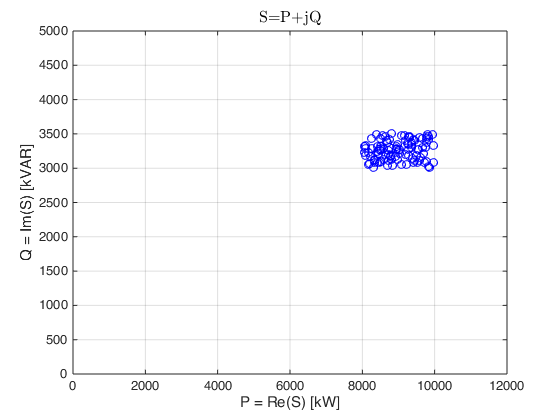
Estimados lectores, en la atención a la demanda, lo usual que se presenta es que las potencias cambien en el tiempo, sea por régimen de carga, perturbaciones, variaciones en el voltaje y la frecuencia, etc. En los estudios ideales se presenta valores de potencia fijos, algunos considerados como capacidad nominal o potencia nominal. En este post os muestro potencia activa y reactiva generadas aleatoreamente como se observa en la primera figura. En la segunda figura se dibuja el vector complejo S que es la potencia aparente y como se puede visualizar, los valores están dentro de una zona o área o parte del plano complejo permitido para el funcionamiento normal del sistema. En la figura, se puede observar como ha ido evolucionando el factor de potencia y esto puede permitir por ejemplo hacer simulaciones de conexión y desconexión de banco de condensadores para corrección del factor de potencia. Datos asumidos pero si tiene alguien datos, lo puede emular y seguramente salen unas figuras bastante interesantes. Hecho con MATLAB de MathWorks Inc.


Dr. Jorge Luis Mírez Tarrillo
Group of Mathematical Modeling and Numerical Simulation (GMMNS).
Universidad Nacional de Ingeniería. Lima, Perú.
E-mail: jmirez@uni.edu.pe
Website Personal: https://jorgemirez2002.wixsite.com/jorgemirez
Facebook http://www.facebook.com/jorgemirezperu
Linkedin https://www.linkedin.com/in/jorge-luis-mirez-tarrillo-94918423/
Scopus ID: https://www.scopus.com/authid/detail.uri?authorId=56488109800
Google Scholar: https://scholar.google.com/citations?user=_dSpp4YAAAAJ
MATLAB Group Admin in Facebook: https://www.facebook.com/groups/Matlab.Simulink.for.All
WhatsApp Channel/Canal: https://whatsapp.com/channel/0029VbCvpZsAYlUSz2esek2y
J1162: Libro «Evolución de los sistemas energéticos en Iberoamérica». Link para leer y descargar PDF
Les invito a consultar el libro «Evolución de los sistemas energéticos en Iberoamérica» en el cual se explora la evolución y estado actual de los sistemas de energía en España, Argentina, Colombia, Cuba, México, Paraguay, Puerto Rico, Ecuador, El Salvador, Uruguay, Panamá, Honduras, República Dominicana, Venezuela, Perú, Costa Rica, Bolivia, Brasil y Guatemala. Los trabajos que conforman el libro son contribuciones de los miembros de la Red RIBIERSE-CYTED – Red para la integración a gran escala de energías renovables en los sistemas eléctricos; cuyo objetivo es promover la descarbonización del sector eléctrico gracias a la integración de fuentes renovables en los sistemas eléctricos y su hibridación con sistemas de almacenamiento y la ‘E-Mobility’. https://zenodo.org/records/15602611

Dr. Jorge Luis Mírez Tarrillo
Group of Mathematical Modeling and Numerical Simulation (GMMNS).
Universidad Nacional de Ingeniería. Lima, Perú.
E-mail: jmirez@uni.edu.pe
Website Personal: https://jorgemirez2002.wixsite.com/jorgemirez
Facebook http://www.facebook.com/jorgemirezperu
Linkedin https://www.linkedin.com/in/jorge-luis-mirez-tarrillo-94918423/
Scopus ID: https://www.scopus.com/authid/detail.uri?authorId=56488109800
Google Scholar: https://scholar.google.com/citations?user=_dSpp4YAAAAJ
MATLAB Group Admin in Facebook: https://www.facebook.com/groups/Matlab.Simulink.for.All
WhatsApp Channel/Canal: https://whatsapp.com/channel/0029VbCvpZsAYlUSz2esek2y
En el mundo de las energías renovables, las microrredes surgen como elementos organizativos de diferentes fuentes y cargas ubicados dentro de un espacio geográfico delimitado y con uno o más puntos de interconexión sea con otra microrred o con la red eléctrica pública. Paneles solares fotovoltaicos, turbinass eólicas, almacenamiento electroquímico, etc. son parte de sus componentes. La demanda igualmente puede ser residencial, comercial o industrial. Todo esto crea comportamiento de la demanda que es atendido por la oferta y en algún momento pueda haber déficil o sobrante. La figura del presente post muestra un ejemplo acerca de ello, en que tres microrredes debido a sus comportamientos propios, presentan diferente necesidad y sobrante en el tiempo. Hecho con MATLAB.

Dr. Jorge Luis Mírez Tarrillo
Group of Mathematical Modeling and Numerical Simulation (GMMNS).
Universidad Nacional de Ingeniería. Lima, Perú.
E-mail: jmirez@uni.edu.pe
Website Personal: https://jorgemirez2002.wixsite.com/jorgemirez
Facebook http://www.facebook.com/jorgemirezperu
Linkedin https://www.linkedin.com/in/jorge-luis-mirez-tarrillo-94918423/
Scopus ID: https://www.scopus.com/authid/detail.uri?authorId=56488109800
Google Scholar: https://scholar.google.com/citations?user=_dSpp4YAAAAJ
MATLAB Group Admin in Facebook: https://www.facebook.com/groups/Matlab.Simulink.for.All
WhatsApp Channel/Canal: https://whatsapp.com/channel/0029VbCvpZsAYlUSz2esek2y
Invitación a participar del Webinar: Microrredes Eléctricas. Expositor: Dr. Jorge Mírez. Jueves 30 de Marzo 2023. Hora: 16:00 horas México (17:00 horas Lima)
Link de Registro Expo Energía México 2023:
https://www.expoenergia.com.mx/Webinar/index.php

Dr. Jorge Luis Mírez Tarrillo
Group of Mathematical Modeling and Numerical Simulation (GMMNS).
Universidad Nacional de Ingeniería. Lima, Perú.
E-mail: jmirez@uni.edu.pe
Website Personal: https://jorgemirez2002.wixsite.com/jorgemirez
Facebook http://www.facebook.com/jorgemirezperu
Linkedin https://www.linkedin.com/in/jorge-luis-mirez-tarrillo-94918423/
Scopus ID: https://www.scopus.com/authid/detail.uri?authorId=56488109800
Google Scholar: https://scholar.google.com/citations?user=_dSpp4YAAAAJ
MATLAB Group Admin in Facebook: https://www.facebook.com/groups/Matlab.Simulink.for.All
WhatsApp Channel/Canal: https://whatsapp.com/channel/0029VbCvpZsAYlUSz2esek2y
Link de Paper en IEEExplore:
https://ieeexplore.ieee.org/document/9359432
DOI: 10.1109/ICMEAE51770.2020.00043
Abstract:
Structure perovskite cells, with the general formula ABX3 and named after the mineral CaTiO3 [1], become good candidates for use in converting solar energy into electrical energy, because their efficiency increased in a short period from an initial 3.8 % to laboratory-scale energy conversion efficiency of 23.3 %, which rivals the performance of commercial multi-crystalline silicon solar cells [2]. Recently the power conversion efficiency (PCE) has reached 24.2 %. In addition, another important merit is its production cost, screen printing [3], roll to roll printing [4]. Another characteristic of the carbon electrode is that, due to its composition, it can transport the holes and does not need a hole-transporter material (HTM) or hole-transporter layer (HTL), unlike peroskite cells with metal. In [19] a study is reported where the storage stability of 1 year and PCE of 10.4 % (AM 1.5G, 100 mW/cm was reached in an area of 49 cm2 of mesoscopic carbon perovskites (CSPC).
Regards:
Dr. Jorge Luis Mírez Tarrillo
Group of Mathematical Modeling and Numerical Simulation (GMMNS).
Universidad Nacional de Ingeniería. Lima, Perú.
E-mail: jmirez@uni.edu.pe
Website Personal: https://jorgemirez2002.wixsite.com/jorgemirez
Facebook http://www.facebook.com/jorgemirezperu
Linkedin https://www.linkedin.com/in/jorge-luis-mirez-tarrillo-94918423/
Scopus ID: https://www.scopus.com/authid/detail.uri?authorId=56488109800
Google Scholar: https://scholar.google.com/citations?user=_dSpp4YAAAAJ
MATLAB Group Admin in Facebook: https://www.facebook.com/groups/Matlab.Simulink.for.All
WhatsApp Channel/Canal: https://whatsapp.com/channel/0029VbCvpZsAYlUSz2esek2y
Determining the necessary area of photovoltaic solar panels to be able to feed a demand is something to evaluate considering that both the demand and the energy source (the Sun) vary in their behavior. The total solar cells area required to supply the load demand can be calculated from the following equation shown in the figure of this post where \F_{s} is the safety factor which includes the possible allowance of insolation data inaccuracy, \V_{F} is the factor of variability which considers the impact of yearly radiation variation. \P_{L} is the power demand, \H_{t} is the solar irradiation and \n_{c} is the efficiency of the photovoltaic solar panel.

Dr. Jorge Luis Mírez Tarrillo
Group of Mathematical Modeling and Numerical Simulation (GMMNS).
Universidad Nacional de Ingeniería. Lima, Perú.
E-mail: jmirez@uni.edu.pe
Website Personal: https://jorgemirez2002.wixsite.com/jorgemirez
Facebook http://www.facebook.com/jorgemirezperu
Linkedin https://www.linkedin.com/in/jorge-luis-mirez-tarrillo-94918423/
Scopus ID: https://www.scopus.com/authid/detail.uri?authorId=56488109800
Google Scholar: https://scholar.google.com/citations?user=_dSpp4YAAAAJ
MATLAB Group Admin in Facebook: https://www.facebook.com/groups/Matlab.Simulink.for.All
WhatsApp Channel/Canal: https://whatsapp.com/channel/0029VbCvpZsAYlUSz2esek2y
Good morning readers, solar energy is an interesting topic and knowing how efficient its capture is interesting to model and simulate. The hourly generating efficiency of the PV system (calculated in percentage) can be obtained in terms of the cell temperature as shown in the following equation shown in the figure of this post, where \beta_{t} is the temperature coefficient, μcr and \T_{cr} are the theoretical solar cell efficiency and temperature at solar radiation flux of 1000 W/m2, respectively, \lambda is the Ross coefficient, \T_{a} is the ambient temperature and \H_{t} is the solar radiation on tilted surface. Note: All the simulation images in this blog have been developed in Matlab/Simulink, the codes are for sale, as well as the thesis and research advisory service. Best regards.

Dr. Jorge Luis Mírez Tarrillo
Group of Mathematical Modeling and Numerical Simulation (GMMNS).
Universidad Nacional de Ingeniería. Lima, Perú.
E-mail: jmirez@uni.edu.pe
Website Personal: https://jorgemirez2002.wixsite.com/jorgemirez
Facebook http://www.facebook.com/jorgemirezperu
Linkedin https://www.linkedin.com/in/jorge-luis-mirez-tarrillo-94918423/
Scopus ID: https://www.scopus.com/authid/detail.uri?authorId=56488109800
Google Scholar: https://scholar.google.com/citations?user=_dSpp4YAAAAJ
MATLAB Group Admin in Facebook: https://www.facebook.com/groups/Matlab.Simulink.for.All
WhatsApp Channel/Canal: https://whatsapp.com/channel/0029VbCvpZsAYlUSz2esek2y
Dear readers, I show you a new simulation using Matlab in the next post. The induced voltage in the coils of a transformer is related to the frequency and the magnetic flux that passes through it. These, beyond the ideal calculation of being constant values, have small variations due to multiple factors, and therefore, lead to the fact that the induced voltage naturally has a slightly variable behavior over time. These changes involve transient processes of energy flow and exchange that can be simulated with Matlab/Simulink creating the appropriate study scenarios. Share my blog. Best regards.


Dr. Jorge Luis Mírez Tarrillo
Group of Mathematical Modeling and Numerical Simulation (GMMNS).
Universidad Nacional de Ingeniería. Lima, Perú.
E-mail: jmirez@uni.edu.pe
Website Personal: https://jorgemirez2002.wixsite.com/jorgemirez
Facebook http://www.facebook.com/jorgemirezperu
Linkedin https://www.linkedin.com/in/jorge-luis-mirez-tarrillo-94918423/
Scopus ID: https://www.scopus.com/authid/detail.uri?authorId=56488109800
Google Scholar: https://scholar.google.com/citations?user=_dSpp4YAAAAJ
MATLAB Group Admin in Facebook: https://www.facebook.com/groups/Matlab.Simulink.for.All
WhatsApp Channel/Canal: https://whatsapp.com/channel/0029VbCvpZsAYlUSz2esek2y
The famous transformation ratio in a power transformer is shown to be an easy algebraic relationship to learn and understand, however, the usual voltage variations involve changes in the electromotive forces that occur inside the coils. The image shows an emulation of such changes with voltage variations within the range allowed by technical standards.


Dr. Jorge Luis Mírez Tarrillo
Group of Mathematical Modeling and Numerical Simulation (GMMNS).
Universidad Nacional de Ingeniería. Lima, Perú.
E-mail: jmirez@uni.edu.pe
Website Personal: https://jorgemirez2002.wixsite.com/jorgemirez
Facebook http://www.facebook.com/jorgemirezperu
Linkedin https://www.linkedin.com/in/jorge-luis-mirez-tarrillo-94918423/
Scopus ID: https://www.scopus.com/authid/detail.uri?authorId=56488109800
Google Scholar: https://scholar.google.com/citations?user=_dSpp4YAAAAJ
MATLAB Group Admin in Facebook: https://www.facebook.com/groups/Matlab.Simulink.for.All
WhatsApp Channel/Canal: https://whatsapp.com/channel/0029VbCvpZsAYlUSz2esek2y
Anuncio publicitario
En el presente video modelamos la potencia de la turbina eólica considerando la variación del área de barrido y la velocidad del viento, además, densidad y coeficiente de potencia se toman como constantes. Hecho en Matlab y 100 % práctico. Invitados a inscribirse en mi canal y seguirme en mis redes sociales.
Dr. Jorge Luis Mírez Tarrillo
Group of Mathematical Modeling and Numerical Simulation (GMMNS).
Universidad Nacional de Ingeniería. Lima, Perú.
E-mail: jmirez@uni.edu.pe
Website Personal: https://jorgemirez2002.wixsite.com/jorgemirez
Facebook http://www.facebook.com/jorgemirezperu
Linkedin https://www.linkedin.com/in/jorge-luis-mirez-tarrillo-94918423/
Scopus ID: https://www.scopus.com/authid/detail.uri?authorId=56488109800
Google Scholar: https://scholar.google.com/citations?user=_dSpp4YAAAAJ
MATLAB Group Admin in Facebook: https://www.facebook.com/groups/Matlab.Simulink.for.All
WhatsApp Channel/Canal: https://whatsapp.com/channel/0029VbCvpZsAYlUSz2esek2y

Regards:
Dr. Jorge Luis Mírez Tarrillo
Group of Mathematical Modeling and Numerical Simulation (GMMNS).
Universidad Nacional de Ingeniería. Lima, Perú.
E-mail: jmirez@uni.edu.pe
Website Personal: https://jorgemirez2002.wixsite.com/jorgemirez
Facebook http://www.facebook.com/jorgemirezperu
Linkedin https://www.linkedin.com/in/jorge-luis-mirez-tarrillo-94918423/
Scopus ID: https://www.scopus.com/authid/detail.uri?authorId=56488109800
Google Scholar: https://scholar.google.com/citations?user=_dSpp4YAAAAJ
MATLAB Group Admin in Facebook: https://www.facebook.com/groups/Matlab.Simulink.for.All
WhatsApp Channel/Canal: https://whatsapp.com/channel/0029VbCvpZsAYlUSz2esek2y
 Fuente: Antonio Moreno-Munoz. “Large Scale Grid Integration of Renewable Energy Sources”. The Institution of Engineering and Technology. 2017.
Dr. Jorge Luis Mírez Tarrillo
Group of Mathematical Modeling and Numerical Simulation (GMMNS).
Universidad Nacional de Ingeniería. Lima, Perú.
E-mail: jmirez@uni.edu.pe
Website Personal: https://jorgemirez2002.wixsite.com/jorgemirez
Facebook http://www.facebook.com/jorgemirezperu
Linkedin https://www.linkedin.com/in/jorge-luis-mirez-tarrillo-94918423/
Scopus ID: https://www.scopus.com/authid/detail.uri?authorId=56488109800
Google Scholar: https://scholar.google.com/citations?user=_dSpp4YAAAAJ
MATLAB Group Admin in Facebook: https://www.facebook.com/groups/Matlab.Simulink.for.All
WhatsApp Channel/Canal: https://whatsapp.com/channel/0029VbCvpZsAYlUSz2esek2y
Fuente: Antonio Moreno-Munoz. “Large Scale Grid Integration of Renewable Energy Sources”. The Institution of Engineering and Technology. 2017.
Dr. Jorge Luis Mírez Tarrillo
Group of Mathematical Modeling and Numerical Simulation (GMMNS).
Universidad Nacional de Ingeniería. Lima, Perú.
E-mail: jmirez@uni.edu.pe
Website Personal: https://jorgemirez2002.wixsite.com/jorgemirez
Facebook http://www.facebook.com/jorgemirezperu
Linkedin https://www.linkedin.com/in/jorge-luis-mirez-tarrillo-94918423/
Scopus ID: https://www.scopus.com/authid/detail.uri?authorId=56488109800
Google Scholar: https://scholar.google.com/citations?user=_dSpp4YAAAAJ
MATLAB Group Admin in Facebook: https://www.facebook.com/groups/Matlab.Simulink.for.All
WhatsApp Channel/Canal: https://whatsapp.com/channel/0029VbCvpZsAYlUSz2esek2y
El Laboratorio Nacional de Energías Renovables de los Estados Unidos de América (NREL) nos muestra una gráfica de evolución del desarrollo de las mejores eficiencias de celdas solares fotovoltaicas logradas hasta mediados del presente año 2019. Ahí se muestran las diferentes tecnologías y las empresas, laboratorios, universidades, etc. que lo han hecho posible lograr tales eficiencias. Algunas de las mismas pueda que sea a nivel experimental o de laboratorio, resulten caras, pero lo bueno es que ya se han fabricado; de acá en adelante es asunto de mejorar la tecnología, simplificarla y hacerla más asequible.

Dr. Jorge Luis Mírez Tarrillo
Group of Mathematical Modeling and Numerical Simulation (GMMNS).
Universidad Nacional de Ingeniería. Lima, Perú.
E-mail: jmirez@uni.edu.pe
Website Personal: https://jorgemirez2002.wixsite.com/jorgemirez
Facebook http://www.facebook.com/jorgemirezperu
Linkedin https://www.linkedin.com/in/jorge-luis-mirez-tarrillo-94918423/
Scopus ID: https://www.scopus.com/authid/detail.uri?authorId=56488109800
Google Scholar: https://scholar.google.com/citations?user=_dSpp4YAAAAJ
MATLAB Group Admin in Facebook: https://www.facebook.com/groups/Matlab.Simulink.for.All
WhatsApp Channel/Canal: https://whatsapp.com/channel/0029VbCvpZsAYlUSz2esek2y
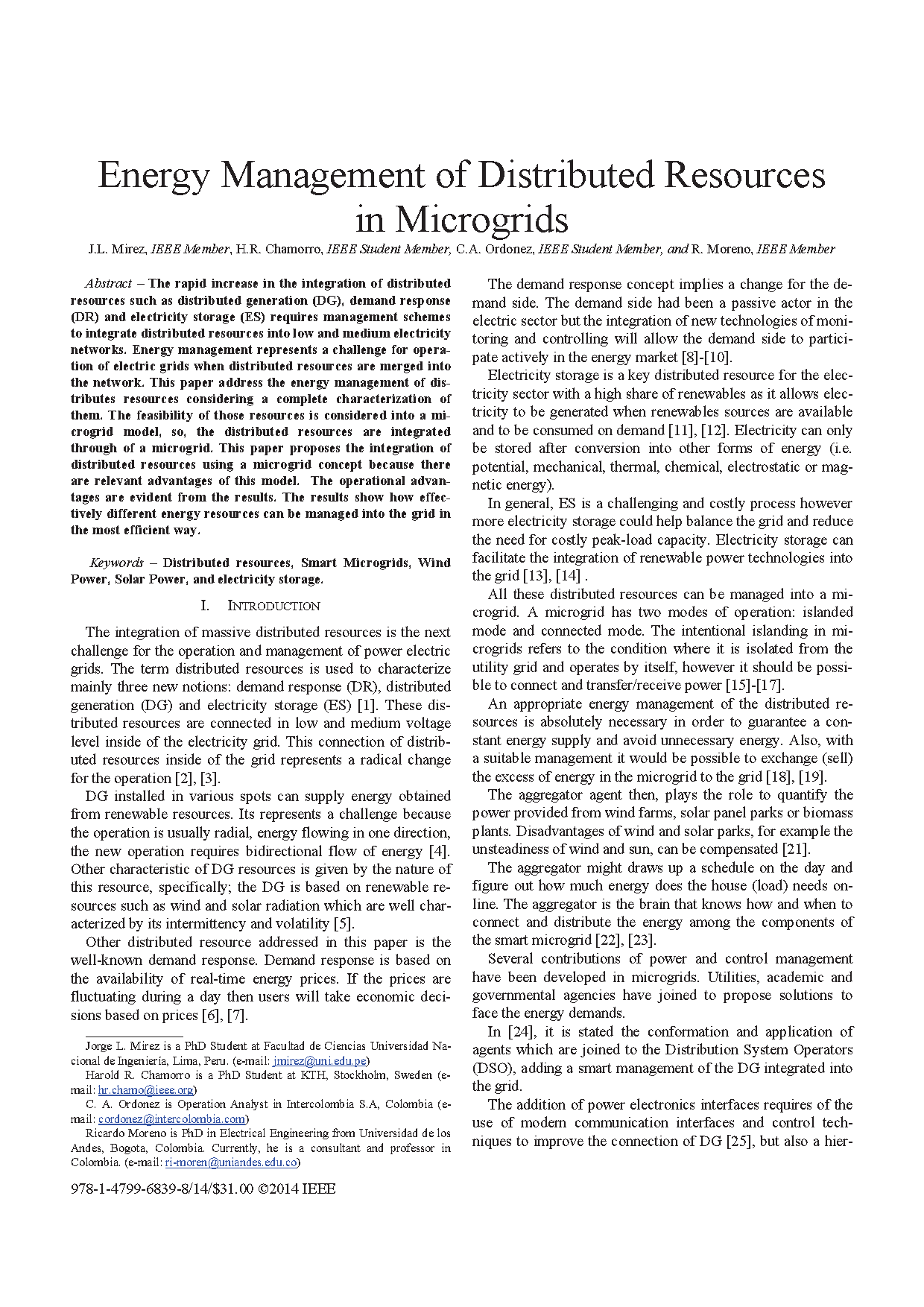
«Energy Management of Distributed Resources in Microgrids». J. L. Mírez, H.R. Chamorro, C.A. Ordonez, R. Moreno. 2014 IEEE 5th Colombian Workshop on Circuits and Systems (CWCAS).
DOI: 10.1109/CWCAS.2014.6994607
Dr. Jorge Luis Mírez Tarrillo
Group of Mathematical Modeling and Numerical Simulation (GMMNS).
Universidad Nacional de Ingeniería. Lima, Perú.
E-mail: jmirez@uni.edu.pe
Website Personal: https://jorgemirez2002.wixsite.com/jorgemirez
Facebook http://www.facebook.com/jorgemirezperu
Linkedin https://www.linkedin.com/in/jorge-luis-mirez-tarrillo-94918423/
Scopus ID: https://www.scopus.com/authid/detail.uri?authorId=56488109800
Google Scholar: https://scholar.google.com/citations?user=_dSpp4YAAAAJ
MATLAB Group Admin in Facebook: https://www.facebook.com/groups/Matlab.Simulink.for.All
WhatsApp Channel/Canal: https://whatsapp.com/channel/0029VbCvpZsAYlUSz2esek2y
Les dejo el video completo de la Transmisión en Vivo hecho el Domingo 16 de junio 2019 desde las 22 PM a 24 horas – hora de Perú. Charla sobre «Aspectos Básicos de Potencia/Energía Eléctrica en Turbinas Eólicas» en base a la literatura que venimos trabajando en la Maestría de Energías Renovables y Eficiencia Energética de la Universidad Nacional de Ingeniería (UNI), Lima, Perú. La transmisión será desde mi fanpagehttp://www.facebook.com/jorgemirezperu — libre y gratuito. COMPARTIR e invitados a darle Like 
Dr. Jorge Luis Mírez Tarrillo
Group of Mathematical Modeling and Numerical Simulation (GMMNS).
Universidad Nacional de Ingeniería. Lima, Perú.
E-mail: jmirez@uni.edu.pe
Website Personal: https://jorgemirez2002.wixsite.com/jorgemirez
Facebook http://www.facebook.com/jorgemirezperu
Linkedin https://www.linkedin.com/in/jorge-luis-mirez-tarrillo-94918423/
Scopus ID: https://www.scopus.com/authid/detail.uri?authorId=56488109800
Google Scholar: https://scholar.google.com/citations?user=_dSpp4YAAAAJ
MATLAB Group Admin in Facebook: https://www.facebook.com/groups/Matlab.Simulink.for.All
WhatsApp Channel/Canal: https://whatsapp.com/channel/0029VbCvpZsAYlUSz2esek2y
PERU Green Smart Energy S.A.C. es una empresa peruana que se dedica al rubro de bienes y servicios en temas de ingeniería, energias renovables, expedientes técnicos, material audiovisual – publicitario y de capacitación, expedientes técnicos en ingenierias, arquitectura, ciencias de la salud, entre otros. También nos dedicamos a la investigación científica, cálculos técnicos y capacitación.
Gustoso de pertenecer a la familia de PGSE S.A.C. en donde doy toda mi experiencia y conocimientos.
Para más información, consultas y coordinaciones sobre los bienes y servicios que ofrecemos, visita nuestra página web:
Pronto comenzaremos con nuestras capacitaciones virtuales (en español) con certificación. Lo estaremos promocionando con tiempo, pero les recomendamos ser nuestros seguidores dándole click en Me Gusta de nuestro fanpage para mantenerse informado de las novedades
Fanpage de PGSE S.A.C. (darle Me Gusta):
http://www.facebook.com/PeruGreenSmartEnergySAC
Atentamente:
Jorge Luis Mírez Tarrillo
Ing. Mecánico Electricista – MSc & Dr. Física.
Dr. Jorge Luis Mírez Tarrillo
Group of Mathematical Modeling and Numerical Simulation (GMMNS).
Universidad Nacional de Ingeniería. Lima, Perú.
E-mail: jmirez@uni.edu.pe
Website Personal: https://jorgemirez2002.wixsite.com/jorgemirez
Facebook http://www.facebook.com/jorgemirezperu
Linkedin https://www.linkedin.com/in/jorge-luis-mirez-tarrillo-94918423/
Scopus ID: https://www.scopus.com/authid/detail.uri?authorId=56488109800
Google Scholar: https://scholar.google.com/citations?user=_dSpp4YAAAAJ
MATLAB Group Admin in Facebook: https://www.facebook.com/groups/Matlab.Simulink.for.All
WhatsApp Channel/Canal: https://whatsapp.com/channel/0029VbCvpZsAYlUSz2esek2y

Tornados occur in most subtropical and temperate landmasses around the world. Fortunately, most tornados do not carry overwhelming winds and therefore cause limited structural damage to engineered structures. On average, 800 to 1,000 tornados occur each year in the contiguous United States, and the activity zone extends well up into Canada. The total number of reported tornados in 1-degree squares of latitude and longitude for a 30-year period (1950 to 1980) is shown in figure.
Dr. Jorge Luis Mírez Tarrillo
Group of Mathematical Modeling and Numerical Simulation (GMMNS).
Universidad Nacional de Ingeniería. Lima, Perú.
E-mail: jmirez@uni.edu.pe
Website Personal: https://jorgemirez2002.wixsite.com/jorgemirez
Facebook http://www.facebook.com/jorgemirezperu
Linkedin https://www.linkedin.com/in/jorge-luis-mirez-tarrillo-94918423/
Scopus ID: https://www.scopus.com/authid/detail.uri?authorId=56488109800
Google Scholar: https://scholar.google.com/citations?user=_dSpp4YAAAAJ
MATLAB Group Admin in Facebook: https://www.facebook.com/groups/Matlab.Simulink.for.All
WhatsApp Channel/Canal: https://whatsapp.com/channel/0029VbCvpZsAYlUSz2esek2y
Hoy jueves 27 diciembre 2018 recibí el Diploma de Doctor en Ciencias mención Física por la Universidad Nacional de Ingeniería, Lima, Perú. // Today, Thursday, December 27, 2018, I received the Diploma of Doctor of Sciences with mention in Physics (Dr. Physics) from the National University of Engineering, Lima, Peru.
Algunas fotos // some photos:

Recibiendo el diploma en Oficina de Grados y Títulos de la Universidad Nacional de Ingeniería, Lima, Perú. // Receiving a diploma in the Office of Degrees of the National University of Engineering, Lima, Peru.

En frente al Rectorado de la Universidad Nacional de Ingeniería, Lima, Perú // In front of the Rector’s Office of the National University of Engineering, Lima, Perú.

Con mi asesor Dr. Manfred Horn (a mi co-asesor Dr. Josep Guerrero en la Universidad de Aalborg, Dinamarca, muchas gracias también) // With my advisor Dr. Manfred Horn (a my co-advisor Dr. Josep Guerrero at the University of Aalborg, Denmark, thank you very much too) //
De mi fanpage // of my Fanpage:
Gracias a todos… A quienes estuvieron, están y/o estarán en este camino… Gracias por su espera, paciencia, enseñanzas, cariño, alegrías… estas cosas no se logran de la noche a la mañana… Queda aún algunos años para devolver lo recibido de la vida… Hoy jueves 27 Diciembre 2018 recibí el diploma de Doctor en Ciencias con mención en Física y al igual que mis grados y títulos anteriores me fue entregado en Ventanilla de una Oficina de Grados y Títulos y está bien, porque todos somos capaces, todos somos seres humanos… // Thank you all … Those who were, are and / or will be on this path … Thank you for your wait, patience, teachings, affection, joys … these things are not achieved overnight … There are still some years to return the received of life … Today, Thursday, December 27, 2018, I received a Doctor of Science degree with a mention in Physics and, like my previous degrees and diplomas, it was delivered to me in the Office of Degrees and Titles and that’s fine, because we’re all capable, we’re all human beings …. Fuente/Source: http://www.facebook.com/jorgemirezperu
Email: jmirez@uni.edu.pe
Dr. Jorge Luis Mírez Tarrillo
Group of Mathematical Modeling and Numerical Simulation (GMMNS).
Universidad Nacional de Ingeniería. Lima, Perú.
E-mail: jmirez@uni.edu.pe
Website Personal: https://jorgemirez2002.wixsite.com/jorgemirez
Facebook http://www.facebook.com/jorgemirezperu
Linkedin https://www.linkedin.com/in/jorge-luis-mirez-tarrillo-94918423/
Scopus ID: https://www.scopus.com/authid/detail.uri?authorId=56488109800
Google Scholar: https://scholar.google.com/citations?user=_dSpp4YAAAAJ
MATLAB Group Admin in Facebook: https://www.facebook.com/groups/Matlab.Simulink.for.All
WhatsApp Channel/Canal: https://whatsapp.com/channel/0029VbCvpZsAYlUSz2esek2y
En este post doy la información sobre PPT y audio de mi Conferencia: «El futuro de las ciudades: Un análisis desde el punto de vista de las redes eléctricas inteligentes». Viernes 30 Nov. 2018. IX Simposio de Ingeniería Eléctrica (IEEE PES UNI). Universidad Nacional de Ingeniería, Lima, Perú.
PPT:


Audio:
Afiche de Conferencia:

Atentamente:
Jorge Mírez
jmirez@uni.edu.pe
Dale Me Gusta a mi Fanpage http://www.facebook.com/jorgemirezperu
Dr. Jorge Luis Mírez Tarrillo
Group of Mathematical Modeling and Numerical Simulation (GMMNS).
Universidad Nacional de Ingeniería. Lima, Perú.
E-mail: jmirez@uni.edu.pe
Website Personal: https://jorgemirez2002.wixsite.com/jorgemirez
Facebook http://www.facebook.com/jorgemirezperu
Linkedin https://www.linkedin.com/in/jorge-luis-mirez-tarrillo-94918423/
Scopus ID: https://www.scopus.com/authid/detail.uri?authorId=56488109800
Google Scholar: https://scholar.google.com/citations?user=_dSpp4YAAAAJ
MATLAB Group Admin in Facebook: https://www.facebook.com/groups/Matlab.Simulink.for.All
WhatsApp Channel/Canal: https://whatsapp.com/channel/0029VbCvpZsAYlUSz2esek2y
Blog in ENGLISH

Compra/Buy – Haz una donación/Make a donation

Dear reader, if you wish to make a donation or are interested in any information or code, please contact me (e-mail: jmirez@uni.edu.pe). Donations will allow you to continue studying and researching, and also to provide more information on this blog. My PayPal account is jorgemirez2002@gmail.com or if it is by bank transfer write to my email jmirez@uni.edu.pe. Any amount of money is welcome. Thank you.
Estimado lector, si desean hacer una donación o le interesa alguna información o código, favor ponerse en contacto con mi persona (e-mail: jmirez@uni.edu.pe). Las donaciones va a permitir seguir estudiando e investigando, y además, el poder brindar más información en este blog. Mi cuenta en PayPal es jorgemirez2002@gmail.com o si es por transferencia bancaria escribirme a mi correo jmirez@uni.edu.pe. Cualquier cantidad de dinero es bienvenido. Gracias.
Datos Generales
Good day. My full name is Jorge Luis MIREZ TARRILLO.
I am Peruvian and live in Lima, capital of Perú in South America.I am Mechanical Electrical Engineering, MSc Physics and Dr. Physics (title doctoral thesis: Control, Optimization, and Management of Microgrid Current Direct)
Too, actually job as Principal Professor in Faculty of Oil, Gas and Petrochemical Engineering of Universidad Nacional de Ingeniería (National University of Engineering) in Lima – PERU (Courses: Modern Physics, Differential Equations and Research's Methodology)
My subjects of my interest are control, signal processing, optimization, simulation, biomedical research, smart grid, microgrid, water.
I have experience in Matlab/Simulink programming, biomedical equipment, electrical systems, renewable energies, microgrids, saturated steam systems 100 psi and organizing academic events.

Comentarios Recientes
Elementos que compon… en J506: Los elementos de un paqu… Dr. Jorge Mírez en Message by IEEE Community Dr. Jorge Mírez en J546: Simulación de campos mag… jose luis huayanay v… en Message by IEEE Community Cesar Aviles en J546: Simulación de campos mag… Dr. Jorge Mírez en J518: La herramienta pdetool d… Dr. Jorge Mírez en J496: Simulación en Matlab/Sim… Raúl Barrios Elizarr… en J496: Simulación en Matlab/Sim… jose luis huayanay v… en J518: La herramienta pdetool d… MSc. Jorge Mírez en J281: La Rosa de Vientos: Frec…


Debe estar conectado para enviar un comentario.