Archive for the ‘Electrical Market’ Category
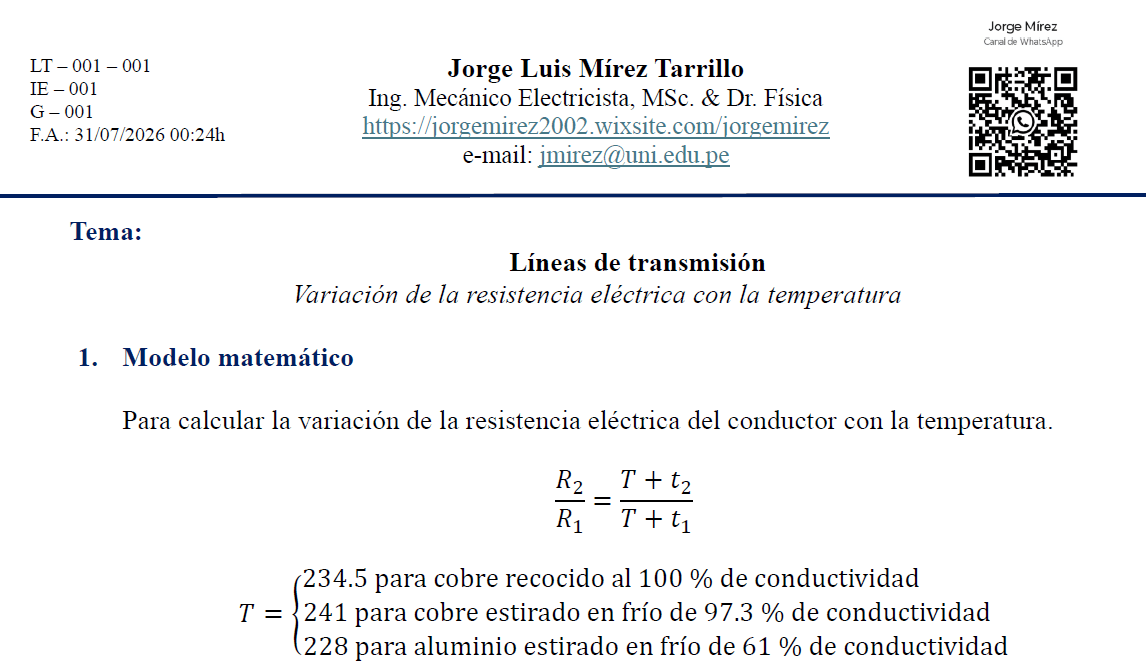
Estimados lectores, Se ha desarrollado dos códigos para calcular la variación de la resistencia eléctrica del conductor con la temperatura en líneas eléctricas de transmisión de potencia eléctrica. El modelo matemático considera el material del conductor, así como las temperaturas inicial y final del conductor, para determinar la resistencia eléctrica del conductor cual la temperatura se ha incrementado cierto valor. Se dan dos escenarios de estudio con un primer resultado que es una gráfica 2D (en el cual la resistencia final está en función de la temperatura final) y una gráfica 3D (en el cual la resistencia final está en función de temperatura final e inicial); en ambos casos la resistencia inicial es unitaria, lo cual permite visualizar el cambio que se presenta en la resistencia eléctrica. Como está en código, los valores se pueden cambiar según uso que se quiera dar el usuario. Archivo ZIP con tres archivos: PDF y dos códigos MATLAB formato *.m disponible en:

G_001: Un modelo de variación de la resistencia eléctrica con la temperatura en líneas de transmisión de potencia
Archivo ZIP con tres archivos: PDF y dos códigos MATLAB formato *.m que contienen un estudio de como cambiar la resistencia eléctrica de un conductor de línea de transmisión eléctrica al variar la temperatura final y, temperatura inicial y final, del mismo.
Dr. Jorge Luis Mírez Tarrillo
Group of Mathematical Modeling and Numerical Simulation (GMMNS).
Universidad Nacional de Ingeniería. Lima, Perú.
E-mail: jmirez@uni.edu.pe
Website Personal: https://jorgemirez2002.wixsite.com/jorgemirez
Facebook http://www.facebook.com/jorgemirezperu
Linkedin https://www.linkedin.com/in/jorge-luis-mirez-tarrillo-94918423/
Scopus ID: https://www.scopus.com/authid/detail.uri?authorId=56488109800
Google Scholar: https://scholar.google.com/citations?user=_dSpp4YAAAAJ
MATLAB Group Admin in Facebook: https://www.facebook.com/groups/Matlab.Simulink.for.All
Jorge Mírez WhatsApp Channel/Canal: https://whatsapp.com/channel/0029VbCvpZsAYlUSz2esek2y
Estimados lectores, en la figura se puede apreciar la proyección de Gt (gigatoneladas) de dióxido de carbono y del producto bruto interno per-cápita bajo dos escenarios: STEPS (escenario basado en las actuales políticas), APS (escenario de compromisos anunciados). En el STEPS, las emisiones globales caen 1 % por año entre el 2030 y 2050, mientras que en APS las emisiones globales caen 4 % por año. Dato adicionales, en un escenario del tipo NZE (escenario de cero emisiones netas al 2050) las emisiones globales caerían 15 % por año. Seguir lo trazado por el STEPS implica un incremento de la temperatura promedio global de 2.4 °C para el año 2100; mientras que en el APS, el incremento sería 1.7 °C, y; el NZE persigue hacer todo lo posible para no pasar los 1.5 °C. La figura muestra a los principales actores de la economía mundial, sin embargo, sería interesante investigar por país y dentro de cada país, cuanto están emitiendo, cuanto podrían dejar de emitir, o que se haga modelamiento matemático en base a los datos que se tienen o la realización de estimaciones. Todo suma en la preservación de nuestro planeta y en el asegurar la continuidad de la especie humana.

Dr. Jorge Luis Mírez Tarrillo
Group of Mathematical Modeling and Numerical Simulation (GMMNS).
Universidad Nacional de Ingeniería. Lima, Perú.
E-mail: jmirez@uni.edu.pe
Website Personal: https://jorgemirez2002.wixsite.com/jorgemirez
Facebook http://www.facebook.com/jorgemirezperu
Linkedin https://www.linkedin.com/in/jorge-luis-mirez-tarrillo-94918423/
Scopus ID: https://www.scopus.com/authid/detail.uri?authorId=56488109800
Google Scholar: https://scholar.google.com/citations?user=_dSpp4YAAAAJ
MATLAB Group Admin in Facebook: https://www.facebook.com/groups/Matlab.Simulink.for.All
WhatsApp Channel/Canal: https://whatsapp.com/channel/0029VbCvpZsAYlUSz2esek2y
Estimados lectores, es de interés enterarse las predicciones de la industria de la energía, involucra no sólo el comportamiento de la demanda, sino toda la cadena de valor desde los generadores de electricidad. En el presente post comparto sobre el consumo final total, acá la intensidad de energía de la economía global ha ido decayendo debido al progreso tecnológico, la mejora de la efiencia y los cambios en la estructura de la economía global. El crecimiento de la participación de las renovables y el incremento de la electricifación de los usuarios finales, juegan ambos, un importante parte del incremento de la eficiencia de los sistemas de energía. En la figura se muestra la proyección hacia el 2025 segun tres escenarios: STEPS (escenario basado en las actuales políticas), APS (escenario de compromisos anunciados), y; NZE (escenario de cero emisiones netas al 2050). Este decrecimiento resulta a pesar de que la población mundial se ira incrementando.

Dr. Jorge Luis Mírez Tarrillo
Group of Mathematical Modeling and Numerical Simulation (GMMNS).
Universidad Nacional de Ingeniería. Lima, Perú.
E-mail: jmirez@uni.edu.pe
Website Personal: https://jorgemirez2002.wixsite.com/jorgemirez
Facebook http://www.facebook.com/jorgemirezperu
Linkedin https://www.linkedin.com/in/jorge-luis-mirez-tarrillo-94918423/
Scopus ID: https://www.scopus.com/authid/detail.uri?authorId=56488109800
Google Scholar: https://scholar.google.com/citations?user=_dSpp4YAAAAJ
MATLAB Group Admin in Facebook: https://www.facebook.com/groups/Matlab.Simulink.for.All
WhatsApp Channel/Canal: https://whatsapp.com/channel/0029VbCvpZsAYlUSz2esek2y
Estimados lectores, según se muestra en el IEA World Energy Outlook 2024, que en la pasada década la participación de los combustibles fósiles en la energía global, ha caído un poco: del 82 % en el 2013 al 80 % en el 2023, de una energía global que sigue en crecimiento dado que la demanda en este mismo período se ha incremento un 15 %. Hay que tener en cuenta que en economías emergentes y en desarrollo, que agrupan al 85 % de la población mundial, la demanda de energía se ha incrementado en alrededor de 2.6 % por año en los últimos 10 años. En la figura se muestra la proyección hacia el 2025 segun tres escenarios: STEPS (escenario basado en las actuales políticas), APS (escenario de compromisos anunciados), y; NZE (escenario de cero emisiones netas al 2050). Se debe tener en cuenta, que la energía es parte de una industria, y esta parte de la economía local, regional, nacional y global, es decir, todos estos cambios se hacen considerando que economía progrese, no se estanque, a nivel micro y macro, desde el ciudadano a las naciones, desde los emprendedores hasta las grandes empresas.

Dr. Jorge Luis Mírez Tarrillo
Group of Mathematical Modeling and Numerical Simulation (GMMNS).
Universidad Nacional de Ingeniería. Lima, Perú.
E-mail: jmirez@uni.edu.pe
Website Personal: https://jorgemirez2002.wixsite.com/jorgemirez
Facebook http://www.facebook.com/jorgemirezperu
Linkedin https://www.linkedin.com/in/jorge-luis-mirez-tarrillo-94918423/
Scopus ID: https://www.scopus.com/authid/detail.uri?authorId=56488109800
Google Scholar: https://scholar.google.com/citations?user=_dSpp4YAAAAJ
MATLAB Group Admin in Facebook: https://www.facebook.com/groups/Matlab.Simulink.for.All
WhatsApp Channel/Canal: https://whatsapp.com/channel/0029VbCvpZsAYlUSz2esek2y
J1162: Libro «Evolución de los sistemas energéticos en Iberoamérica». Link para leer y descargar PDF
Les invito a consultar el libro «Evolución de los sistemas energéticos en Iberoamérica» en el cual se explora la evolución y estado actual de los sistemas de energía en España, Argentina, Colombia, Cuba, México, Paraguay, Puerto Rico, Ecuador, El Salvador, Uruguay, Panamá, Honduras, República Dominicana, Venezuela, Perú, Costa Rica, Bolivia, Brasil y Guatemala. Los trabajos que conforman el libro son contribuciones de los miembros de la Red RIBIERSE-CYTED – Red para la integración a gran escala de energías renovables en los sistemas eléctricos; cuyo objetivo es promover la descarbonización del sector eléctrico gracias a la integración de fuentes renovables en los sistemas eléctricos y su hibridación con sistemas de almacenamiento y la ‘E-Mobility’. https://zenodo.org/records/15602611

Dr. Jorge Luis Mírez Tarrillo
Group of Mathematical Modeling and Numerical Simulation (GMMNS).
Universidad Nacional de Ingeniería. Lima, Perú.
E-mail: jmirez@uni.edu.pe
Website Personal: https://jorgemirez2002.wixsite.com/jorgemirez
Facebook http://www.facebook.com/jorgemirezperu
Linkedin https://www.linkedin.com/in/jorge-luis-mirez-tarrillo-94918423/
Scopus ID: https://www.scopus.com/authid/detail.uri?authorId=56488109800
Google Scholar: https://scholar.google.com/citations?user=_dSpp4YAAAAJ
MATLAB Group Admin in Facebook: https://www.facebook.com/groups/Matlab.Simulink.for.All
WhatsApp Channel/Canal: https://whatsapp.com/channel/0029VbCvpZsAYlUSz2esek2y
Link in IEEExplore: https://ieeexplore.ieee.org/document/9140175
DOI: 10.1109/ICMEAE.2019.00034
Abstract:
This article includes a compilation and analysis of relevant information on the state of the art of the implementation of the Droop Control technique in microgrids. To this end, a summary and compilation of the theoretical models of the Droop Control and a summary of implementations have been made and, in general, try to summarize the great variety of experiences developed in this topic. The chosen experiences have been selected according to the research motivations that are available in the future and that are explained throughout this article, since this will serve as a starting point and guide for future research in microgrids and similar novel topics such as Low Voltage Distribution in Direct Current (LV DC) and DC microgrids (DC MG). The LV DC distribution for this article is related to houses in direct current (DC Home).
Gratefully for this news !!
Regards:
Dr. Jorge Luis Mírez Tarrillo
Group of Mathematical Modeling and Numerical Simulation (GMMNS).
Universidad Nacional de Ingeniería. Lima, Perú.
E-mail: jmirez@uni.edu.pe
Website Personal: https://jorgemirez2002.wixsite.com/jorgemirez
Facebook http://www.facebook.com/jorgemirezperu
Linkedin https://www.linkedin.com/in/jorge-luis-mirez-tarrillo-94918423/
Scopus ID: https://www.scopus.com/authid/detail.uri?authorId=56488109800
Google Scholar: https://scholar.google.com/citations?user=_dSpp4YAAAAJ
MATLAB Group Admin in Facebook: https://www.facebook.com/groups/Matlab.Simulink.for.All
WhatsApp Channel/Canal: https://whatsapp.com/channel/0029VbCvpZsAYlUSz2esek2y
ESPOCH 50 años ‘Congreso Internacional ESPOCH 50 años’. Un espacio de investigación con expositores de todo el mundo.
Expositor: Dr. Jorge Luis Mírez Tarrillo
Tema: Microrredes Eléctricas
Institución: Universidad Nacional de Ingeniería, Lima, Perú.
https://fb.watch/cGlrOoPc9s/
Dr. Jorge Luis Mírez Tarrillo
Group of Mathematical Modeling and Numerical Simulation (GMMNS).
Universidad Nacional de Ingeniería. Lima, Perú.
E-mail: jmirez@uni.edu.pe
Website Personal: https://jorgemirez2002.wixsite.com/jorgemirez
Facebook http://www.facebook.com/jorgemirezperu
Linkedin https://www.linkedin.com/in/jorge-luis-mirez-tarrillo-94918423/
Scopus ID: https://www.scopus.com/authid/detail.uri?authorId=56488109800
Google Scholar: https://scholar.google.com/citations?user=_dSpp4YAAAAJ
MATLAB Group Admin in Facebook: https://www.facebook.com/groups/Matlab.Simulink.for.All
WhatsApp Channel/Canal: https://whatsapp.com/channel/0029VbCvpZsAYlUSz2esek2y
Dear readers, in the large cities and interurban spaces increasingly populated by the increase in the world population, it will be possible in the near future – if it does not exist now – to be able to configure the electrical loads in sets of multi-nanogrids. and / or multi-microgrids. All of them can have their own storage or have a storage for all of them. The figure, shows that I have been able to model and simulate the behavior of the energy stored in a storage source that collects or supplies energy to all nanogrids and / or microgrids. Its importance lies in sharing the surpluses to supply those that lack energy. If there is surplus, then know how much value they can get. If there is a deficit between all of them, the energy purchase will be made. Here they enter to carve different types of technologies between power electronics, control and protection systems. Random behavior has been considered anyway, as it is what happens in real life. While this is all mathematical modeling and numerical simulation, real data can be added. I hope it is of interest to you and I leave my contact information at the signing of this post. Regards.

Dr. Jorge Luis Mírez Tarrillo
Group of Mathematical Modeling and Numerical Simulation (GMMNS).
Universidad Nacional de Ingeniería. Lima, Perú.
E-mail: jmirez@uni.edu.pe
Website Personal: https://jorgemirez2002.wixsite.com/jorgemirez
Facebook http://www.facebook.com/jorgemirezperu
Linkedin https://www.linkedin.com/in/jorge-luis-mirez-tarrillo-94918423/
Scopus ID: https://www.scopus.com/authid/detail.uri?authorId=56488109800
Google Scholar: https://scholar.google.com/citations?user=_dSpp4YAAAAJ
MATLAB Group Admin in Facebook: https://www.facebook.com/groups/Matlab.Simulink.for.All
WhatsApp Channel/Canal: https://whatsapp.com/channel/0029VbCvpZsAYlUSz2esek2y
Dear readers, I am grateful for the multiple visits each day to my different blogs. On the subject of renewable energies, there are concepts such as microgrids (a cell with the ability to connect and disconnect from the Public Electricity Grid (PEG) through a Common Coupling Point with a capacity of up to 10 MW) and nanogrids (a unit of Generally a small residential and / or commercial load equipped with renewable sources such as photovoltaic solar panels, wind turbines or others plus a storage system. Nanogrids and microgrids must work with other similar ones in a coordinated way and sharing resources that they have surplus to Some, transfer it to others. With this, in front of the PEG, the microgrids / nanogrids arrangements that we will call multi-nanogrids – multi-microgrids must present a global balance of excess or missing power of all. The image of this post shows an axis of states – to generalize – how the deficit and surplus of the power that houses the entire set of multi-nanogrids – mult i-microgrids. I hope it is of interest to you and I leave my contact information at the signing of this post. Regards.

Dr. Jorge Luis Mírez Tarrillo
Group of Mathematical Modeling and Numerical Simulation (GMMNS).
Universidad Nacional de Ingeniería. Lima, Perú.
E-mail: jmirez@uni.edu.pe
Website Personal: https://jorgemirez2002.wixsite.com/jorgemirez
Facebook http://www.facebook.com/jorgemirezperu
Linkedin https://www.linkedin.com/in/jorge-luis-mirez-tarrillo-94918423/
Scopus ID: https://www.scopus.com/authid/detail.uri?authorId=56488109800
Google Scholar: https://scholar.google.com/citations?user=_dSpp4YAAAAJ
MATLAB Group Admin in Facebook: https://www.facebook.com/groups/Matlab.Simulink.for.All
WhatsApp Channel/Canal: https://whatsapp.com/channel/0029VbCvpZsAYlUSz2esek2y
Estimados lectores, quedo agradecido por las múltiples visitas de cada día a mis diferentes blogs. En el tema de las energías renovables se encuentra conceptos como microgrids (una célula con capacidad de conectarse y desconectarse de la Red Eléctrica Pública (REP) a través de un Punto de Común Acoplamiento con capacidad de hasta 10 MW) y nanogrids (una unidad de carga por lo general residencial y/o comercial de pequeño tamaño dotado de fuentes de renovables como paneles solares fotovoltaicos, turbinas eólicas u otras más un sistema de almacenamiento. Nanogrids y microgrids deben trabajar con otros similares de manera coordinada y compartiendo recursos que le sobren a unos, lo transfieran a los demás. Con ello, frente a la REP los arreglos de microgrids/nanogrids que llamaremos multi-nanogrids – multi-microgrids deben presentar en global un balance de potencia sobrante o faltante de entre todos. La gráfica del presente post muestra un eje de estados – para generalizar – como se presenta el déficit y el sobrante de la potencia que alberga a todo el conjunto de multi-nanogrids – multi-microgrids. Espero sea de su interés y dejo mis datos de contacto en la firma del presente post. Regards.
Dr. Jorge Luis Mírez Tarrillo
Group of Mathematical Modeling and Numerical Simulation (GMMNS).
Universidad Nacional de Ingeniería. Lima, Perú.
E-mail: jmirez@uni.edu.pe
Website Personal: https://jorgemirez2002.wixsite.com/jorgemirez
Facebook http://www.facebook.com/jorgemirezperu
Linkedin https://www.linkedin.com/in/jorge-luis-mirez-tarrillo-94918423/
Scopus ID: https://www.scopus.com/authid/detail.uri?authorId=56488109800
Google Scholar: https://scholar.google.com/citations?user=_dSpp4YAAAAJ
MATLAB Group Admin in Facebook: https://www.facebook.com/groups/Matlab.Simulink.for.All
WhatsApp Channel/Canal: https://whatsapp.com/channel/0029VbCvpZsAYlUSz2esek2y

As a wind turbine generator, a permanent magnet synchronous generator (PMSG) is used in this post. Mechanical energy is acquired from the kinetic energy of the wind through a wind turbine, and the PMSG converts this energy to electrical energy. The PMSG output is converted to DC power through a thyristor rectifier. The output power of the wind turbine is equal to the DC converted power if the losses in the generator and rectifier are negligible.
Referencia: S. M. Muyeen “Wind Energy Conversion Systems – Technology and Trends” Springer. New York. DOI 10.1007/978-1-4471-2201-2
Regards:
Dr. Jorge Luis Mírez Tarrillo
Group of Mathematical Modeling and Numerical Simulation (GMMNS).
Universidad Nacional de Ingeniería. Lima, Perú.
E-mail: jmirez@uni.edu.pe
Website Personal: https://jorgemirez2002.wixsite.com/jorgemirez
Facebook http://www.facebook.com/jorgemirezperu
Linkedin https://www.linkedin.com/in/jorge-luis-mirez-tarrillo-94918423/
Scopus ID: https://www.scopus.com/authid/detail.uri?authorId=56488109800
Google Scholar: https://scholar.google.com/citations?user=_dSpp4YAAAAJ
MATLAB Group Admin in Facebook: https://www.facebook.com/groups/Matlab.Simulink.for.All
WhatsApp Channel/Canal: https://whatsapp.com/channel/0029VbCvpZsAYlUSz2esek2y
«A mathematical model of SmartValley for estimation of contribution of biomass to the electrical generation»
Jorge Mírez ; Segundo Horna ; Daniel Carranza
2019 IEEE International Autumn Meeting on Power, Electronics and Computing (ROPEC). Ixtapa, Mexico, Mexico
Abstract:
A mathematical model is presented for the estimation of the contribution of biomass to the generation of electricity for a valley as a geographical scope of application. Is considered that a valley has several species that are cultivated during the year and that have by-products of the harvest that we have considered as biomass that can be used for the production of electricity that would benefit the valley’s inhabiting community. We have called this integration between population and crops SmartValley, which leads to the use of monitoring, control, management and planning among the different agricultural-energy actors.
Link: https://ieeexplore.ieee.org/document/9057045
Gratefully for this news !!
Regards:
Dr. Jorge Luis Mírez Tarrillo – PERU
Facebook http://www.facebook.com/jorgemirezperu
Linkedin https://www.linkedin.com/in/jorge-luis-mirez-tarrillo-94918423/
E-mail: jmirez@uni.edu.pe
Dr. Jorge Luis Mírez Tarrillo
Group of Mathematical Modeling and Numerical Simulation (GMMNS).
Universidad Nacional de Ingeniería. Lima, Perú.
E-mail: jmirez@uni.edu.pe
Website Personal: https://jorgemirez2002.wixsite.com/jorgemirez
Facebook http://www.facebook.com/jorgemirezperu
Linkedin https://www.linkedin.com/in/jorge-luis-mirez-tarrillo-94918423/
Scopus ID: https://www.scopus.com/authid/detail.uri?authorId=56488109800
Google Scholar: https://scholar.google.com/citations?user=_dSpp4YAAAAJ
MATLAB Group Admin in Facebook: https://www.facebook.com/groups/Matlab.Simulink.for.All
WhatsApp Channel/Canal: https://whatsapp.com/channel/0029VbCvpZsAYlUSz2esek2y
 Source: Antonio Moreno-Munoz. “Large Scale Grid Integration of Renewable Energy Sources”. The Institution of Engineering and Technology. 2017.
Dr. Jorge Luis Mírez Tarrillo
Group of Mathematical Modeling and Numerical Simulation (GMMNS).
Universidad Nacional de Ingeniería. Lima, Perú.
E-mail: jmirez@uni.edu.pe
Website Personal: https://jorgemirez2002.wixsite.com/jorgemirez
Facebook http://www.facebook.com/jorgemirezperu
Linkedin https://www.linkedin.com/in/jorge-luis-mirez-tarrillo-94918423/
Scopus ID: https://www.scopus.com/authid/detail.uri?authorId=56488109800
Google Scholar: https://scholar.google.com/citations?user=_dSpp4YAAAAJ
MATLAB Group Admin in Facebook: https://www.facebook.com/groups/Matlab.Simulink.for.All
WhatsApp Channel/Canal: https://whatsapp.com/channel/0029VbCvpZsAYlUSz2esek2y
Source: Antonio Moreno-Munoz. “Large Scale Grid Integration of Renewable Energy Sources”. The Institution of Engineering and Technology. 2017.
Dr. Jorge Luis Mírez Tarrillo
Group of Mathematical Modeling and Numerical Simulation (GMMNS).
Universidad Nacional de Ingeniería. Lima, Perú.
E-mail: jmirez@uni.edu.pe
Website Personal: https://jorgemirez2002.wixsite.com/jorgemirez
Facebook http://www.facebook.com/jorgemirezperu
Linkedin https://www.linkedin.com/in/jorge-luis-mirez-tarrillo-94918423/
Scopus ID: https://www.scopus.com/authid/detail.uri?authorId=56488109800
Google Scholar: https://scholar.google.com/citations?user=_dSpp4YAAAAJ
MATLAB Group Admin in Facebook: https://www.facebook.com/groups/Matlab.Simulink.for.All
WhatsApp Channel/Canal: https://whatsapp.com/channel/0029VbCvpZsAYlUSz2esek2y
 Source: Antonio Moreno-Munoz. “Large Scale Grid Integration of Renewable Energy Sources”. The Institution of Engineering and Technology. 2017.
Dr. Jorge Luis Mírez Tarrillo
Group of Mathematical Modeling and Numerical Simulation (GMMNS).
Universidad Nacional de Ingeniería. Lima, Perú.
E-mail: jmirez@uni.edu.pe
Website Personal: https://jorgemirez2002.wixsite.com/jorgemirez
Facebook http://www.facebook.com/jorgemirezperu
Linkedin https://www.linkedin.com/in/jorge-luis-mirez-tarrillo-94918423/
Scopus ID: https://www.scopus.com/authid/detail.uri?authorId=56488109800
Google Scholar: https://scholar.google.com/citations?user=_dSpp4YAAAAJ
MATLAB Group Admin in Facebook: https://www.facebook.com/groups/Matlab.Simulink.for.All
WhatsApp Channel/Canal: https://whatsapp.com/channel/0029VbCvpZsAYlUSz2esek2y
Fuente: Antonio Moreno-Munoz. «Large Scale Grid Integration of Renewable Energy Sources». The Institution of Engineering and Technology. 2017.
Dr. Jorge Luis Mírez Tarrillo
Group of Mathematical Modeling and Numerical Simulation (GMMNS).
Universidad Nacional de Ingeniería. Lima, Perú.
E-mail: jmirez@uni.edu.pe
Website Personal: https://jorgemirez2002.wixsite.com/jorgemirez
Facebook http://www.facebook.com/jorgemirezperu
Linkedin https://www.linkedin.com/in/jorge-luis-mirez-tarrillo-94918423/
Scopus ID: https://www.scopus.com/authid/detail.uri?authorId=56488109800
Google Scholar: https://scholar.google.com/citations?user=_dSpp4YAAAAJ
MATLAB Group Admin in Facebook: https://www.facebook.com/groups/Matlab.Simulink.for.All
WhatsApp Channel/Canal: https://whatsapp.com/channel/0029VbCvpZsAYlUSz2esek2y
Source: Antonio Moreno-Munoz. “Large Scale Grid Integration of Renewable Energy Sources”. The Institution of Engineering and Technology. 2017.
Dr. Jorge Luis Mírez Tarrillo
Group of Mathematical Modeling and Numerical Simulation (GMMNS).
Universidad Nacional de Ingeniería. Lima, Perú.
E-mail: jmirez@uni.edu.pe
Website Personal: https://jorgemirez2002.wixsite.com/jorgemirez
Facebook http://www.facebook.com/jorgemirezperu
Linkedin https://www.linkedin.com/in/jorge-luis-mirez-tarrillo-94918423/
Scopus ID: https://www.scopus.com/authid/detail.uri?authorId=56488109800
Google Scholar: https://scholar.google.com/citations?user=_dSpp4YAAAAJ
MATLAB Group Admin in Facebook: https://www.facebook.com/groups/Matlab.Simulink.for.All
WhatsApp Channel/Canal: https://whatsapp.com/channel/0029VbCvpZsAYlUSz2esek2y
Fuente: Antonio Moreno-Munoz. «Large Scale Grid Integration of Renewable Energy Sources». The Institution of Engineering and Technology. 2017.
Dr. Jorge Luis Mírez Tarrillo
Group of Mathematical Modeling and Numerical Simulation (GMMNS).
Universidad Nacional de Ingeniería. Lima, Perú.
E-mail: jmirez@uni.edu.pe
Website Personal: https://jorgemirez2002.wixsite.com/jorgemirez
Facebook http://www.facebook.com/jorgemirezperu
Linkedin https://www.linkedin.com/in/jorge-luis-mirez-tarrillo-94918423/
Scopus ID: https://www.scopus.com/authid/detail.uri?authorId=56488109800
Google Scholar: https://scholar.google.com/citations?user=_dSpp4YAAAAJ
MATLAB Group Admin in Facebook: https://www.facebook.com/groups/Matlab.Simulink.for.All
WhatsApp Channel/Canal: https://whatsapp.com/channel/0029VbCvpZsAYlUSz2esek2y
 Source: Alan K. Burnham. “Global Chemical Kinetics of Fossil Fuels Alan K. Burnham – How to Model Maturation and Pyrolysis”. Springer. 2017.
Dr. Jorge Luis Mírez Tarrillo
Group of Mathematical Modeling and Numerical Simulation (GMMNS).
Universidad Nacional de Ingeniería. Lima, Perú.
E-mail: jmirez@uni.edu.pe
Website Personal: https://jorgemirez2002.wixsite.com/jorgemirez
Facebook http://www.facebook.com/jorgemirezperu
Linkedin https://www.linkedin.com/in/jorge-luis-mirez-tarrillo-94918423/
Scopus ID: https://www.scopus.com/authid/detail.uri?authorId=56488109800
Google Scholar: https://scholar.google.com/citations?user=_dSpp4YAAAAJ
MATLAB Group Admin in Facebook: https://www.facebook.com/groups/Matlab.Simulink.for.All
WhatsApp Channel/Canal: https://whatsapp.com/channel/0029VbCvpZsAYlUSz2esek2y
Source: Alan K. Burnham. “Global Chemical Kinetics of Fossil Fuels Alan K. Burnham – How to Model Maturation and Pyrolysis”. Springer. 2017.
Dr. Jorge Luis Mírez Tarrillo
Group of Mathematical Modeling and Numerical Simulation (GMMNS).
Universidad Nacional de Ingeniería. Lima, Perú.
E-mail: jmirez@uni.edu.pe
Website Personal: https://jorgemirez2002.wixsite.com/jorgemirez
Facebook http://www.facebook.com/jorgemirezperu
Linkedin https://www.linkedin.com/in/jorge-luis-mirez-tarrillo-94918423/
Scopus ID: https://www.scopus.com/authid/detail.uri?authorId=56488109800
Google Scholar: https://scholar.google.com/citations?user=_dSpp4YAAAAJ
MATLAB Group Admin in Facebook: https://www.facebook.com/groups/Matlab.Simulink.for.All
WhatsApp Channel/Canal: https://whatsapp.com/channel/0029VbCvpZsAYlUSz2esek2y
Source: Alan K. Burnham. “Global Chemical Kinetics of Fossil Fuels Alan K. Burnham – How to Model Maturation and Pyrolysis”. Springer. 2017.
Dr. Jorge Luis Mírez Tarrillo
Group of Mathematical Modeling and Numerical Simulation (GMMNS).
Universidad Nacional de Ingeniería. Lima, Perú.
E-mail: jmirez@uni.edu.pe
Website Personal: https://jorgemirez2002.wixsite.com/jorgemirez
Facebook http://www.facebook.com/jorgemirezperu
Linkedin https://www.linkedin.com/in/jorge-luis-mirez-tarrillo-94918423/
Scopus ID: https://www.scopus.com/authid/detail.uri?authorId=56488109800
Google Scholar: https://scholar.google.com/citations?user=_dSpp4YAAAAJ
MATLAB Group Admin in Facebook: https://www.facebook.com/groups/Matlab.Simulink.for.All
WhatsApp Channel/Canal: https://whatsapp.com/channel/0029VbCvpZsAYlUSz2esek2y
Source: Alan K. Burnham. “Global Chemical Kinetics of Fossil Fuels Alan K. Burnham – How to Model Maturation and Pyrolysis”. Springer. 2017.
Dr. Jorge Luis Mírez Tarrillo
Group of Mathematical Modeling and Numerical Simulation (GMMNS).
Universidad Nacional de Ingeniería. Lima, Perú.
E-mail: jmirez@uni.edu.pe
Website Personal: https://jorgemirez2002.wixsite.com/jorgemirez
Facebook http://www.facebook.com/jorgemirezperu
Linkedin https://www.linkedin.com/in/jorge-luis-mirez-tarrillo-94918423/
Scopus ID: https://www.scopus.com/authid/detail.uri?authorId=56488109800
Google Scholar: https://scholar.google.com/citations?user=_dSpp4YAAAAJ
MATLAB Group Admin in Facebook: https://www.facebook.com/groups/Matlab.Simulink.for.All
WhatsApp Channel/Canal: https://whatsapp.com/channel/0029VbCvpZsAYlUSz2esek2y
Although Colonel Drake’s 1859 well in Oil Creek, Pennsylvania, is commonly thought to be the first well drilled specifically for oil, it was actually preceded the year before by one in Oil Springs, Ontario, a couple years before that by an oil mine in Poland, and a few years before that by a well in Baku, Asia. Nevertheless, the Pennsylvania discovery led to the Rockefeller monopoly and fortune within 20 years. Crude oil continued its rise at the turn of the 20th century. Winston Churchill saw the future and converted the British naval fleet after World War I. Gasoline, which was a waste product from making lighting oil, became the most popular petroleum product in the 20th century with the advent of the automobile. As shown in Fig., petroleum (crude oil, condensate, and liquefied petroleum gases) surpassed coal as the largest energy source in the United States in the middle of the 20th century.

Source: Alan K. Burnham. “Global Chemical Kinetics of Fossil Fuels Alan K. Burnham – How to Model Maturation and Pyrolysis”. Springer. 2017.
Dr. Jorge Luis Mírez Tarrillo
Group of Mathematical Modeling and Numerical Simulation (GMMNS).
Universidad Nacional de Ingeniería. Lima, Perú.
E-mail: jmirez@uni.edu.pe
Website Personal: https://jorgemirez2002.wixsite.com/jorgemirez
Facebook http://www.facebook.com/jorgemirezperu
Linkedin https://www.linkedin.com/in/jorge-luis-mirez-tarrillo-94918423/
Scopus ID: https://www.scopus.com/authid/detail.uri?authorId=56488109800
Google Scholar: https://scholar.google.com/citations?user=_dSpp4YAAAAJ
MATLAB Group Admin in Facebook: https://www.facebook.com/groups/Matlab.Simulink.for.All
WhatsApp Channel/Canal: https://whatsapp.com/channel/0029VbCvpZsAYlUSz2esek2y
«Energy storage systems». Jorge Mírez. XIX Peruvian Symposium on Solar Energy and the Environment (XIX-SPES), Puno, 12-17.11.2012.
Available in: http://www.perusolar.org/wp-content/uploads/2013/01/3.pdf

Dr. Jorge Luis Mírez Tarrillo
Group of Mathematical Modeling and Numerical Simulation (GMMNS).
Universidad Nacional de Ingeniería. Lima, Perú.
E-mail: jmirez@uni.edu.pe
Website Personal: https://jorgemirez2002.wixsite.com/jorgemirez
Facebook http://www.facebook.com/jorgemirezperu
Linkedin https://www.linkedin.com/in/jorge-luis-mirez-tarrillo-94918423/
Scopus ID: https://www.scopus.com/authid/detail.uri?authorId=56488109800
Google Scholar: https://scholar.google.com/citations?user=_dSpp4YAAAAJ
MATLAB Group Admin in Facebook: https://www.facebook.com/groups/Matlab.Simulink.for.All
WhatsApp Channel/Canal: https://whatsapp.com/channel/0029VbCvpZsAYlUSz2esek2y
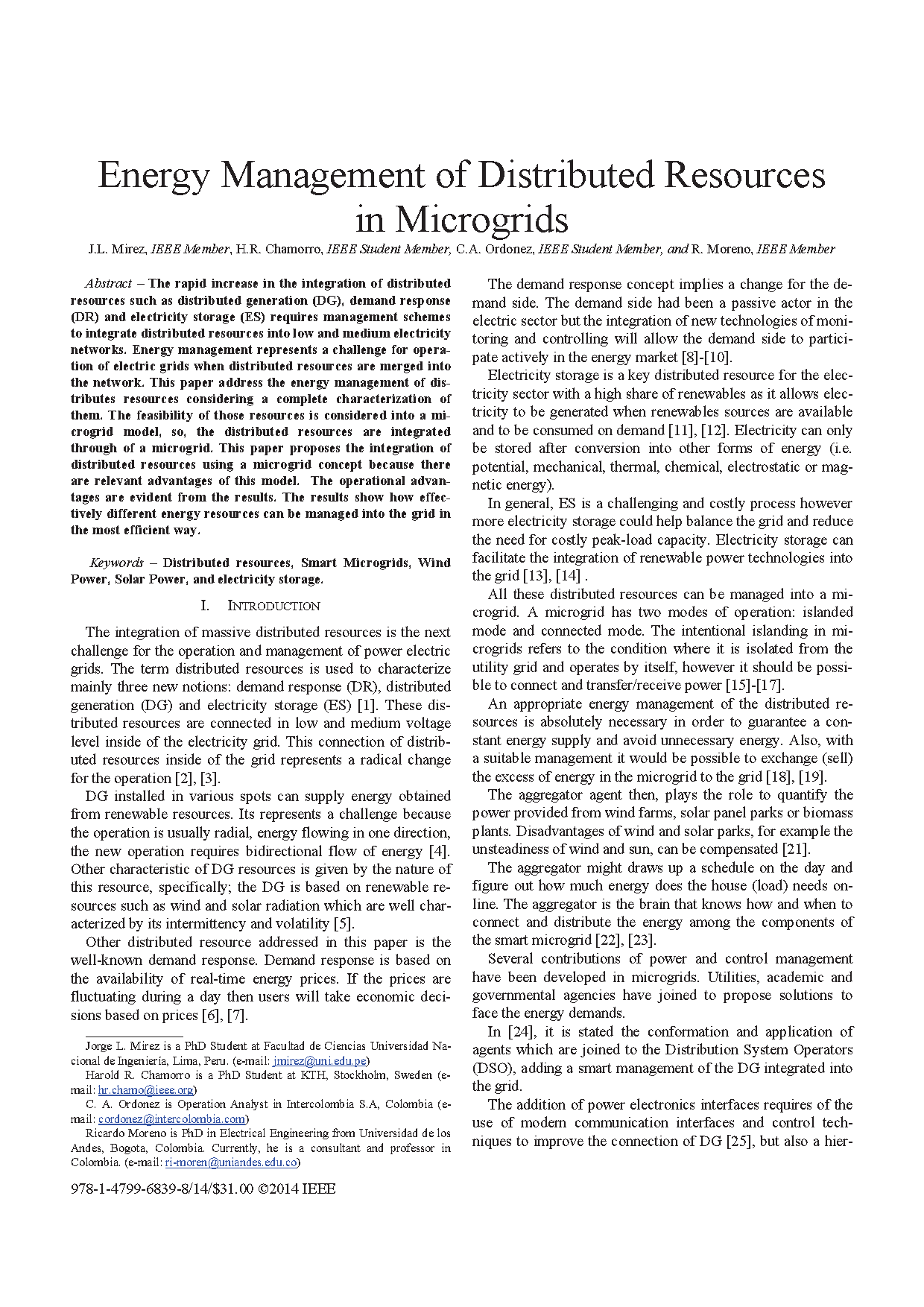
«Energy Management of Distributed Resources in Microgrids». J. L. Mírez, H.R. Chamorro, C.A. Ordonez, R. Moreno. 2014 IEEE 5th Colombian Workshop on Circuits and Systems (CWCAS).
DOI: 10.1109/CWCAS.2014.6994607
Dr. Jorge Luis Mírez Tarrillo
Group of Mathematical Modeling and Numerical Simulation (GMMNS).
Universidad Nacional de Ingeniería. Lima, Perú.
E-mail: jmirez@uni.edu.pe
Website Personal: https://jorgemirez2002.wixsite.com/jorgemirez
Facebook http://www.facebook.com/jorgemirezperu
Linkedin https://www.linkedin.com/in/jorge-luis-mirez-tarrillo-94918423/
Scopus ID: https://www.scopus.com/authid/detail.uri?authorId=56488109800
Google Scholar: https://scholar.google.com/citations?user=_dSpp4YAAAAJ
MATLAB Group Admin in Facebook: https://www.facebook.com/groups/Matlab.Simulink.for.All
WhatsApp Channel/Canal: https://whatsapp.com/channel/0029VbCvpZsAYlUSz2esek2y
Blog in ENGLISH

Compra/Buy – Haz una donación/Make a donation

Dear reader, if you wish to make a donation or are interested in any information or code, please contact me (e-mail: jmirez@uni.edu.pe). Donations will allow you to continue studying and researching, and also to provide more information on this blog. My PayPal account is jorgemirez2002@gmail.com or if it is by bank transfer write to my email jmirez@uni.edu.pe. Any amount of money is welcome. Thank you.
Estimado lector, si desean hacer una donación o le interesa alguna información o código, favor ponerse en contacto con mi persona (e-mail: jmirez@uni.edu.pe). Las donaciones va a permitir seguir estudiando e investigando, y además, el poder brindar más información en este blog. Mi cuenta en PayPal es jorgemirez2002@gmail.com o si es por transferencia bancaria escribirme a mi correo jmirez@uni.edu.pe. Cualquier cantidad de dinero es bienvenido. Gracias.
Datos Generales
Good day. My full name is Jorge Luis MIREZ TARRILLO.
I am Peruvian and live in Lima, capital of Perú in South America.I am Mechanical Electrical Engineering, MSc Physics and Dr. Physics (title doctoral thesis: Control, Optimization, and Management of Microgrid Current Direct)
Too, actually job as Principal Professor in Faculty of Oil, Gas and Petrochemical Engineering of Universidad Nacional de Ingeniería (National University of Engineering) in Lima – PERU (Courses: Modern Physics, Differential Equations and Research's Methodology)
My subjects of my interest are control, signal processing, optimization, simulation, biomedical research, smart grid, microgrid, water.
I have experience in Matlab/Simulink programming, biomedical equipment, electrical systems, renewable energies, microgrids, saturated steam systems 100 psi and organizing academic events.

Comentarios Recientes
Elementos que compon… en J506: Los elementos de un paqu… Dr. Jorge Mírez en Message by IEEE Community Dr. Jorge Mírez en J546: Simulación de campos mag… jose luis huayanay v… en Message by IEEE Community Cesar Aviles en J546: Simulación de campos mag… Dr. Jorge Mírez en J518: La herramienta pdetool d… Dr. Jorge Mírez en J496: Simulación en Matlab/Sim… Raúl Barrios Elizarr… en J496: Simulación en Matlab/Sim… jose luis huayanay v… en J518: La herramienta pdetool d… MSc. Jorge Mírez en J281: La Rosa de Vientos: Frec…


Debe estar conectado para enviar un comentario.