Archive for the ‘Líneas de Transmisión’ Category
Dear lectors, in this post I show the results of the 3D simulation with variable axial spacing between conductors within the cable (S) and conductor diameter (d) of the inductance L per core of a 3-core cable or of three single-core cables comprises two parts, the self-inductance of the conductor and the mutual inductance with other cores, given by:
L = K + 0.2 loge (2D/d)

Si deseas adquirir el código su costo es US$ 1.00 mediante Paypal.

Código de gráfica de post J1159
Se envía el código MATLAB al correo electrónico del cliente.
1,00 US$
Dr. Jorge Luis Mírez Tarrillo
Group of Mathematical Modeling and Numerical Simulation (GMMNS).
Universidad Nacional de Ingeniería. Lima, Perú.
E-mail: jmirez@uni.edu.pe
Website Personal: https://jorgemirez2002.wixsite.com/jorgemirez
Facebook http://www.facebook.com/jorgemirezperu
Linkedin https://www.linkedin.com/in/jorge-luis-mirez-tarrillo-94918423/
Scopus ID: https://www.scopus.com/authid/detail.uri?authorId=56488109800
Google Scholar: https://scholar.google.com/citations?user=_dSpp4YAAAAJ
MATLAB Group Admin in Facebook: https://www.facebook.com/groups/Matlab.Simulink.for.All
WhatsApp Channel/Canal: https://whatsapp.com/channel/0029VbCvpZsAYlUSz2esek2y
Dear readers, I show you a new simulation using Matlab in the next post. The induced voltage in the coils of a transformer is related to the frequency and the magnetic flux that passes through it. These, beyond the ideal calculation of being constant values, have small variations due to multiple factors, and therefore, lead to the fact that the induced voltage naturally has a slightly variable behavior over time. These changes involve transient processes of energy flow and exchange that can be simulated with Matlab/Simulink creating the appropriate study scenarios. Share my blog. Best regards.


Dr. Jorge Luis Mírez Tarrillo
Group of Mathematical Modeling and Numerical Simulation (GMMNS).
Universidad Nacional de Ingeniería. Lima, Perú.
E-mail: jmirez@uni.edu.pe
Website Personal: https://jorgemirez2002.wixsite.com/jorgemirez
Facebook http://www.facebook.com/jorgemirezperu
Linkedin https://www.linkedin.com/in/jorge-luis-mirez-tarrillo-94918423/
Scopus ID: https://www.scopus.com/authid/detail.uri?authorId=56488109800
Google Scholar: https://scholar.google.com/citations?user=_dSpp4YAAAAJ
MATLAB Group Admin in Facebook: https://www.facebook.com/groups/Matlab.Simulink.for.All
WhatsApp Channel/Canal: https://whatsapp.com/channel/0029VbCvpZsAYlUSz2esek2y
PERU Green Smart Energy S.A.C. es una empresa peruana que se dedica al rubro de bienes y servicios en temas de ingeniería, energias renovables, expedientes técnicos, material audiovisual – publicitario y de capacitación, expedientes técnicos en ingenierias, arquitectura, ciencias de la salud, entre otros. También nos dedicamos a la investigación científica, cálculos técnicos y capacitación.
Gustoso de pertenecer a la familia de PGSE S.A.C. en donde doy toda mi experiencia y conocimientos.
Para más información, consultas y coordinaciones sobre los bienes y servicios que ofrecemos, visita nuestra página web:
Pronto comenzaremos con nuestras capacitaciones virtuales (en español) con certificación. Lo estaremos promocionando con tiempo, pero les recomendamos ser nuestros seguidores dándole click en Me Gusta  de nuestro fanpage para mantenerse informado de las novedades
Fanpage de PGSE S.A.C. (darle Me Gusta):
http://www.facebook.com/PeruGreenSmartEnergySAC
Atentamente:
Jorge Luis Mírez Tarrillo
Ing. Mecánico Electricista – MSc & Dr. Física.
Dr. Jorge Luis Mírez Tarrillo
Group of Mathematical Modeling and Numerical Simulation (GMMNS).
Universidad Nacional de Ingeniería. Lima, Perú.
E-mail: jmirez@uni.edu.pe
Website Personal: https://jorgemirez2002.wixsite.com/jorgemirez
Facebook http://www.facebook.com/jorgemirezperu
Linkedin https://www.linkedin.com/in/jorge-luis-mirez-tarrillo-94918423/
Scopus ID: https://www.scopus.com/authid/detail.uri?authorId=56488109800
Google Scholar: https://scholar.google.com/citations?user=_dSpp4YAAAAJ
MATLAB Group Admin in Facebook: https://www.facebook.com/groups/Matlab.Simulink.for.All
WhatsApp Channel/Canal: https://whatsapp.com/channel/0029VbCvpZsAYlUSz2esek2y

The figure in this post shows the simplest type of circuit in which the series capacitor is protected by a self-triggered spark gap. The spark gap is set to flashover at a given voltage, usually in the range of 2.0–3.5 per unit (where 1.0 per unit is equal to the crest voltage produced across the series capacitor at rated current). But, the spark gap may not fire for low-current faults. Therefore, the line protection scheme must also perform properly with the series capacitor still in operation. The bypass breaker is used by an operator to remove the capacitor bank from the service for maintenance and for reinserting the capacitor bank into the service following these intentional removals
Dr. Jorge Luis Mírez Tarrillo
Group of Mathematical Modeling and Numerical Simulation (GMMNS).
Universidad Nacional de Ingeniería. Lima, Perú.
E-mail: jmirez@uni.edu.pe
Website Personal: https://jorgemirez2002.wixsite.com/jorgemirez
Facebook http://www.facebook.com/jorgemirezperu
Linkedin https://www.linkedin.com/in/jorge-luis-mirez-tarrillo-94918423/
Scopus ID: https://www.scopus.com/authid/detail.uri?authorId=56488109800
Google Scholar: https://scholar.google.com/citations?user=_dSpp4YAAAAJ
MATLAB Group Admin in Facebook: https://www.facebook.com/groups/Matlab.Simulink.for.All
WhatsApp Channel/Canal: https://whatsapp.com/channel/0029VbCvpZsAYlUSz2esek2y
Hoy jueves 27 diciembre 2018 recibí el Diploma de Doctor en Ciencias mención Física por la Universidad Nacional de Ingeniería, Lima, Perú. // Today, Thursday, December 27, 2018, I received the Diploma of Doctor of Sciences with mention in Physics (Dr. Physics) from the National University of Engineering, Lima, Peru.
Algunas fotos // some photos:

Recibiendo el diploma en Oficina de Grados y Títulos de la Universidad Nacional de Ingeniería, Lima, Perú. // Receiving a diploma in the Office of Degrees of the National University of Engineering, Lima, Peru.

En frente al Rectorado de la Universidad Nacional de Ingeniería, Lima, Perú // In front of the Rector’s Office of the National University of Engineering, Lima, Perú.

Con mi asesor Dr. Manfred Horn (a mi co-asesor Dr. Josep Guerrero en la Universidad de Aalborg, Dinamarca, muchas gracias también) // With my advisor Dr. Manfred Horn (a my co-advisor Dr. Josep Guerrero at the University of Aalborg, Denmark, thank you very much too) //
De mi fanpage // of my Fanpage:
Gracias a todos… A quienes estuvieron, están y/o estarán en este camino… Gracias por su espera, paciencia, enseñanzas, cariño, alegrías… estas cosas no se logran de la noche a la mañana… Queda aún algunos años para devolver lo recibido de la vida… Hoy jueves 27 Diciembre 2018 recibí el diploma de Doctor en Ciencias con mención en Física y al igual que mis grados y títulos anteriores me fue entregado en Ventanilla de una Oficina de Grados y Títulos y está bien, porque todos somos capaces, todos somos seres humanos… // Thank you all … Those who were, are and / or will be on this path … Thank you for your wait, patience, teachings, affection, joys … these things are not achieved overnight … There are still some years to return the received of life … Today, Thursday, December 27, 2018, I received a Doctor of Science degree with a mention in Physics and, like my previous degrees and diplomas, it was delivered to me in the Office of Degrees and Titles and that’s fine, because we’re all capable, we’re all human beings …. Fuente/Source: http://www.facebook.com/jorgemirezperu
Email: jmirez@uni.edu.pe
Dr. Jorge Luis Mírez Tarrillo
Group of Mathematical Modeling and Numerical Simulation (GMMNS).
Universidad Nacional de Ingeniería. Lima, Perú.
E-mail: jmirez@uni.edu.pe
Website Personal: https://jorgemirez2002.wixsite.com/jorgemirez
Facebook http://www.facebook.com/jorgemirezperu
Linkedin https://www.linkedin.com/in/jorge-luis-mirez-tarrillo-94918423/
Scopus ID: https://www.scopus.com/authid/detail.uri?authorId=56488109800
Google Scholar: https://scholar.google.com/citations?user=_dSpp4YAAAAJ
MATLAB Group Admin in Facebook: https://www.facebook.com/groups/Matlab.Simulink.for.All
WhatsApp Channel/Canal: https://whatsapp.com/channel/0029VbCvpZsAYlUSz2esek2y

Una microredes una unidad energética que puede trabajar de manera independiente o conectada a la red eléctrica externa y cuenta con numerosos elementos en su interior de tal manera que puedan manipular hasta 10 MVA en el punto de común acoplamiento. Entre estos diferentes elementos están aquellos que crean el costo por el que se debe pagar como clientes, es decir: me refiero a la generación, almacenamiento, distribución y conversión adecuada de la energía eléctrica para el cliente final. Más aún la energía eléctrica tiene que ser de alta calidad o ultra alta calidad bajo la espectativa de los sistemas eléctricos avanzados. Por lo tanto, debido a tantos elementos inmersos los costos no pueden ser los mismos durante el funcionamiento y pueden cambiar en tiempos relativamente cortos como: días, horas, minutos. La imagen es producto del resultado de una simulación de costos de operación de una microred de corriente continua que os dejo a su disposición.
Dr. Jorge Luis Mírez Tarrillo
Group of Mathematical Modeling and Numerical Simulation (GMMNS).
Universidad Nacional de Ingeniería. Lima, Perú.
E-mail: jmirez@uni.edu.pe
Website Personal: https://jorgemirez2002.wixsite.com/jorgemirez
Facebook http://www.facebook.com/jorgemirezperu
Linkedin https://www.linkedin.com/in/jorge-luis-mirez-tarrillo-94918423/
Scopus ID: https://www.scopus.com/authid/detail.uri?authorId=56488109800
Google Scholar: https://scholar.google.com/citations?user=_dSpp4YAAAAJ
MATLAB Group Admin in Facebook: https://www.facebook.com/groups/Matlab.Simulink.for.All
WhatsApp Channel/Canal: https://whatsapp.com/channel/0029VbCvpZsAYlUSz2esek2y
En éste post hago un resumen hablado de mi ponencia «Orientaciones para hacer modelamiento matemático y simulación numérica en Ingeniería Electromecánica» que lo dí durante el evento Primeras Jornadas Tecnológicas Internacionales en Electromecánica
Universidad de las Fuerzas Armadas – ESPE.
Unidad de Gestión de Tecnologías
Latacunga, Ecuador. 12 – 14 Dic 2016
más información mía en mi fanpage http://www.facebook.com/jorgemirezperu que les invito a dar Me Gusta  (Y) y visitar mi blog http://jmirez.wordpress.com y mis otros blogs están en mi website http://www.geocities.ws/jorgemirez
Dr. Jorge Luis Mírez Tarrillo
Group of Mathematical Modeling and Numerical Simulation (GMMNS).
Universidad Nacional de Ingeniería. Lima, Perú.
E-mail: jmirez@uni.edu.pe
Website Personal: https://jorgemirez2002.wixsite.com/jorgemirez
Facebook http://www.facebook.com/jorgemirezperu
Linkedin https://www.linkedin.com/in/jorge-luis-mirez-tarrillo-94918423/
Scopus ID: https://www.scopus.com/authid/detail.uri?authorId=56488109800
Google Scholar: https://scholar.google.com/citations?user=_dSpp4YAAAAJ
MATLAB Group Admin in Facebook: https://www.facebook.com/groups/Matlab.Simulink.for.All
WhatsApp Channel/Canal: https://whatsapp.com/channel/0029VbCvpZsAYlUSz2esek2y
Buenas horas a todos los que leen este mi blog.
A pedido de la comunidad transmití un videochat en el que hablé sobre energías renovables, ingeniería eléctrica y otros temas que iban pidiendo mediante mensajes, y cuyos enlaces lo coloco en el presente post para los seguidores de éste mi blog.
Espero les interese y presto a brindar mis servicios de consultoría y capacitación en temas de sistemas eléctricos, energías renovables, equipamiento para hospitales, elaboración y desarrollo de investigaciones, además de expedientes de instalaciones eléctricas y mecánicas; tanto a nivel nacional (Perú) como internacional. Mi email de contacto es jmirez@uni.edu.pe y por WhatsApp a +51970030394
PD: Información adicional lo pueden encontrar en mi fanpagehttp://wwwfacebook.com/jorgemirezperu y en mi blog de energías renovables y Matlab/Simulink https://jmirez.wordpress.com, otros blogs y redes sociales de interés lo pueden encontrar en http://www.geocities.ws/jorgemirez
Parte 1:
Parte 2:
Dr. Jorge Luis Mírez Tarrillo
Group of Mathematical Modeling and Numerical Simulation (GMMNS).
Universidad Nacional de Ingeniería. Lima, Perú.
E-mail: jmirez@uni.edu.pe
Website Personal: https://jorgemirez2002.wixsite.com/jorgemirez
Facebook http://www.facebook.com/jorgemirezperu
Linkedin https://www.linkedin.com/in/jorge-luis-mirez-tarrillo-94918423/
Scopus ID: https://www.scopus.com/authid/detail.uri?authorId=56488109800
Google Scholar: https://scholar.google.com/citations?user=_dSpp4YAAAAJ
MATLAB Group Admin in Facebook: https://www.facebook.com/groups/Matlab.Simulink.for.All
WhatsApp Channel/Canal: https://whatsapp.com/channel/0029VbCvpZsAYlUSz2esek2y
En el presente post doy una videocharla sobre lo que voy a hablar hoy en SINATEC 2017 «IMPORTANCIA Y TRANSICIÓN DE LAS REDES ELÉCTRICAS INTELIGENTES» a realizarse en la Universidad Nacional del Callao hoy 23 octubre a las 2:40 pm. Espero les interese y presto a brindar mis servicios de consultoría y capacitación en temas de sistemas eléctricos, energías renovables, equipamiento para hospitales, elaboración y desarrollo de investigaciones, además de expedientes de instalaciones eléctricas y mecánicas; tanto a nivel nacional (Perú) como internacional. Mi email de contacto es jmirez@uni.edu.pe y por WhatsApp a +51970030394
PD: Información adicional lo pueden encontrar en mi fanpagehttp://wwwfacebook.com/jorgemirezperu y en mi blog de energías renovables y Matlab/Simulink http://jmirez.wordpress.com, otros blogs y redes sociales de interés lo pueden encontrar en http://www.geocities.ws/jorgemirez
Dr. Jorge Luis Mírez Tarrillo
Group of Mathematical Modeling and Numerical Simulation (GMMNS).
Universidad Nacional de Ingeniería. Lima, Perú.
E-mail: jmirez@uni.edu.pe
Website Personal: https://jorgemirez2002.wixsite.com/jorgemirez
Facebook http://www.facebook.com/jorgemirezperu
Linkedin https://www.linkedin.com/in/jorge-luis-mirez-tarrillo-94918423/
Scopus ID: https://www.scopus.com/authid/detail.uri?authorId=56488109800
Google Scholar: https://scholar.google.com/citations?user=_dSpp4YAAAAJ
MATLAB Group Admin in Facebook: https://www.facebook.com/groups/Matlab.Simulink.for.All
WhatsApp Channel/Canal: https://whatsapp.com/channel/0029VbCvpZsAYlUSz2esek2y
El 17 Marzo 2017 sí una charla titulada «Taller de Redacción de Papers». El evento fue organizado por los integrantes de la Sección Estudiantil de la Sociedad de Sistemas de Potencia de la IEEE en la Universidad Nacional de Ingeniería – IEEE PES UNI (Lima, Perú) y se desarrolló en la Sede de la Rama Estudiantil IEEE PES UNI en la Facultad de Ingeniería Eléctrica y Electrónica (FIEE) de la UNI. He tratado de resumir lo experimentado y visto en estas diapositivas, además de poder explicar en pizarra detalles de posibles temas en base a la actualidad energética. Éste tema es uno de aquellos que voy a ir progresivamente mejorándolo aportando nuevos elementos que sean útiles, prácticos y claros. Contacto: jmirez@uni.edu.pe


Dr. Jorge Luis Mírez Tarrillo
Group of Mathematical Modeling and Numerical Simulation (GMMNS).
Universidad Nacional de Ingeniería. Lima, Perú.
E-mail: jmirez@uni.edu.pe
Website Personal: https://jorgemirez2002.wixsite.com/jorgemirez
Facebook http://www.facebook.com/jorgemirezperu
Linkedin https://www.linkedin.com/in/jorge-luis-mirez-tarrillo-94918423/
Scopus ID: https://www.scopus.com/authid/detail.uri?authorId=56488109800
Google Scholar: https://scholar.google.com/citations?user=_dSpp4YAAAAJ
MATLAB Group Admin in Facebook: https://www.facebook.com/groups/Matlab.Simulink.for.All
WhatsApp Channel/Canal: https://whatsapp.com/channel/0029VbCvpZsAYlUSz2esek2y

Dr. Jorge Luis Mírez Tarrillo
Group of Mathematical Modeling and Numerical Simulation (GMMNS).
Universidad Nacional de Ingeniería. Lima, Perú.
E-mail: jmirez@uni.edu.pe
Website Personal: https://jorgemirez2002.wixsite.com/jorgemirez
Facebook http://www.facebook.com/jorgemirezperu
Linkedin https://www.linkedin.com/in/jorge-luis-mirez-tarrillo-94918423/
Scopus ID: https://www.scopus.com/authid/detail.uri?authorId=56488109800
Google Scholar: https://scholar.google.com/citations?user=_dSpp4YAAAAJ
MATLAB Group Admin in Facebook: https://www.facebook.com/groups/Matlab.Simulink.for.All
WhatsApp Channel/Canal: https://whatsapp.com/channel/0029VbCvpZsAYlUSz2esek2y
Dr. Jorge Luis Mírez Tarrillo
Group of Mathematical Modeling and Numerical Simulation (GMMNS).
Universidad Nacional de Ingeniería. Lima, Perú.
E-mail: jmirez@uni.edu.pe
Website Personal: https://jorgemirez2002.wixsite.com/jorgemirez
Facebook http://www.facebook.com/jorgemirezperu
Linkedin https://www.linkedin.com/in/jorge-luis-mirez-tarrillo-94918423/
Scopus ID: https://www.scopus.com/authid/detail.uri?authorId=56488109800
Google Scholar: https://scholar.google.com/citations?user=_dSpp4YAAAAJ
MATLAB Group Admin in Facebook: https://www.facebook.com/groups/Matlab.Simulink.for.All
WhatsApp Channel/Canal: https://whatsapp.com/channel/0029VbCvpZsAYlUSz2esek2y
Dr. Jorge Luis Mírez Tarrillo
Group of Mathematical Modeling and Numerical Simulation (GMMNS).
Universidad Nacional de Ingeniería. Lima, Perú.
E-mail: jmirez@uni.edu.pe
Website Personal: https://jorgemirez2002.wixsite.com/jorgemirez
Facebook http://www.facebook.com/jorgemirezperu
Linkedin https://www.linkedin.com/in/jorge-luis-mirez-tarrillo-94918423/
Scopus ID: https://www.scopus.com/authid/detail.uri?authorId=56488109800
Google Scholar: https://scholar.google.com/citations?user=_dSpp4YAAAAJ
MATLAB Group Admin in Facebook: https://www.facebook.com/groups/Matlab.Simulink.for.All
WhatsApp Channel/Canal: https://whatsapp.com/channel/0029VbCvpZsAYlUSz2esek2y

Página Web: http://jmirez.wixsite.com/mapchota2016
Fanpage: https://www.facebook.com/mapchota2016/
PD: Se invita a los que desean grabarlo, transmitirlo por radio, TV y/o cable el evento.
Link Transmisión en Vivo y en Directo en Español
Dr. Jorge Luis Mírez Tarrillo
Group of Mathematical Modeling and Numerical Simulation (GMMNS).
Universidad Nacional de Ingeniería. Lima, Perú.
E-mail: jmirez@uni.edu.pe
Website Personal: https://jorgemirez2002.wixsite.com/jorgemirez
Facebook http://www.facebook.com/jorgemirezperu
Linkedin https://www.linkedin.com/in/jorge-luis-mirez-tarrillo-94918423/
Scopus ID: https://www.scopus.com/authid/detail.uri?authorId=56488109800
Google Scholar: https://scholar.google.com/citations?user=_dSpp4YAAAAJ
MATLAB Group Admin in Facebook: https://www.facebook.com/groups/Matlab.Simulink.for.All
WhatsApp Channel/Canal: https://whatsapp.com/channel/0029VbCvpZsAYlUSz2esek2y


Se invita a todos los que desean participar como Ponentes de este Encuentro. Las reglas son:
-
Las ponencias serán de al menos 15 minutos.
-
Hay espacio para 24 ponencias de 15 minutos.
-
Las ponencias serán transmitidas vía internet por dos canales de YouTube (uno en español y otro en inglés con traductor en vivo).
-
Los ponentes enviarán hasta el 21 de diciembre sus ponencias y CV para ser colocados en el Programa del evento.
-
El modelo del CV en formato Word está disponible en el siguiente link: https://jmirez.com/wp-content/uploads/2016/12/map-chota-2016_nombreyapellidoponente_cv.docx
-
El modelo de la presentación en formato PPT está disponible en: https://jmirez.com/wp-content/uploads/2016/12/ppt_mar-chota-2016_autor.pptx
-
Los archivo PPT y Word enviarlo a jmirez@uni.edu.pe
Motivación del Encuentro
Las fiestas de fin de año reúnen a la familia y amigos, para lo cual se da el retorno de estudiantes, académicos y profesionales desde sus centros de estudio, investigación y de trabajo a sus ciudades de origen (en los diferentes ciudades y pueblos a nivel nacional) a pasarla en familia, con las amistades o simplemente es un tiempo de retorno a nuestros lugares de origen.
Este es un motivo especial para reunirnos para conocernos y compartir lo realizado durante el año mediante la conversación y ponencias tanto en lo académico y en las experiencias profesionales sean éstas realizadas en el sector público como privado.
Chota, la Atenas del Norte del Perú, se viste de gala al organizar el MAP Chota 2016 e invita a ser parte de este encuentro entre estudiantes de escuelas, colegios, pregrado y postgrado, académicos, profesores, padres de familia, investigadores, profesionales, organizaciones de base y sociedad en general de fin de año 2016 y hacemos el llamado a todas las ciudades del Perú a que se realicen eventos similares, y hacemos extensivo también a todos los pueblos y ciudades de América Latina.
Durante el MAP Chota 2016 estamos organizando algunas actividades extras: como un compartir; feria tecnológica, artesanal y artística; exposición de fotografías y de libros.
Las seis horas que durará el evento quedará guardado en YouTube y la participación en el evento como Ponente o Asistente es totalmente libre y gratuito. Quedan todos invitados a participar.
Página Web del Encuentro http://jmirez.wixsite.com/mapchota2016
Dr. Jorge Luis Mírez Tarrillo
Group of Mathematical Modeling and Numerical Simulation (GMMNS).
Universidad Nacional de Ingeniería. Lima, Perú.
E-mail: jmirez@uni.edu.pe
Website Personal: https://jorgemirez2002.wixsite.com/jorgemirez
Facebook http://www.facebook.com/jorgemirezperu
Linkedin https://www.linkedin.com/in/jorge-luis-mirez-tarrillo-94918423/
Scopus ID: https://www.scopus.com/authid/detail.uri?authorId=56488109800
Google Scholar: https://scholar.google.com/citations?user=_dSpp4YAAAAJ
MATLAB Group Admin in Facebook: https://www.facebook.com/groups/Matlab.Simulink.for.All
WhatsApp Channel/Canal: https://whatsapp.com/channel/0029VbCvpZsAYlUSz2esek2y

Con el rápido crecimiento de las fuentes renovables, el crecimiento en acceso a la electricidad; la electrificación de nuevos servicios en transportes, industria y construcciones; y la necesidad de construir una red inteligente, nuevas tecnologías para la transmisión de potencia sobre largas distancias y entre sistemas de potencia tienen la expectativa de crecer más allá de sus niveles actuales de implementación. La Figura muestra el histórico de crecimiento y la prospectiva hacia el año 2025 de las líneas de transmisión en HVDC.
Fuente: International Energy Agency. “Large-Scale Electricity Interconnecction: Technology and prospects for cross-regional networks”. IEA Publications http://www.iea.org. Paris, November 2016.
Dr. Jorge Luis Mírez Tarrillo
Group of Mathematical Modeling and Numerical Simulation (GMMNS).
Universidad Nacional de Ingeniería. Lima, Perú.
E-mail: jmirez@uni.edu.pe
Website Personal: https://jorgemirez2002.wixsite.com/jorgemirez
Facebook http://www.facebook.com/jorgemirezperu
Linkedin https://www.linkedin.com/in/jorge-luis-mirez-tarrillo-94918423/
Scopus ID: https://www.scopus.com/authid/detail.uri?authorId=56488109800
Google Scholar: https://scholar.google.com/citations?user=_dSpp4YAAAAJ
MATLAB Group Admin in Facebook: https://www.facebook.com/groups/Matlab.Simulink.for.All
WhatsApp Channel/Canal: https://whatsapp.com/channel/0029VbCvpZsAYlUSz2esek2y
Los sistemas eléctricos en el futuro próximo cercano van a tener que ser inteligentes por obligación competitiva entre empresas eléctricas a fin de optimizar y mejorar sus prestaciones, esto sumado a la implementación de tecnologías de energías renovables, generación distribuida, entre otras. En especial énfasis la distribución dado que promueve los activos de generación. Ante ello un nuevo marco de transmisión y distribución se hace necesario en muchos países, siendo el marco regulativo de distribución el de mayor desafío. Incluyendo la interacción con los clientes, los cuales son más activos ahora, por ejemplo, ahora se tiene que si llaman varios clientes de una misma zona se deduce que se tiene una falla. Siendo ahora cada vez más importante en la vida diaria de las personas y las industrias se requiere cambios de índices de continuidad de suministro (1) continuidad, cantidad y tiempo de cortes, (2) calidad del producto eléctrico: armónicas, flicker’s, voltaje, frecuencia, factor de potencia y (3) atención comercial. Además, se debe tener esquemas de tarifa muy óptimos y generales de tal manera que las empresas tengan una perspectiva en el tiempo estable y lo menos complicado posible. Los marcos regulatorios (regulativos) contemplados desde hace años no se adaptan a la modernidad existente.
Dr. Jorge Luis Mírez Tarrillo
Group of Mathematical Modeling and Numerical Simulation (GMMNS).
Universidad Nacional de Ingeniería. Lima, Perú.
E-mail: jmirez@uni.edu.pe
Website Personal: https://jorgemirez2002.wixsite.com/jorgemirez
Facebook http://www.facebook.com/jorgemirezperu
Linkedin https://www.linkedin.com/in/jorge-luis-mirez-tarrillo-94918423/
Scopus ID: https://www.scopus.com/authid/detail.uri?authorId=56488109800
Google Scholar: https://scholar.google.com/citations?user=_dSpp4YAAAAJ
MATLAB Group Admin in Facebook: https://www.facebook.com/groups/Matlab.Simulink.for.All
WhatsApp Channel/Canal: https://whatsapp.com/channel/0029VbCvpZsAYlUSz2esek2y

As Figure demonstrates, the existing electricity grid is a strictly hierarchical system in which power plants at the top of the chain ensure power delivery to customers’ loads at the bottom of the chain. The system is essentially a oneway pipeline where the source has no real-time information about the service parameters of the termination points. The grid is therefore overengineered to withstand maximum anticipated peak demand across its aggregated load. And since this peak demand is an infrequent occurrence, the system is inherently inefficient. Moreover, an unprecedented rise in demand for electrical power, coupled with lagging investments in the electrical power infrastructure, has decreased system stability. With the safe margins exhausted, any unforeseen surge in demand or anomalies across the distribution network causing component failures can trigger catastrophic blackouts.
Source:
Hassan Farhangi “The Path of the Smart Grid” IEEE Power & Energy Mazagine. January/February 2010. Pag 18 -28.
Dr. Jorge Luis Mírez Tarrillo
Group of Mathematical Modeling and Numerical Simulation (GMMNS).
Universidad Nacional de Ingeniería. Lima, Perú.
E-mail: jmirez@uni.edu.pe
Website Personal: https://jorgemirez2002.wixsite.com/jorgemirez
Facebook http://www.facebook.com/jorgemirezperu
Linkedin https://www.linkedin.com/in/jorge-luis-mirez-tarrillo-94918423/
Scopus ID: https://www.scopus.com/authid/detail.uri?authorId=56488109800
Google Scholar: https://scholar.google.com/citations?user=_dSpp4YAAAAJ
MATLAB Group Admin in Facebook: https://www.facebook.com/groups/Matlab.Simulink.for.All
WhatsApp Channel/Canal: https://whatsapp.com/channel/0029VbCvpZsAYlUSz2esek2y
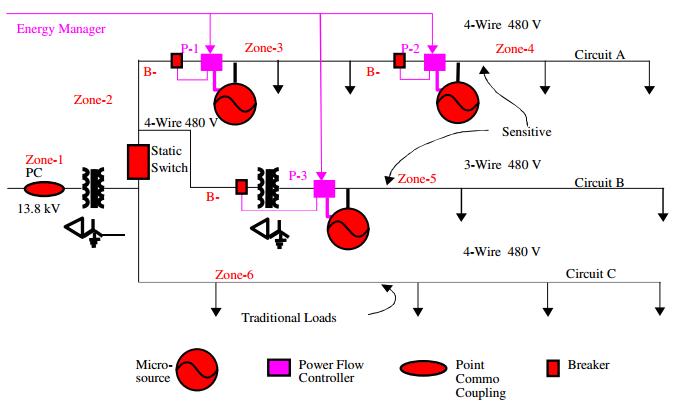
The CERTS Microgrid program has developed control methods to allow the installation of distributed generators (DGs) in commercial and industrial electric power systems in a “plug and play” manner. These control methods allow the generators to be electrically distributed, rather than be installed on the same electrical bus, and do not require intergenerator communications in order to maintain appropriate voltage and frequency at each generator. Note in figure that there is a communication link with the DGs that is labeled “Energy Manager”. This is a conventional energy manager that is used for power dispatch purposes, not for frequency or voltage control. This energy manager can use relatively slow communications links, such as telephone or internet, since it has no bearing on system stability.
Source:
John Stevens «CERTS Microgrid System Test». IEEExplore
Dr. Jorge Luis Mírez Tarrillo
Group of Mathematical Modeling and Numerical Simulation (GMMNS).
Universidad Nacional de Ingeniería. Lima, Perú.
E-mail: jmirez@uni.edu.pe
Website Personal: https://jorgemirez2002.wixsite.com/jorgemirez
Facebook http://www.facebook.com/jorgemirezperu
Linkedin https://www.linkedin.com/in/jorge-luis-mirez-tarrillo-94918423/
Scopus ID: https://www.scopus.com/authid/detail.uri?authorId=56488109800
Google Scholar: https://scholar.google.com/citations?user=_dSpp4YAAAAJ
MATLAB Group Admin in Facebook: https://www.facebook.com/groups/Matlab.Simulink.for.All
WhatsApp Channel/Canal: https://whatsapp.com/channel/0029VbCvpZsAYlUSz2esek2y
Blog in ENGLISH

Compra/Buy – Haz una donación/Make a donation

Dear reader, if you wish to make a donation or are interested in any information or code, please contact me (e-mail: jmirez@uni.edu.pe). Donations will allow you to continue studying and researching, and also to provide more information on this blog. My PayPal account is jorgemirez2002@gmail.com or if it is by bank transfer write to my email jmirez@uni.edu.pe. Any amount of money is welcome. Thank you.
Estimado lector, si desean hacer una donación o le interesa alguna información o código, favor ponerse en contacto con mi persona (e-mail: jmirez@uni.edu.pe). Las donaciones va a permitir seguir estudiando e investigando, y además, el poder brindar más información en este blog. Mi cuenta en PayPal es jorgemirez2002@gmail.com o si es por transferencia bancaria escribirme a mi correo jmirez@uni.edu.pe. Cualquier cantidad de dinero es bienvenido. Gracias.
Datos Generales
Good day. My full name is Jorge Luis MIREZ TARRILLO.
I am Peruvian and live in Lima, capital of Perú in South America.I am Mechanical Electrical Engineering, MSc Physics and Dr. Physics (title doctoral thesis: Control, Optimization, and Management of Microgrid Current Direct)
Too, actually job as Principal Professor in Faculty of Oil, Gas and Petrochemical Engineering of Universidad Nacional de Ingeniería (National University of Engineering) in Lima – PERU (Courses: Modern Physics, Differential Equations and Research's Methodology)
My subjects of my interest are control, signal processing, optimization, simulation, biomedical research, smart grid, microgrid, water.
I have experience in Matlab/Simulink programming, biomedical equipment, electrical systems, renewable energies, microgrids, saturated steam systems 100 psi and organizing academic events.

Comentarios Recientes
Elementos que compon… en J506: Los elementos de un paqu… Dr. Jorge Mírez en Message by IEEE Community Dr. Jorge Mírez en J546: Simulación de campos mag… jose luis huayanay v… en Message by IEEE Community Cesar Aviles en J546: Simulación de campos mag… Dr. Jorge Mírez en J518: La herramienta pdetool d… Dr. Jorge Mírez en J496: Simulación en Matlab/Sim… Raúl Barrios Elizarr… en J496: Simulación en Matlab/Sim… jose luis huayanay v… en J518: La herramienta pdetool d… MSc. Jorge Mírez en J281: La Rosa de Vientos: Frec…


Debe estar conectado para enviar un comentario.