Archive for the ‘Metering’ Category
A. Azizi, M. Z. Jahromi, P. Dehghanian, H. R. Chamorro, J. Mírez and V. K. Sood, «Decentralized Multi-Objective Energy Management With Dynamic Power Electronic Converters and Demand Response Constraints,» in IEEE Access, vol. 11, pp. 146297-146312, 2023, doi: 10.1109/ACCESS.2023.3344209. keywords: {Costs;Energy management;Renewable energy sources;Power system dynamics;Voltage;Power system stability;Optimization;Demand response;Dynamic generation;demand response;renewable energy;optimization;energy management;microgrid},
https://ieeexplore.ieee.org/document/10364854

Dr. Jorge Luis Mírez Tarrillo
Group of Mathematical Modeling and Numerical Simulation (GMMNS).
Universidad Nacional de Ingeniería. Lima, Perú.
E-mail: jmirez@uni.edu.pe
Website Personal: https://jorgemirez2002.wixsite.com/jorgemirez
Facebook http://www.facebook.com/jorgemirezperu
Linkedin https://www.linkedin.com/in/jorge-luis-mirez-tarrillo-94918423/
Scopus ID: https://www.scopus.com/authid/detail.uri?authorId=56488109800
Google Scholar: https://scholar.google.com/citations?user=_dSpp4YAAAAJ
MATLAB Group Admin in Facebook: https://www.facebook.com/groups/Matlab.Simulink.for.All
WhatsApp Channel/Canal: https://whatsapp.com/channel/0029VbCvpZsAYlUSz2esek2y
Wind resources and the electric power output from wind turbine at a particular location depend on wind speed at the hub height, the wind turbine speed characteristics. Wind speed at the hub height of wind turbine is calculated by the power law equation using the wind speed data collected at the anemometer height as the equation in figure where, u(h) and u(hg) are wind speeds at hub height (h ) and anemometer height (hg), respectively, and Greek letter alpha is the roughness factor considered as 1.0 and 1.4 for this post. In this simulation hg = 10 meters and u(hg) = 10 m/s. This simulation is the result of the implementation of the mathematical model in Matlab.


Dr. Jorge Luis Mírez Tarrillo
Group of Mathematical Modeling and Numerical Simulation (GMMNS).
Universidad Nacional de Ingeniería. Lima, Perú.
E-mail: jmirez@uni.edu.pe
Website Personal: https://jorgemirez2002.wixsite.com/jorgemirez
Facebook http://www.facebook.com/jorgemirezperu
Linkedin https://www.linkedin.com/in/jorge-luis-mirez-tarrillo-94918423/
Scopus ID: https://www.scopus.com/authid/detail.uri?authorId=56488109800
Google Scholar: https://scholar.google.com/citations?user=_dSpp4YAAAAJ
MATLAB Group Admin in Facebook: https://www.facebook.com/groups/Matlab.Simulink.for.All
WhatsApp Channel/Canal: https://whatsapp.com/channel/0029VbCvpZsAYlUSz2esek2y
 Source: Antonio Moreno-Munoz. “Large Scale Grid Integration of Renewable Energy Sources”. The Institution of Engineering and Technology. 2017.
Dr. Jorge Luis Mírez Tarrillo
Group of Mathematical Modeling and Numerical Simulation (GMMNS).
Universidad Nacional de Ingeniería. Lima, Perú.
E-mail: jmirez@uni.edu.pe
Website Personal: https://jorgemirez2002.wixsite.com/jorgemirez
Facebook http://www.facebook.com/jorgemirezperu
Linkedin https://www.linkedin.com/in/jorge-luis-mirez-tarrillo-94918423/
Scopus ID: https://www.scopus.com/authid/detail.uri?authorId=56488109800
Google Scholar: https://scholar.google.com/citations?user=_dSpp4YAAAAJ
MATLAB Group Admin in Facebook: https://www.facebook.com/groups/Matlab.Simulink.for.All
WhatsApp Channel/Canal: https://whatsapp.com/channel/0029VbCvpZsAYlUSz2esek2y
Source: Antonio Moreno-Munoz. “Large Scale Grid Integration of Renewable Energy Sources”. The Institution of Engineering and Technology. 2017.
Dr. Jorge Luis Mírez Tarrillo
Group of Mathematical Modeling and Numerical Simulation (GMMNS).
Universidad Nacional de Ingeniería. Lima, Perú.
E-mail: jmirez@uni.edu.pe
Website Personal: https://jorgemirez2002.wixsite.com/jorgemirez
Facebook http://www.facebook.com/jorgemirezperu
Linkedin https://www.linkedin.com/in/jorge-luis-mirez-tarrillo-94918423/
Scopus ID: https://www.scopus.com/authid/detail.uri?authorId=56488109800
Google Scholar: https://scholar.google.com/citations?user=_dSpp4YAAAAJ
MATLAB Group Admin in Facebook: https://www.facebook.com/groups/Matlab.Simulink.for.All
WhatsApp Channel/Canal: https://whatsapp.com/channel/0029VbCvpZsAYlUSz2esek2y
«Energy Management of Distributed Resources in Microgrids». J. L. Mírez, H.R. Chamorro, C.A. Ordonez, R. Moreno. 2014 IEEE 5th Colombian Workshop on Circuits and Systems (CWCAS).
DOI: 10.1109/CWCAS.2014.6994607
Dr. Jorge Luis Mírez Tarrillo
Group of Mathematical Modeling and Numerical Simulation (GMMNS).
Universidad Nacional de Ingeniería. Lima, Perú.
E-mail: jmirez@uni.edu.pe
Website Personal: https://jorgemirez2002.wixsite.com/jorgemirez
Facebook http://www.facebook.com/jorgemirezperu
Linkedin https://www.linkedin.com/in/jorge-luis-mirez-tarrillo-94918423/
Scopus ID: https://www.scopus.com/authid/detail.uri?authorId=56488109800
Google Scholar: https://scholar.google.com/citations?user=_dSpp4YAAAAJ
MATLAB Group Admin in Facebook: https://www.facebook.com/groups/Matlab.Simulink.for.All
WhatsApp Channel/Canal: https://whatsapp.com/channel/0029VbCvpZsAYlUSz2esek2y
Hoy jueves 27 diciembre 2018 recibí el Diploma de Doctor en Ciencias mención Física por la Universidad Nacional de Ingeniería, Lima, Perú. // Today, Thursday, December 27, 2018, I received the Diploma of Doctor of Sciences with mention in Physics (Dr. Physics) from the National University of Engineering, Lima, Peru.
Algunas fotos // some photos:

Recibiendo el diploma en Oficina de Grados y Títulos de la Universidad Nacional de Ingeniería, Lima, Perú. // Receiving a diploma in the Office of Degrees of the National University of Engineering, Lima, Peru.

En frente al Rectorado de la Universidad Nacional de Ingeniería, Lima, Perú // In front of the Rector’s Office of the National University of Engineering, Lima, Perú.

Con mi asesor Dr. Manfred Horn (a mi co-asesor Dr. Josep Guerrero en la Universidad de Aalborg, Dinamarca, muchas gracias también) // With my advisor Dr. Manfred Horn (a my co-advisor Dr. Josep Guerrero at the University of Aalborg, Denmark, thank you very much too) //
De mi fanpage // of my Fanpage:
Gracias a todos… A quienes estuvieron, están y/o estarán en este camino… Gracias por su espera, paciencia, enseñanzas, cariño, alegrías… estas cosas no se logran de la noche a la mañana… Queda aún algunos años para devolver lo recibido de la vida… Hoy jueves 27 Diciembre 2018 recibí el diploma de Doctor en Ciencias con mención en Física y al igual que mis grados y títulos anteriores me fue entregado en Ventanilla de una Oficina de Grados y Títulos y está bien, porque todos somos capaces, todos somos seres humanos… // Thank you all … Those who were, are and / or will be on this path … Thank you for your wait, patience, teachings, affection, joys … these things are not achieved overnight … There are still some years to return the received of life … Today, Thursday, December 27, 2018, I received a Doctor of Science degree with a mention in Physics and, like my previous degrees and diplomas, it was delivered to me in the Office of Degrees and Titles and that’s fine, because we’re all capable, we’re all human beings …. Fuente/Source: http://www.facebook.com/jorgemirezperu
Email: jmirez@uni.edu.pe
Dr. Jorge Luis Mírez Tarrillo
Group of Mathematical Modeling and Numerical Simulation (GMMNS).
Universidad Nacional de Ingeniería. Lima, Perú.
E-mail: jmirez@uni.edu.pe
Website Personal: https://jorgemirez2002.wixsite.com/jorgemirez
Facebook http://www.facebook.com/jorgemirezperu
Linkedin https://www.linkedin.com/in/jorge-luis-mirez-tarrillo-94918423/
Scopus ID: https://www.scopus.com/authid/detail.uri?authorId=56488109800
Google Scholar: https://scholar.google.com/citations?user=_dSpp4YAAAAJ
MATLAB Group Admin in Facebook: https://www.facebook.com/groups/Matlab.Simulink.for.All
WhatsApp Channel/Canal: https://whatsapp.com/channel/0029VbCvpZsAYlUSz2esek2y
TÍTULO DEL CURSO
Introducción a la Eficiencia Energética y Sostenibilidad
MARCO DEL CURSO
El curso está enmarcado dentro de una actividad de la Red Temática CITIES (Ciudades Inteligentes Totalmente Integrales, Eficientes y Sostenibles). CITIES es una iniciativa promovida y financiada por la CYTED (Programa Iberoamericano de Ciencia y Tecnología para el Desarrollo).
CITIES ha planteado una formación a lo largo de cuatro años, realizando para ello cuatro módulos formativos, cada uno de los cuales se realizará de forma anual y de forma independiente con los otros tres. Este primer módulo de 2018 está formado por 9 temas.
El curso está orientado a alumnos Universitarios, Investigadores y Docentes interesados en la temática planteada. Podrán tomar parte del curso integrantes y no integrantes de CITIES.
MODALIDAD DEL CURSO, DURACIÓN Y COSTE
El curso seguirá la modalidad online, y se realizará del 5 al 18 de noviembre de 2018.
La carga docente concentrada en esas dos semanas de duración será de 60 horas.
La formación será GRATUITA.
Más información descargar archivo PDF con Objetivos del Curso, Contenido del Curso, Profesorado, Contacto e Inscripción:
Atentamente:
Jorge Mírez Tarrillo
Profesor Principal yLíder Grupo de Modelamiento Matemático y Simulación Numérica
Universidad Nacional de Ingeniería, Lima, Perú.
e-mail: jmirez@uni.edu.pe
Dr. Jorge Luis Mírez Tarrillo
Group of Mathematical Modeling and Numerical Simulation (GMMNS).
Universidad Nacional de Ingeniería. Lima, Perú.
E-mail: jmirez@uni.edu.pe
Website Personal: https://jorgemirez2002.wixsite.com/jorgemirez
Facebook http://www.facebook.com/jorgemirezperu
Linkedin https://www.linkedin.com/in/jorge-luis-mirez-tarrillo-94918423/
Scopus ID: https://www.scopus.com/authid/detail.uri?authorId=56488109800
Google Scholar: https://scholar.google.com/citations?user=_dSpp4YAAAAJ
MATLAB Group Admin in Facebook: https://www.facebook.com/groups/Matlab.Simulink.for.All
WhatsApp Channel/Canal: https://whatsapp.com/channel/0029VbCvpZsAYlUSz2esek2y
Dictado en la Facultad de Ingeniería Eléctrica y Electrónica de la Universidad Nacional de Ingeniería (UNI) en Lima, Perú los días jueves 25 de Mayo (5 a 8 pm) y viernes 26 de Mayo (6 a 8 pm) del 2017.


Dr. Jorge Luis Mírez Tarrillo
Group of Mathematical Modeling and Numerical Simulation (GMMNS).
Universidad Nacional de Ingeniería. Lima, Perú.
E-mail: jmirez@uni.edu.pe
Website Personal: https://jorgemirez2002.wixsite.com/jorgemirez
Facebook http://www.facebook.com/jorgemirezperu
Linkedin https://www.linkedin.com/in/jorge-luis-mirez-tarrillo-94918423/
Scopus ID: https://www.scopus.com/authid/detail.uri?authorId=56488109800
Google Scholar: https://scholar.google.com/citations?user=_dSpp4YAAAAJ
MATLAB Group Admin in Facebook: https://www.facebook.com/groups/Matlab.Simulink.for.All
WhatsApp Channel/Canal: https://whatsapp.com/channel/0029VbCvpZsAYlUSz2esek2y

Página Web: http://jmirez.wixsite.com/mapchota2016
Fanpage: https://www.facebook.com/mapchota2016/
PD: Se invita a los que desean grabarlo, transmitirlo por radio, TV y/o cable el evento.
Link Transmisión en Vivo y en Directo en Español
Dr. Jorge Luis Mírez Tarrillo
Group of Mathematical Modeling and Numerical Simulation (GMMNS).
Universidad Nacional de Ingeniería. Lima, Perú.
E-mail: jmirez@uni.edu.pe
Website Personal: https://jorgemirez2002.wixsite.com/jorgemirez
Facebook http://www.facebook.com/jorgemirezperu
Linkedin https://www.linkedin.com/in/jorge-luis-mirez-tarrillo-94918423/
Scopus ID: https://www.scopus.com/authid/detail.uri?authorId=56488109800
Google Scholar: https://scholar.google.com/citations?user=_dSpp4YAAAAJ
MATLAB Group Admin in Facebook: https://www.facebook.com/groups/Matlab.Simulink.for.All
WhatsApp Channel/Canal: https://whatsapp.com/channel/0029VbCvpZsAYlUSz2esek2y


Se invita a todos los que desean participar como Ponentes de este Encuentro. Las reglas son:
-
Las ponencias serán de al menos 15 minutos.
-
Hay espacio para 24 ponencias de 15 minutos.
-
Las ponencias serán transmitidas vía internet por dos canales de YouTube (uno en español y otro en inglés con traductor en vivo).
-
Los ponentes enviarán hasta el 21 de diciembre sus ponencias y CV para ser colocados en el Programa del evento.
-
El modelo del CV en formato Word está disponible en el siguiente link: https://jmirez.com/wp-content/uploads/2016/12/map-chota-2016_nombreyapellidoponente_cv.docx
-
El modelo de la presentación en formato PPT está disponible en: https://jmirez.com/wp-content/uploads/2016/12/ppt_mar-chota-2016_autor.pptx
-
Los archivo PPT y Word enviarlo a jmirez@uni.edu.pe
Motivación del Encuentro
Las fiestas de fin de año reúnen a la familia y amigos, para lo cual se da el retorno de estudiantes, académicos y profesionales desde sus centros de estudio, investigación y de trabajo a sus ciudades de origen (en los diferentes ciudades y pueblos a nivel nacional) a pasarla en familia, con las amistades o simplemente es un tiempo de retorno a nuestros lugares de origen.
Este es un motivo especial para reunirnos para conocernos y compartir lo realizado durante el año mediante la conversación y ponencias tanto en lo académico y en las experiencias profesionales sean éstas realizadas en el sector público como privado.
Chota, la Atenas del Norte del Perú, se viste de gala al organizar el MAP Chota 2016 e invita a ser parte de este encuentro entre estudiantes de escuelas, colegios, pregrado y postgrado, académicos, profesores, padres de familia, investigadores, profesionales, organizaciones de base y sociedad en general de fin de año 2016 y hacemos el llamado a todas las ciudades del Perú a que se realicen eventos similares, y hacemos extensivo también a todos los pueblos y ciudades de América Latina.
Durante el MAP Chota 2016 estamos organizando algunas actividades extras: como un compartir; feria tecnológica, artesanal y artística; exposición de fotografías y de libros.
Las seis horas que durará el evento quedará guardado en YouTube y la participación en el evento como Ponente o Asistente es totalmente libre y gratuito. Quedan todos invitados a participar.
Página Web del Encuentro http://jmirez.wixsite.com/mapchota2016
Dr. Jorge Luis Mírez Tarrillo
Group of Mathematical Modeling and Numerical Simulation (GMMNS).
Universidad Nacional de Ingeniería. Lima, Perú.
E-mail: jmirez@uni.edu.pe
Website Personal: https://jorgemirez2002.wixsite.com/jorgemirez
Facebook http://www.facebook.com/jorgemirezperu
Linkedin https://www.linkedin.com/in/jorge-luis-mirez-tarrillo-94918423/
Scopus ID: https://www.scopus.com/authid/detail.uri?authorId=56488109800
Google Scholar: https://scholar.google.com/citations?user=_dSpp4YAAAAJ
MATLAB Group Admin in Facebook: https://www.facebook.com/groups/Matlab.Simulink.for.All
WhatsApp Channel/Canal: https://whatsapp.com/channel/0029VbCvpZsAYlUSz2esek2y
PPT de mi videoconferencia: «Orientaciones para hacer modelamiento matemático y simulación numérica en Ingeniería Electromecánica» en Primeras Jornadas Tecnológicas Internacionales en Electromecánica, Universidad de las Fuerzas Armadas – ESPE, Unidad de Gestión de Tecnologías, Latacunga, Ecuador. 12 Dic 2016 3 pm (hora de Ecuador/Perú)


Invitados a dar Me Gusta en mi FanPage http://www.facebook.com/jorgemirezperu en donde pueden encontrar información de todas las publicaciones, notas y post hechos.
Dr. Jorge Luis Mírez Tarrillo
Group of Mathematical Modeling and Numerical Simulation (GMMNS).
Universidad Nacional de Ingeniería. Lima, Perú.
E-mail: jmirez@uni.edu.pe
Website Personal: https://jorgemirez2002.wixsite.com/jorgemirez
Facebook http://www.facebook.com/jorgemirezperu
Linkedin https://www.linkedin.com/in/jorge-luis-mirez-tarrillo-94918423/
Scopus ID: https://www.scopus.com/authid/detail.uri?authorId=56488109800
Google Scholar: https://scholar.google.com/citations?user=_dSpp4YAAAAJ
MATLAB Group Admin in Facebook: https://www.facebook.com/groups/Matlab.Simulink.for.All
WhatsApp Channel/Canal: https://whatsapp.com/channel/0029VbCvpZsAYlUSz2esek2y
Los sistemas eléctricos en el futuro próximo cercano van a tener que ser inteligentes por obligación competitiva entre empresas eléctricas a fin de optimizar y mejorar sus prestaciones, esto sumado a la implementación de tecnologías de energías renovables, generación distribuida, entre otras. En especial énfasis la distribución dado que promueve los activos de generación. Ante ello un nuevo marco de transmisión y distribución se hace necesario en muchos países, siendo el marco regulativo de distribución el de mayor desafío. Incluyendo la interacción con los clientes, los cuales son más activos ahora, por ejemplo, ahora se tiene que si llaman varios clientes de una misma zona se deduce que se tiene una falla. Siendo ahora cada vez más importante en la vida diaria de las personas y las industrias se requiere cambios de índices de continuidad de suministro (1) continuidad, cantidad y tiempo de cortes, (2) calidad del producto eléctrico: armónicas, flicker’s, voltaje, frecuencia, factor de potencia y (3) atención comercial. Además, se debe tener esquemas de tarifa muy óptimos y generales de tal manera que las empresas tengan una perspectiva en el tiempo estable y lo menos complicado posible. Los marcos regulatorios (regulativos) contemplados desde hace años no se adaptan a la modernidad existente.
Dr. Jorge Luis Mírez Tarrillo
Group of Mathematical Modeling and Numerical Simulation (GMMNS).
Universidad Nacional de Ingeniería. Lima, Perú.
E-mail: jmirez@uni.edu.pe
Website Personal: https://jorgemirez2002.wixsite.com/jorgemirez
Facebook http://www.facebook.com/jorgemirezperu
Linkedin https://www.linkedin.com/in/jorge-luis-mirez-tarrillo-94918423/
Scopus ID: https://www.scopus.com/authid/detail.uri?authorId=56488109800
Google Scholar: https://scholar.google.com/citations?user=_dSpp4YAAAAJ
MATLAB Group Admin in Facebook: https://www.facebook.com/groups/Matlab.Simulink.for.All
WhatsApp Channel/Canal: https://whatsapp.com/channel/0029VbCvpZsAYlUSz2esek2y
In this post there is three examples of load diagram for different users. The data is colected each hour. This data has been used for optimization process in the reference. The load diagrams are:


From:
Francisco Goncalves Goiana Mesquita.“Design Optimization of Stand-Alone Hybrid Energy Sytems”. Mestrado Integrado em Engenharia Electrotécnica e de Computadores Major Energía. Universidade do Porto. Portugal. 2010
Dr. Jorge Luis Mírez Tarrillo
Group of Mathematical Modeling and Numerical Simulation (GMMNS).
Universidad Nacional de Ingeniería. Lima, Perú.
E-mail: jmirez@uni.edu.pe
Website Personal: https://jorgemirez2002.wixsite.com/jorgemirez
Facebook http://www.facebook.com/jorgemirezperu
Linkedin https://www.linkedin.com/in/jorge-luis-mirez-tarrillo-94918423/
Scopus ID: https://www.scopus.com/authid/detail.uri?authorId=56488109800
Google Scholar: https://scholar.google.com/citations?user=_dSpp4YAAAAJ
MATLAB Group Admin in Facebook: https://www.facebook.com/groups/Matlab.Simulink.for.All
WhatsApp Channel/Canal: https://whatsapp.com/channel/0029VbCvpZsAYlUSz2esek2y
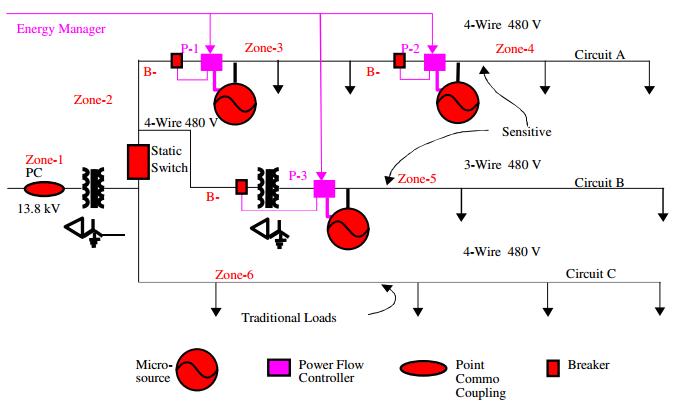
The CERTS Microgrid program has developed control methods to allow the installation of distributed generators (DGs) in commercial and industrial electric power systems in a “plug and play” manner. These control methods allow the generators to be electrically distributed, rather than be installed on the same electrical bus, and do not require intergenerator communications in order to maintain appropriate voltage and frequency at each generator. Note in figure that there is a communication link with the DGs that is labeled “Energy Manager”. This is a conventional energy manager that is used for power dispatch purposes, not for frequency or voltage control. This energy manager can use relatively slow communications links, such as telephone or internet, since it has no bearing on system stability.
Source:
John Stevens «CERTS Microgrid System Test». IEEExplore
Dr. Jorge Luis Mírez Tarrillo
Group of Mathematical Modeling and Numerical Simulation (GMMNS).
Universidad Nacional de Ingeniería. Lima, Perú.
E-mail: jmirez@uni.edu.pe
Website Personal: https://jorgemirez2002.wixsite.com/jorgemirez
Facebook http://www.facebook.com/jorgemirezperu
Linkedin https://www.linkedin.com/in/jorge-luis-mirez-tarrillo-94918423/
Scopus ID: https://www.scopus.com/authid/detail.uri?authorId=56488109800
Google Scholar: https://scholar.google.com/citations?user=_dSpp4YAAAAJ
MATLAB Group Admin in Facebook: https://www.facebook.com/groups/Matlab.Simulink.for.All
WhatsApp Channel/Canal: https://whatsapp.com/channel/0029VbCvpZsAYlUSz2esek2y

This simulation is about microgrid with solar and wind source, battery storage and utility network. It have cost differents and the simulation is para 96 time’s step. The distance between time’s step is configurable and it depend of characteristic of each source and all source in general. Made on Matlab of Math/Works Inc.
Dr. Jorge Luis Mírez Tarrillo
Group of Mathematical Modeling and Numerical Simulation (GMMNS).
Universidad Nacional de Ingeniería. Lima, Perú.
E-mail: jmirez@uni.edu.pe
Website Personal: https://jorgemirez2002.wixsite.com/jorgemirez
Facebook http://www.facebook.com/jorgemirezperu
Linkedin https://www.linkedin.com/in/jorge-luis-mirez-tarrillo-94918423/
Scopus ID: https://www.scopus.com/authid/detail.uri?authorId=56488109800
Google Scholar: https://scholar.google.com/citations?user=_dSpp4YAAAAJ
MATLAB Group Admin in Facebook: https://www.facebook.com/groups/Matlab.Simulink.for.All
WhatsApp Channel/Canal: https://whatsapp.com/channel/0029VbCvpZsAYlUSz2esek2y

Electricity meters are used to measure the quantity of electricity supplied to customers as well as to calculate energy and transportation charges for electricity retailers and network operators. The most common type of meter is an accumulation meter, which records energy consumption over time. Accumulation meters in consumer premises are read manually to assess how much energy has been used within a billing period. In recent years, industrial and commercial consumers with large loads have increasingly been using more advanced meters, for example, interval meters which record energy use over short intervals, typically every half hour. This allows the energy suppliers to design tariffs and charging structures that reflect wholesale prices and helps the customers understand and manage their pattern of electricity demand. Smart meters are even more sophisticated as they have two-way communications and provide a real-time display of energy use and pricing information, dynamic tariffs and facilitate the automatic control of electrical appliances
Source:
SMART GRID
TECHNOLOGY AND APPLICATIONS
Janaka Ekanayake
Cardiff University, UK
Kithsiri Liyanage
University of Peradeniya, Sri Lanka
Jianzhong Wu
Cardiff University, UK
Akihiko Yokoyama
University of Tokyo, Japan
Nick Jenkins
Cardiff University, UK
A John Wiley & Sons, Ltd., Publication
Dr. Jorge Luis Mírez Tarrillo
Group of Mathematical Modeling and Numerical Simulation (GMMNS).
Universidad Nacional de Ingeniería. Lima, Perú.
E-mail: jmirez@uni.edu.pe
Website Personal: https://jorgemirez2002.wixsite.com/jorgemirez
Facebook http://www.facebook.com/jorgemirezperu
Linkedin https://www.linkedin.com/in/jorge-luis-mirez-tarrillo-94918423/
Scopus ID: https://www.scopus.com/authid/detail.uri?authorId=56488109800
Google Scholar: https://scholar.google.com/citations?user=_dSpp4YAAAAJ
MATLAB Group Admin in Facebook: https://www.facebook.com/groups/Matlab.Simulink.for.All
WhatsApp Channel/Canal: https://whatsapp.com/channel/0029VbCvpZsAYlUSz2esek2y
Blog in ENGLISH

Compra/Buy – Haz una donación/Make a donation

Dear reader, if you wish to make a donation or are interested in any information or code, please contact me (e-mail: jmirez@uni.edu.pe). Donations will allow you to continue studying and researching, and also to provide more information on this blog. My PayPal account is jorgemirez2002@gmail.com or if it is by bank transfer write to my email jmirez@uni.edu.pe. Any amount of money is welcome. Thank you.
Estimado lector, si desean hacer una donación o le interesa alguna información o código, favor ponerse en contacto con mi persona (e-mail: jmirez@uni.edu.pe). Las donaciones va a permitir seguir estudiando e investigando, y además, el poder brindar más información en este blog. Mi cuenta en PayPal es jorgemirez2002@gmail.com o si es por transferencia bancaria escribirme a mi correo jmirez@uni.edu.pe. Cualquier cantidad de dinero es bienvenido. Gracias.
Datos Generales
Good day. My full name is Jorge Luis MIREZ TARRILLO.
I am Peruvian and live in Lima, capital of Perú in South America.I am Mechanical Electrical Engineering, MSc Physics and Dr. Physics (title doctoral thesis: Control, Optimization, and Management of Microgrid Current Direct)
Too, actually job as Principal Professor in Faculty of Oil, Gas and Petrochemical Engineering of Universidad Nacional de Ingeniería (National University of Engineering) in Lima – PERU (Courses: Modern Physics, Differential Equations and Research's Methodology)
My subjects of my interest are control, signal processing, optimization, simulation, biomedical research, smart grid, microgrid, water.
I have experience in Matlab/Simulink programming, biomedical equipment, electrical systems, renewable energies, microgrids, saturated steam systems 100 psi and organizing academic events.

Comentarios Recientes
Elementos que compon… en J506: Los elementos de un paqu… Dr. Jorge Mírez en Message by IEEE Community Dr. Jorge Mírez en J546: Simulación de campos mag… jose luis huayanay v… en Message by IEEE Community Cesar Aviles en J546: Simulación de campos mag… Dr. Jorge Mírez en J518: La herramienta pdetool d… Dr. Jorge Mírez en J496: Simulación en Matlab/Sim… Raúl Barrios Elizarr… en J496: Simulación en Matlab/Sim… jose luis huayanay v… en J518: La herramienta pdetool d… MSc. Jorge Mírez en J281: La Rosa de Vientos: Frec…


Debe estar conectado para enviar un comentario.