Archive for the ‘Quality Energy’ Category

Sometimes, the reactive power in a electric system exceed the nominal capacity of condensers bank, therefore, all units capacitores is connected to give the maximum reactive power compensation possible. The figure is one of my simulations on Matlab and complement past post. Matlab is from MathWork Inc. The figure is the results of mathematical model of condensers bank operation (control and optimization).
Dr. Jorge Luis Mírez Tarrillo
Group of Mathematical Modeling and Numerical Simulation (GMMNS).
Universidad Nacional de Ingeniería. Lima, Perú.
E-mail: jmirez@uni.edu.pe
Website Personal: https://jorgemirez2002.wixsite.com/jorgemirez
Facebook http://www.facebook.com/jorgemirezperu
Linkedin https://www.linkedin.com/in/jorge-luis-mirez-tarrillo-94918423/
Scopus ID: https://www.scopus.com/authid/detail.uri?authorId=56488109800
Google Scholar: https://scholar.google.com/citations?user=_dSpp4YAAAAJ
MATLAB Group Admin in Facebook: https://www.facebook.com/groups/Matlab.Simulink.for.All
WhatsApp Channel/Canal: https://whatsapp.com/channel/0029VbCvpZsAYlUSz2esek2y

A microgrid operate in state stable in this simulation made on Matlab. Each state represent a determinate time (10 minutes, 15 minutes o more o less). But during this time, la Microgrid makes calculations of energy cost dispatched for each source. The imagen is the global cost of microgrid (or similar or other electric system considering all costs). The microgrid optimizer decides in base a linear programming the connection and disconnection of each source.
Dr. Jorge Luis Mírez Tarrillo
Group of Mathematical Modeling and Numerical Simulation (GMMNS).
Universidad Nacional de Ingeniería. Lima, Perú.
E-mail: jmirez@uni.edu.pe
Website Personal: https://jorgemirez2002.wixsite.com/jorgemirez
Facebook http://www.facebook.com/jorgemirezperu
Linkedin https://www.linkedin.com/in/jorge-luis-mirez-tarrillo-94918423/
Scopus ID: https://www.scopus.com/authid/detail.uri?authorId=56488109800
Google Scholar: https://scholar.google.com/citations?user=_dSpp4YAAAAJ
MATLAB Group Admin in Facebook: https://www.facebook.com/groups/Matlab.Simulink.for.All
WhatsApp Channel/Canal: https://whatsapp.com/channel/0029VbCvpZsAYlUSz2esek2y

One of the most promising applications of renewable energy technology is the installation of hybrid
energy systems (HES) in remote areas, where the grid extension is costly and the cost of fuel increases drastically with the remoteness of the location. Recent research have shown that HES have an excellent potential, as a form of supplementary contribution to conventional power generation systems. In figure, one of the most common hybrid renewable system implemented and studied is described.
Source:
Francisco Goncalves Goina Mesquita. «Design Optimization of Stand-Alone Hybrid Energy Systems». A Dissertation submitted under the scope of Mestrado Integrado em Engenharia Electrotécnica e de Computadores Major Energia. Fevereiro de 2010. Facultade de Engenharia da Universidade do Porto.
Dr. Jorge Luis Mírez Tarrillo
Group of Mathematical Modeling and Numerical Simulation (GMMNS).
Universidad Nacional de Ingeniería. Lima, Perú.
E-mail: jmirez@uni.edu.pe
Website Personal: https://jorgemirez2002.wixsite.com/jorgemirez
Facebook http://www.facebook.com/jorgemirezperu
Linkedin https://www.linkedin.com/in/jorge-luis-mirez-tarrillo-94918423/
Scopus ID: https://www.scopus.com/authid/detail.uri?authorId=56488109800
Google Scholar: https://scholar.google.com/citations?user=_dSpp4YAAAAJ
MATLAB Group Admin in Facebook: https://www.facebook.com/groups/Matlab.Simulink.for.All
WhatsApp Channel/Canal: https://whatsapp.com/channel/0029VbCvpZsAYlUSz2esek2y

Inthe recent past, dramatic improvements in productivity have been realized in the high technology sector as well as in the traditional industries. For the electric power supply to these industries, this hasled to a concomitant increase in the number of loads that are sensitive to power quality. Some of the industries that have such large sensitive loads include semiconductor manufacturing, textile mills, paper millsand plastic injection molding.Of course, a number of smaller but equally critical loads such as computers and electronic data processing equipment are also sensitive to power quality.Thetolerance
levels of computer equipment are specified by the Information Technology Industry/Computer and Business Equipment Manufacturers’ Association (ITI/CBEMA) curves. Figure illustrates theCBEMA curves. This figure gives thepercent of nominal voltage versus duration in (60-Hz) cycles. The CBEMA curves represent the boundary of the ac input voltage envelope that can be tolerated (typically) by most
computer-based equipment. The upper curve represents the maximum voltage below which the equipment will continue to function normally. The lower curve is the minimum voltage above which the equipment will continue to function normally.
As seen in Figure, the steady state range of tolerance for computer equipmentis ±10% from the nominal voltage, i.e., the equipment continues to operate normally when sourced by any voltages in this range for an indefinite period of time. Similarly, voltages wells to a magnitude of 120% of the nominal value can be tolerated for about 0.5 s or 30 cycles; voltage sags to 80% of nominal for 10 s, or 600 cycles, can be tolerated. When the supply voltage is outside the boundaries of the susceptibility curves, improvement of the quality of power supplied to sensitive loads is essential to avoid a possible failure in their operation.
Source:
G. Venkataramanan, M.S. Illindala, C. Houle, and R.H. Lasseter. «Hardware Development of a Laboratory-Scale Microgrid Phase 1—Single Inverter in Island Mode Operation». NREL. November 2002 • NREL/SR-560-32527
Dr. Jorge Luis Mírez Tarrillo
Group of Mathematical Modeling and Numerical Simulation (GMMNS).
Universidad Nacional de Ingeniería. Lima, Perú.
E-mail: jmirez@uni.edu.pe
Website Personal: https://jorgemirez2002.wixsite.com/jorgemirez
Facebook http://www.facebook.com/jorgemirezperu
Linkedin https://www.linkedin.com/in/jorge-luis-mirez-tarrillo-94918423/
Scopus ID: https://www.scopus.com/authid/detail.uri?authorId=56488109800
Google Scholar: https://scholar.google.com/citations?user=_dSpp4YAAAAJ
MATLAB Group Admin in Facebook: https://www.facebook.com/groups/Matlab.Simulink.for.All
WhatsApp Channel/Canal: https://whatsapp.com/channel/0029VbCvpZsAYlUSz2esek2y

One question that most system operators are concerned with is the optimised DG penetration level. Relationship regarding different cost models between optimum DG penetration level and interruption frequency is indicated in Figure.
Optimum micro-source penetration level is positive related with the interruption frequency without DG penetration; especially for average interruption costs, the relationship is almost linear. This relationship is important for systemplanning; as the system interruption frequency without DG penetration is generally known, the system operator is able to roughly determine of the optimum DG penetration level from reliability point of view
Dr. Jorge Luis Mírez Tarrillo
Group of Mathematical Modeling and Numerical Simulation (GMMNS).
Universidad Nacional de Ingeniería. Lima, Perú.
E-mail: jmirez@uni.edu.pe
Website Personal: https://jorgemirez2002.wixsite.com/jorgemirez
Facebook http://www.facebook.com/jorgemirezperu
Linkedin https://www.linkedin.com/in/jorge-luis-mirez-tarrillo-94918423/
Scopus ID: https://www.scopus.com/authid/detail.uri?authorId=56488109800
Google Scholar: https://scholar.google.com/citations?user=_dSpp4YAAAAJ
MATLAB Group Admin in Facebook: https://www.facebook.com/groups/Matlab.Simulink.for.All
WhatsApp Channel/Canal: https://whatsapp.com/channel/0029VbCvpZsAYlUSz2esek2y

A reduction of system unavailability Q, as one example for system reliability indices, by the installation of micro-sources that enable (partial) island operation is demonstrated in Figure for selected European countries, compared to the case without DG.
The countries which have worse system reliability achieve higher improvements than the countries with high system reliabilities also in case without DG. For instance, in Portugal rural network the system unavailability decreases from more than 10 h/a to the value of below 1 h/a with maximum and average cost model; even with average cost model yearly unavailability is also reduced to approximate 4h/a. However, the improvement for German urban network and Holland network, which have already good system reliability without micro-sources, is not obvious, although system reliability is also improved to a certain extent in both networks. With higher interruption cost model, system reliability can be better improved. Higher interruption costs justify higher micro-source investment, thus achieving higher system reliability improvements. Microgrid operation from reliability point of view is thus most beneficial in countries with lower power quality or in regions or for customer segments with comparably high outage costs.
Source:
Christine Schwaegerl. “DG3&DG4 Report on the technical, social, economic, and environmental benefits provided by Microgrids on power system operation”. Siemens AG. 2009
Dr. Jorge Luis Mírez Tarrillo
Group of Mathematical Modeling and Numerical Simulation (GMMNS).
Universidad Nacional de Ingeniería. Lima, Perú.
E-mail: jmirez@uni.edu.pe
Website Personal: https://jorgemirez2002.wixsite.com/jorgemirez
Facebook http://www.facebook.com/jorgemirezperu
Linkedin https://www.linkedin.com/in/jorge-luis-mirez-tarrillo-94918423/
Scopus ID: https://www.scopus.com/authid/detail.uri?authorId=56488109800
Google Scholar: https://scholar.google.com/citations?user=_dSpp4YAAAAJ
MATLAB Group Admin in Facebook: https://www.facebook.com/groups/Matlab.Simulink.for.All
WhatsApp Channel/Canal: https://whatsapp.com/channel/0029VbCvpZsAYlUSz2esek2y
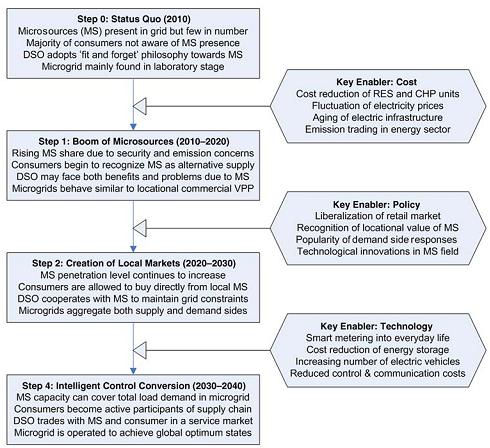
Currently, an increasing number of microgrid pilot sites can be observed in many parts of the world. It is true, however, that up to now,cost, policy and technology barriers have largely restrained the wide deployment of microgrids in distribution networks owing to their limited commercial appeal or social recognition. However, these three barriers are currently undergoing considerable changes – they are very likely to turn into key enablers in the future, eventually leading to a widespread microgrid adoption worldwide.
Firstly, the cost factor might prove to be the most effective driving force for microgrids in the very near future. This might happen not only because of the reduction of microsource costs, but also because of the relative changes of external opportunity costs due to economic (fluctuating market prices), technical (aging of network infrastructure) and environmental (emission trading) factors.
When microsource penetration at a LV grid becomes significant, participants in the electricity retail business will consider the aggregated power from small generators as a new market opportunity. Unlike in the case of VPP, microgrid stakeholders will eventually recognize a unique feature of aggregated microsource units, namely locality: the microsource units can potentially sell directly to end consumers in an “over-the-grid” manner. In order to turn this potential into reality, however, the second factor – appropriate policy and regulatory environment – is needed to enable the operation of a local market within a microgrid.
Finally, the adoption of favorable selling prices in local retail markets will attract even more microsource units, allowing the microgrid to operate islanded, if beneficial. With the help of smart metering, control and communication technologies, the microgrid operator will eventually be able to coordinate a large consortium of intermittent and controllable microsource units, as well as central and distributed storage devices, to achieve multiple objectives and, at the same time, to cater for the interests of different stakeholders.
Source:
MICROGRIDS: Architectures and Control
Nikos Hatziargynou
Dr. Jorge Luis Mírez Tarrillo
Group of Mathematical Modeling and Numerical Simulation (GMMNS).
Universidad Nacional de Ingeniería. Lima, Perú.
E-mail: jmirez@uni.edu.pe
Website Personal: https://jorgemirez2002.wixsite.com/jorgemirez
Facebook http://www.facebook.com/jorgemirezperu
Linkedin https://www.linkedin.com/in/jorge-luis-mirez-tarrillo-94918423/
Scopus ID: https://www.scopus.com/authid/detail.uri?authorId=56488109800
Google Scholar: https://scholar.google.com/citations?user=_dSpp4YAAAAJ
MATLAB Group Admin in Facebook: https://www.facebook.com/groups/Matlab.Simulink.for.All
WhatsApp Channel/Canal: https://whatsapp.com/channel/0029VbCvpZsAYlUSz2esek2y

The communication infrastructure of a power system typically consists of SCADA systems with dedicated communication channels to and from the System Control Centre and a Wide Area Network (WAN). Some long-established power utilities may have private telephone networks and other legacy communication systems. The SCADA systems connect all the major power system operational facilities, that is, the central generating stations, the transmission grid substations and the primary distribution substations to the System Control Centre. The WAN is used for corporate business and market operations. These form the core communication networks of the traditional power system. However, in the Smart Grid,it is expected that these two elements of communication infrastructure will merge into a Utility WAN.
An essential development of the Smart Grid (see figure ) is to extend communication throughout the distribution system and to establish two-way communications with customers through Neighbourhood Area Networks (NANs) covering the areas served by distribution substations. Customers’ premises will have Home Area Networks (HANs). The interface of the Home and Neighbourhood Area Networks will be through a smart meter or smart interfacing device.
Source:
SMART GRID
TECHNOLOGY AND APPLICATIONS
Janaka Ekanayake
Cardiff University, UK
Kithsiri Liyanage
University of Peradeniya, Sri Lanka
Jianzhong Wu
Cardiff University, UK
Akihiko Yokoyama
University of Tokyo, Japan
Nick Jenkins
Cardiff University, UK
A John Wiley & Sons, Ltd., Publication
Dr. Jorge Luis Mírez Tarrillo
Group of Mathematical Modeling and Numerical Simulation (GMMNS).
Universidad Nacional de Ingeniería. Lima, Perú.
E-mail: jmirez@uni.edu.pe
Website Personal: https://jorgemirez2002.wixsite.com/jorgemirez
Facebook http://www.facebook.com/jorgemirezperu
Linkedin https://www.linkedin.com/in/jorge-luis-mirez-tarrillo-94918423/
Scopus ID: https://www.scopus.com/authid/detail.uri?authorId=56488109800
Google Scholar: https://scholar.google.com/citations?user=_dSpp4YAAAAJ
MATLAB Group Admin in Facebook: https://www.facebook.com/groups/Matlab.Simulink.for.All
WhatsApp Channel/Canal: https://whatsapp.com/channel/0029VbCvpZsAYlUSz2esek2y

The figure shows the DMSC controller building blocks that assess operating conditions and find the control settings for devices connected to the network. The key functions of the DMSC are state estimation, bad data detection and the calculation of optimal control settings. The DMSC receives a limited number of real-time measurements at set intervals from the network nodes. The measurements are normally voltage, load injections and power flow measurements from the primary substation and other secondary substations. These measurements are used to calculate the network operating conditions. In addition to these real-time measurements, the DMSC uses load models to forecast load injections at each node on the network for a given period that coincides with the real-time measurements. The network topology and impedances are also supplied to the DMSC.
The state estimator uses this data to assess the network conditions in terms of node voltage magnitudes, line power flows and network injections. Bad measurements coming to the system will be filtered using bad data detection and identification methods.
Source:
SMART GRID
TECHNOLOGY AND APPLICATIONS
Janaka Ekanayake
Cardiff University, UK
Kithsiri Liyanage
University of Peradeniya, Sri Lanka
Jianzhong Wu
Cardiff University, UK
Akihiko Yokoyama
University of Tokyo, Japan
Nick Jenkins
Cardiff University, UK
A John Wiley & Sons, Ltd., Publication
Dr. Jorge Luis Mírez Tarrillo
Group of Mathematical Modeling and Numerical Simulation (GMMNS).
Universidad Nacional de Ingeniería. Lima, Perú.
E-mail: jmirez@uni.edu.pe
Website Personal: https://jorgemirez2002.wixsite.com/jorgemirez
Facebook http://www.facebook.com/jorgemirezperu
Linkedin https://www.linkedin.com/in/jorge-luis-mirez-tarrillo-94918423/
Scopus ID: https://www.scopus.com/authid/detail.uri?authorId=56488109800
Google Scholar: https://scholar.google.com/citations?user=_dSpp4YAAAAJ
MATLAB Group Admin in Facebook: https://www.facebook.com/groups/Matlab.Simulink.for.All
WhatsApp Channel/Canal: https://whatsapp.com/channel/0029VbCvpZsAYlUSz2esek2y

The present post describe the charge and discharge process of a battery bank of a microgrid. This microgrid have a aleatory voltage with inferior and superior limit. The current and electric power of charge and discharge is in picture. This simulation has writing and processing on Matlab/Simulink of MathaWorth Inc. Actually my interest is the control, optimization and management of microgrid DC. Greetings from Perú.
The information related to this post for sale for US $ 1000.00. You can make payments through PayPal account: jorgemirez2002@gmail.com or send an e-mail to receive PayPal invoice and make your payment quickly and easily. Tell us (through e-mail) the name of the input or inputs that interests you. // La información relacionada con este post en venta por US $ 1000.00. Usted puede hacer pagos a través de cuenta PayPal: jorgemirez2002@gmail.com o enviar un e-mail para recibir la factura de PayPal y hacer su pago de forma rápida y sencilla. Díganos (por medio de email) el nombre de la entrada o entradas que le interese.
Dr. Jorge Luis Mírez Tarrillo
Group of Mathematical Modeling and Numerical Simulation (GMMNS).
Universidad Nacional de Ingeniería. Lima, Perú.
E-mail: jmirez@uni.edu.pe
Website Personal: https://jorgemirez2002.wixsite.com/jorgemirez
Facebook http://www.facebook.com/jorgemirezperu
Linkedin https://www.linkedin.com/in/jorge-luis-mirez-tarrillo-94918423/
Scopus ID: https://www.scopus.com/authid/detail.uri?authorId=56488109800
Google Scholar: https://scholar.google.com/citations?user=_dSpp4YAAAAJ
MATLAB Group Admin in Facebook: https://www.facebook.com/groups/Matlab.Simulink.for.All
WhatsApp Channel/Canal: https://whatsapp.com/channel/0029VbCvpZsAYlUSz2esek2y

La figura muestra el concepto de un sistema híbrido ac/dc donde varias fuentes y cargas ac y dc son conectadas a sus correspondientes redes ac y dc. Las redes ac y dc están conectadas a través de dos transformadores y conversores trifásicos ac/dc bidireccionales. Pueden observar la diversidad de micro fuentes que se está utilizando en la descripción de la microred, incluye los diferentes dispositivos de electrónica de potencia que sirven para adecuar la energía eléctrica desde fuentes y para cargas eléctricas. Hay vehículos eléctricos conectados a la microred. Los generadores eólicos tienen diferentes configuración de control (diferentes tipos de turbinas eólicas). Un grupo electrógeno diesel también se da, dado que estos grupos se consideran los que en último caso darán energía a la microred eléctrica en situaciones ya críticas pero a la vez rentables en lo posible en economía. Para todo esto se crea modelos matemáticos de cada elemento y luego se integran en un solo programa en que se puedan cambiar las condiciones de trabajo y analizar las variables de respuesta de lo que se desea estudiar. Yo lo hago en Matlab/Simulink para quienes deseen que les brinde el servicio de asesoramiento.
The information related to this post for sale for US $ 10.00. You can make payments through PayPal account: jorgemirez2002@gmail.com or send an e-mail to receive PayPal invoice and make your payment quickly and easily. Tell us (through e-mail) the name of the input or inputs that interests you. // La información relacionada con este post en venta por US $ 10.00. Usted puede hacer pagos a través de cuenta PayPal: jorgemirez2002@gmail.com o enviar un e-mail para recibir la factura de PayPal y hacer su pago de forma rápida y sencilla. Díganos (por medio de email) el nombre de la entrada o entradas que le interese.
Dr. Jorge Luis Mírez Tarrillo
Group of Mathematical Modeling and Numerical Simulation (GMMNS).
Universidad Nacional de Ingeniería. Lima, Perú.
E-mail: jmirez@uni.edu.pe
Website Personal: https://jorgemirez2002.wixsite.com/jorgemirez
Facebook http://www.facebook.com/jorgemirezperu
Linkedin https://www.linkedin.com/in/jorge-luis-mirez-tarrillo-94918423/
Scopus ID: https://www.scopus.com/authid/detail.uri?authorId=56488109800
Google Scholar: https://scholar.google.com/citations?user=_dSpp4YAAAAJ
MATLAB Group Admin in Facebook: https://www.facebook.com/groups/Matlab.Simulink.for.All
WhatsApp Channel/Canal: https://whatsapp.com/channel/0029VbCvpZsAYlUSz2esek2y

La distorción armónica total de la corriente de salida en el rango de operación de un generador debe ser menor que 5 % de la corriente fundamental. La tabla muestra el valor de los armónicos que no deben exceder esos límites, expresados en relación a la corriente fundamental. Se habla de armónicos pares e impares, interesan todos dado que dependiendo del armónicos los efectos son diferentes, algunos de ellos se les puede reconocer con los cinco sentidos, otros requieren equipos como Analizadores de Redes Eléctricas. Que hacer en lugares con alta distorción armónica?. Una de las formas más fáciles es colocar un transformador de impedancia y un transformador de aislamiento (corregirme si me equivoco). Sin embargo, estas cosas para instalaciones medianas y grandes resultan bastante caras y espaciosas, considerando también las pérdidas asociadas a su funcionamiento. Por lo tanto, como cliente es pararse bien frente a las empresas de electricidad y como autoproductor de electricidad es comprar un buen generador que cumpla las exigencias de calidad de energía eléctrica, de esta manera proteges tu inversión y obtienes una fiabilidad alta y rentabilidad bastante ya que el beneficio es para toda la instalación (máquinas y sistemas de iluminación que en condiciones adecuadas brinda clima laboral adecuado sin flickers y/o baja iluminación).
The information related to this post for sale for US $ 1000.00. You can make payments through PayPal account: jorgemirez2002@gmail.com or send an e-mail to receive PayPal invoice and make your payment quickly and easily. Tell us (through e-mail) the name of the input or inputs that interests you. // La información relacionada con este post en venta por US $ 1000.00. Usted puede hacer pagos a través de cuenta PayPal: jorgemirez2002@gmail.com o enviar un e-mail para recibir la factura de PayPal y hacer su pago de forma rápida y sencilla. Díganos (por medio de email) el nombre de la entrada o entradas que le interese.
Dr. Jorge Luis Mírez Tarrillo
Group of Mathematical Modeling and Numerical Simulation (GMMNS).
Universidad Nacional de Ingeniería. Lima, Perú.
E-mail: jmirez@uni.edu.pe
Website Personal: https://jorgemirez2002.wixsite.com/jorgemirez
Facebook http://www.facebook.com/jorgemirezperu
Linkedin https://www.linkedin.com/in/jorge-luis-mirez-tarrillo-94918423/
Scopus ID: https://www.scopus.com/authid/detail.uri?authorId=56488109800
Google Scholar: https://scholar.google.com/citations?user=_dSpp4YAAAAJ
MATLAB Group Admin in Facebook: https://www.facebook.com/groups/Matlab.Simulink.for.All
WhatsApp Channel/Canal: https://whatsapp.com/channel/0029VbCvpZsAYlUSz2esek2y

En este post muestro la portada de tesis «Implementación de un Sistema de Generación Distribuida con Energías Renovables ENDE Corporación» elaborado por Mario Torrico para la Universidad Privada del Valle en Cochabamba – Bolivia para optar el título de Ingeniero Electromecánico. Trabajo que compartimos durante unos tres meses de intercambio de información, modelos matemáticos y simulaciones numéricas, además de diálogo, envío de información, debate y varios borradores de tesis que iban y venían en el correo electrónico. Su defensa fue un éxito alcanzando la nota de 90/100 para alegría de Mario, de su familia, profesores, colegas y amigos. Éxitos Mario en tu vida profesional, tengo un colega amigo más :)D . En lo personal el tema fue muy interesante e implicó ingresar en una temática no desarrollada e innovadora… la portada de la tesis esta bonita también. Saludos a la plurinación boliviana… A quienes desean desarrollar conmigo sus tesis (Yo como Asesor Externo) a nivel de pregrado y postgrado, así como desarrollar sus proyectos de investigación tanto en universidades, institutos o empresas me escriben.
Dr. Jorge Luis Mírez Tarrillo
Group of Mathematical Modeling and Numerical Simulation (GMMNS).
Universidad Nacional de Ingeniería. Lima, Perú.
E-mail: jmirez@uni.edu.pe
Website Personal: https://jorgemirez2002.wixsite.com/jorgemirez
Facebook http://www.facebook.com/jorgemirezperu
Linkedin https://www.linkedin.com/in/jorge-luis-mirez-tarrillo-94918423/
Scopus ID: https://www.scopus.com/authid/detail.uri?authorId=56488109800
Google Scholar: https://scholar.google.com/citations?user=_dSpp4YAAAAJ
MATLAB Group Admin in Facebook: https://www.facebook.com/groups/Matlab.Simulink.for.All
WhatsApp Channel/Canal: https://whatsapp.com/channel/0029VbCvpZsAYlUSz2esek2y

Quienes hemos visto como funciona un banco de condensadores, podemos ver y escuchar el conectar y desconectar de los condensadores los cuales se van conectando dependiendo de la necesidad de potencia reactiva a inyectar y de las acciones del sistema de control. En la figura se muestra un ejemplo de funcionamiento de condensador para unos 100 estados o ciclos de trabajo, medida que he usado en esta figura, dado que la necesidad de potencia reactiva no depende de la escala de tiempo, es por lo general aleatoria, entonces lo que puedo ir determinando es si esta en conectado ON o desconectado OFF. Un sistema de ceros y unos sirven para identificar cada estado. La simulación está hecha en Matlab de MathWork Inc y complementa lo que post atrás es la ponencia que realice en Costa Rica durante el III Congreso Iberoamericano de Microredes con Generación Distribuida de Renovables. Favor difundir éste blog y si les interesa mis servicios, me escriben :)D
The information related to this post for sale for US $ 100.00. You can make payments through PayPal account: jorgemirez2002@gmail.com or send an e-mail to receive PayPal invoice and make your payment quickly and easily. Tell us (through e-mail) the name of the input or inputs that interests you. // La información relacionada con este post en venta por US $ 100.00. Usted puede hacer pagos a través de cuenta PayPal: jorgemirez2002@gmail.com o enviar un e-mail para recibir la factura de PayPal y hacer su pago de forma rápida y sencilla. Díganos (por medio de email) el nombre de la entrada o entradas que le interese.
Dr. Jorge Luis Mírez Tarrillo
Group of Mathematical Modeling and Numerical Simulation (GMMNS).
Universidad Nacional de Ingeniería. Lima, Perú.
E-mail: jmirez@uni.edu.pe
Website Personal: https://jorgemirez2002.wixsite.com/jorgemirez
Facebook http://www.facebook.com/jorgemirezperu
Linkedin https://www.linkedin.com/in/jorge-luis-mirez-tarrillo-94918423/
Scopus ID: https://www.scopus.com/authid/detail.uri?authorId=56488109800
Google Scholar: https://scholar.google.com/citations?user=_dSpp4YAAAAJ
MATLAB Group Admin in Facebook: https://www.facebook.com/groups/Matlab.Simulink.for.All
WhatsApp Channel/Canal: https://whatsapp.com/channel/0029VbCvpZsAYlUSz2esek2y

La energía reactiva solicitada por los diferentes dispositivos como motores eléctricos o equipos de electrónica de potencia es para poder funcionar, sin embargo, ocupan espacio dentro de la capacidad de transmisión de los conductores eléctricos, es por ello que hay que reducir dicho flujo a lo necesario que es la potencia activa, sin embargo, no puede ser sólo energía activa, dado que se entrar en una resonancia, pero si bien se puede trabajar en un factor de potencia lo más cercano a 1, pero no tanto que el sistema de control no lo pueda coordinar bien. La figura muestra una simulación del trabajo de un banco de condensadores, se puede apreciar tanto la potencia reactiva solicitada por la red eléctrica como la que brinda el banco de condensadores, ambos lo bastante cercanos que las curvas se parecen suporponer. Hecho en Matlab de MathWorks Inc para todos los interesados en los sistemas eléctricos y en el manejo adecuado del factor de potencia.
The information related to this post for sale for US $ 100.00. You can make payments through PayPal account: jorgemirez2002@gmail.com or send an e-mail to receive PayPal invoice and make your payment quickly and easily. Tell us (through e-mail) the name of the input or inputs that interests you. // La información relacionada con este post en venta por US $ 100.00. Usted puede hacer pagos a través de cuenta PayPal: jorgemirez2002@gmail.com o enviar un e-mail para recibir la factura de PayPal y hacer su pago de forma rápida y sencilla. Díganos (por medio de email) el nombre de la entrada o entradas que le interese.
Dr. Jorge Luis Mírez Tarrillo
Group of Mathematical Modeling and Numerical Simulation (GMMNS).
Universidad Nacional de Ingeniería. Lima, Perú.
E-mail: jmirez@uni.edu.pe
Website Personal: https://jorgemirez2002.wixsite.com/jorgemirez
Facebook http://www.facebook.com/jorgemirezperu
Linkedin https://www.linkedin.com/in/jorge-luis-mirez-tarrillo-94918423/
Scopus ID: https://www.scopus.com/authid/detail.uri?authorId=56488109800
Google Scholar: https://scholar.google.com/citations?user=_dSpp4YAAAAJ
MATLAB Group Admin in Facebook: https://www.facebook.com/groups/Matlab.Simulink.for.All
WhatsApp Channel/Canal: https://whatsapp.com/channel/0029VbCvpZsAYlUSz2esek2y


The information related to this post for sale for US $ 100.00. You can make payments through PayPal account: jorgemirez2002@gmail.com or send an e-mail to receive PayPal invoice and make your payment quickly and easily. Tell us (through e-mail) the name of the input or inputs that interests you. // La información relacionada con este post en venta por US $ 100.00. Usted puede hacer pagos a través de cuenta PayPal: jorgemirez2002@gmail.com o enviar un e-mail para recibir la factura de PayPal y hacer su pago de forma rápida y sencilla. Díganos (por medio de email) el nombre de la entrada o entradas que le interese.
Dr. Jorge Luis Mírez Tarrillo
Group of Mathematical Modeling and Numerical Simulation (GMMNS).
Universidad Nacional de Ingeniería. Lima, Perú.
E-mail: jmirez@uni.edu.pe
Website Personal: https://jorgemirez2002.wixsite.com/jorgemirez
Facebook http://www.facebook.com/jorgemirezperu
Linkedin https://www.linkedin.com/in/jorge-luis-mirez-tarrillo-94918423/
Scopus ID: https://www.scopus.com/authid/detail.uri?authorId=56488109800
Google Scholar: https://scholar.google.com/citations?user=_dSpp4YAAAAJ
MATLAB Group Admin in Facebook: https://www.facebook.com/groups/Matlab.Simulink.for.All
WhatsApp Channel/Canal: https://whatsapp.com/channel/0029VbCvpZsAYlUSz2esek2y


Atiendo a esta reunión bastante importante es que gracias al apoyo de CYTED y CEDER-CIEMAT es que daremos esta conferencia en el marco del IIi Congreso Iberoamericano de Microredes con Generación Distribuida de Renovables. Este evento sirve de marco para el intercambio de información, experiencias y el tomar en contacto con investigadores provenientes de diferentes países de habla hispana y no hispana, dedicados al sector energía y otros sectores incluyendo el aeroespacial en que el uso de fuentes de energía como sol, viento, biomasa, celdas de combustible, entre otras es bastante importante. Y no sólo eso, importante y quizás mucho más lo que es las técnicas de control, predicción, modelamiento y simulación, software desarrollado que son las cosas de mayor valor agregado, la combinación de diferentes escenarios de trabajo y de implementación en industrias, centros de atención de salud, barcos, naves espaciales, soporte de vida en condiciones extremas, etc. Les dejo la portada de mi presentación y cualquier comunicación a jorgemirez2002@gmail.com, y quienes estén por acá, estaremos conversando.
The information related to this post for sale for US $ 100.00. You can make payments through PayPal account: jorgemirez2002@gmail.com or send an e-mail to receive PayPal invoice and make your payment quickly and easily. Tell us (through e-mail) the name of the input or inputs that interests you. // La información relacionada con este post en venta por US $ 100.00. Usted puede hacer pagos a través de cuenta PayPal: jorgemirez2002@gmail.com o enviar un e-mail para recibir la factura de PayPal y hacer su pago de forma rápida y sencilla. Díganos (por medio de email) el nombre de la entrada o entradas que le interese.
Dr. Jorge Luis Mírez Tarrillo
Group of Mathematical Modeling and Numerical Simulation (GMMNS).
Universidad Nacional de Ingeniería. Lima, Perú.
E-mail: jmirez@uni.edu.pe
Website Personal: https://jorgemirez2002.wixsite.com/jorgemirez
Facebook http://www.facebook.com/jorgemirezperu
Linkedin https://www.linkedin.com/in/jorge-luis-mirez-tarrillo-94918423/
Scopus ID: https://www.scopus.com/authid/detail.uri?authorId=56488109800
Google Scholar: https://scholar.google.com/citations?user=_dSpp4YAAAAJ
MATLAB Group Admin in Facebook: https://www.facebook.com/groups/Matlab.Simulink.for.All
WhatsApp Channel/Canal: https://whatsapp.com/channel/0029VbCvpZsAYlUSz2esek2y
Estimados lectores, éstas son las diapositivas de la ponencia que daré el día jueves 19 de noviembre del 2015 en la Universidad Nacional San Agustín de Arequipa como parte de las actividades del XXII Simposio Peruano de Energía Solar que se está realizando desde del 17 al 21 de Noviembre en Arequipa – Perú. Quedan todos invitados, igualmente bienvenidas sus preguntas, opiniones, sugerencias y el hacer cooperación académica o conversar sobre asuntos laborales. Arequipa está cerca de Bolivia y Chile.


The information related to this post for sale for US $ 100.00. You can make payments through PayPal account: jorgemirez2002@gmail.com or send an e-mail to receive PayPal invoice and make your payment quickly and easily. Tell us (through e-mail) the name of the input or inputs that interests you. // La información relacionada con este post en venta por US $ 100.00. Usted puede hacer pagos a través de cuenta PayPal: jorgemirez2002@gmail.com o enviar un e-mail para recibir la factura de PayPal y hacer su pago de forma rápida y sencilla. Díganos (por medio de email) el nombre de la entrada o entradas que le interese.
Dr. Jorge Luis Mírez Tarrillo
Group of Mathematical Modeling and Numerical Simulation (GMMNS).
Universidad Nacional de Ingeniería. Lima, Perú.
E-mail: jmirez@uni.edu.pe
Website Personal: https://jorgemirez2002.wixsite.com/jorgemirez
Facebook http://www.facebook.com/jorgemirezperu
Linkedin https://www.linkedin.com/in/jorge-luis-mirez-tarrillo-94918423/
Scopus ID: https://www.scopus.com/authid/detail.uri?authorId=56488109800
Google Scholar: https://scholar.google.com/citations?user=_dSpp4YAAAAJ
MATLAB Group Admin in Facebook: https://www.facebook.com/groups/Matlab.Simulink.for.All
WhatsApp Channel/Canal: https://whatsapp.com/channel/0029VbCvpZsAYlUSz2esek2y

Buen día a todos los lectores de este blog y de mi Blog de Equipos y Máquinas en Establecimientos de Salud.
La presente es para comunicarles que he retomado la actividad de inspeccionar, revisar, diagnosticar los equipos, máquinas y demás componentes que hay en un sistema eléctrico, y además, lo que se tenga que ver con mantenimiento preventivo y correctivo. El mensaje es para toda la comunidad hispana hablante y también para quienes leen este blog a través del traductor. Estas actividades las hago yo mismo, en las que pongo mis conocimientos y experiencia.
Tableros eléctricos, equipos biomédicos, interruptores, banco de condensadores, circuitos de fuerza e iluminación, motores eléctricos, demás aparataje en baja tensión, cálculo y diseño de sistemas eléctricos de baja tensión para uso industrial y/o de hospitales.
La imagen es nuestro primer instrumento que estamos adquiriendo y a medida que las oportunidades laborales la iremos complementando según el mercado y complejidad de los estudios que se desea realizar. En cada equipo se le crea una ficha en que se detalla las características generales del equipo y el diagnóstico del mismo detallando la secuencia de acciones de medición, criterios de medición, valores de las mediciones y lo que fuera necesario para un buen diagnóstico; de manera semejante en los mantenimientos preventivos.
Un multímetro analógico tiene muchas ventajas, dado que es un mecanismo electrodinámico, tiene un factor de amortiguamiento y por lo tanto, me permite apreciar los cambios que existen en las variables medidas, estas variaciones por lo tanto, me hacen inferir como es el comportamiento de las variables del sistema eléctrico u otra variable que siempre buscan un set point – valor preestablecido.
Los interesados escribir a jorgemirez2002@gmail.com
Atte
Jorge Mïrez
Perú
Dr. Jorge Luis Mírez Tarrillo
Group of Mathematical Modeling and Numerical Simulation (GMMNS).
Universidad Nacional de Ingeniería. Lima, Perú.
E-mail: jmirez@uni.edu.pe
Website Personal: https://jorgemirez2002.wixsite.com/jorgemirez
Facebook http://www.facebook.com/jorgemirezperu
Linkedin https://www.linkedin.com/in/jorge-luis-mirez-tarrillo-94918423/
Scopus ID: https://www.scopus.com/authid/detail.uri?authorId=56488109800
Google Scholar: https://scholar.google.com/citations?user=_dSpp4YAAAAJ
MATLAB Group Admin in Facebook: https://www.facebook.com/groups/Matlab.Simulink.for.All
WhatsApp Channel/Canal: https://whatsapp.com/channel/0029VbCvpZsAYlUSz2esek2y

Las microredes son sistemas eléctricos con capacidades de hasta 10 MVA, lo cual para América Latina es una potencia apreciable, sin embargo, en los estándares mundiales 10 MVA es un pizca energética y para lo cual hay que estar ya desde la formación universitaria acostumbrados a realizar todos los cálculos posibles bajo lo que acarrea en equipamiento ese nivel de potencia. La figura muestra un esquema de configuración de microred de corriente continua – acá nada que ver con la absurda y nostálgica idea de la lucha entre AC y DC, esas cosas son arcaicas y quedaron en el pasado, dado que son las actuales necesidades energética y de distribución las que determinan las decisiones en el mercado eléctrico – podrán ver entre elementos entre baterías electroquímicas, super condensadores, celdas de combustible, cargas eléctricas y una conexión hacia la red eléctrica externa. Hay mucha electrónica de potencia?…. Pero sí y lo hay, y no es que se quiera decir que se necesitan muchos ingenieros electrónicos, se necesitan pero buenos, además, estos sistemas ya tienen cierta madurez y son de fabricación masiva y lo bueno es que tienen todas las herramientas para una operación inteligente, así que evitaremos que las empresas nos vengan con el cuentito de que necesitan mantenimiento cada cierto tiempo – cosa que suele suceder es falso y en algunos equipos bastante absurdo – dado el reporte con que suplen con información al controlador central de la microred. Microredes y sus componentes es lo que ahora investigo mediante modelamiento matemático y simulaciones numéricas con Matlab/Simulink…
The information related to this post for sale for US $ 20.00. You can make payments through PayPal account: jorgemirez2002@gmail.com or send an e-mail to receive PayPal invoice and make your payment quickly and easily. Tell us (through e-mail) the name of the input or inputs that interests you. // La información relacionada con este post en venta por US $ 20.00. Usted puede hacer pagos a través de cuenta PayPal: jorgemirez2002@gmail.com o enviar un e-mail para recibir la factura de PayPal y hacer su pago de forma rápida y sencilla. Díganos (por medio de email) el nombre de la entrada o entradas que le interese.
Dr. Jorge Luis Mírez Tarrillo
Group of Mathematical Modeling and Numerical Simulation (GMMNS).
Universidad Nacional de Ingeniería. Lima, Perú.
E-mail: jmirez@uni.edu.pe
Website Personal: https://jorgemirez2002.wixsite.com/jorgemirez
Facebook http://www.facebook.com/jorgemirezperu
Linkedin https://www.linkedin.com/in/jorge-luis-mirez-tarrillo-94918423/
Scopus ID: https://www.scopus.com/authid/detail.uri?authorId=56488109800
Google Scholar: https://scholar.google.com/citations?user=_dSpp4YAAAAJ
MATLAB Group Admin in Facebook: https://www.facebook.com/groups/Matlab.Simulink.for.All
WhatsApp Channel/Canal: https://whatsapp.com/channel/0029VbCvpZsAYlUSz2esek2y
Blog in ENGLISH

Compra/Buy – Haz una donación/Make a donation

Dear reader, if you wish to make a donation or are interested in any information or code, please contact me (e-mail: jmirez@uni.edu.pe). Donations will allow you to continue studying and researching, and also to provide more information on this blog. My PayPal account is jorgemirez2002@gmail.com or if it is by bank transfer write to my email jmirez@uni.edu.pe. Any amount of money is welcome. Thank you.
Estimado lector, si desean hacer una donación o le interesa alguna información o código, favor ponerse en contacto con mi persona (e-mail: jmirez@uni.edu.pe). Las donaciones va a permitir seguir estudiando e investigando, y además, el poder brindar más información en este blog. Mi cuenta en PayPal es jorgemirez2002@gmail.com o si es por transferencia bancaria escribirme a mi correo jmirez@uni.edu.pe. Cualquier cantidad de dinero es bienvenido. Gracias.
Datos Generales
Good day. My full name is Jorge Luis MIREZ TARRILLO.
I am Peruvian and live in Lima, capital of Perú in South America.I am Mechanical Electrical Engineering, MSc Physics and Dr. Physics (title doctoral thesis: Control, Optimization, and Management of Microgrid Current Direct)
Too, actually job as Principal Professor in Faculty of Oil, Gas and Petrochemical Engineering of Universidad Nacional de Ingeniería (National University of Engineering) in Lima – PERU (Courses: Modern Physics, Differential Equations and Research's Methodology)
My subjects of my interest are control, signal processing, optimization, simulation, biomedical research, smart grid, microgrid, water.
I have experience in Matlab/Simulink programming, biomedical equipment, electrical systems, renewable energies, microgrids, saturated steam systems 100 psi and organizing academic events.

Comentarios Recientes
Elementos que compon… en J506: Los elementos de un paqu… Dr. Jorge Mírez en Message by IEEE Community Dr. Jorge Mírez en J546: Simulación de campos mag… jose luis huayanay v… en Message by IEEE Community Cesar Aviles en J546: Simulación de campos mag… Dr. Jorge Mírez en J518: La herramienta pdetool d… Dr. Jorge Mírez en J496: Simulación en Matlab/Sim… Raúl Barrios Elizarr… en J496: Simulación en Matlab/Sim… jose luis huayanay v… en J518: La herramienta pdetool d… MSc. Jorge Mírez en J281: La Rosa de Vientos: Frec…


Debe estar conectado para enviar un comentario.