Archive for the ‘Seguridad Energética’ Category

The figure shows the minimum requirements for a VPP: a number of small participants (consumers or DERs); a communications network (the internet or dedicated lines); a communication platform with a common information model and a consensus on the communication architecture; a primary energy supply network; and a link to the energy market. The primary energy supply is the foundation of the VPP, the communication system forms the glue holding the VPP together, and the market link is the incentive which drives the system to service the needs of its owners and customers.A VPP may be dispersed over a large area, though in the case of islands and other microgrids it may equally well have tight geographical limits.
Source:
Riso Energy Report 8. “The intelligent energy system infraestructure for the future”. Riso National Laboratory. Technical University of Denmark. September 2009. ISBN 978-87-550-3754-0
Dr. Jorge Luis Mírez Tarrillo
Group of Mathematical Modeling and Numerical Simulation (GMMNS).
Universidad Nacional de Ingeniería. Lima, Perú.
E-mail: jmirez@uni.edu.pe
Website Personal: https://jorgemirez2002.wixsite.com/jorgemirez
Facebook http://www.facebook.com/jorgemirezperu
Linkedin https://www.linkedin.com/in/jorge-luis-mirez-tarrillo-94918423/
Scopus ID: https://www.scopus.com/authid/detail.uri?authorId=56488109800
Google Scholar: https://scholar.google.com/citations?user=_dSpp4YAAAAJ
MATLAB Group Admin in Facebook: https://www.facebook.com/groups/Matlab.Simulink.for.All
WhatsApp Channel/Canal: https://whatsapp.com/channel/0029VbCvpZsAYlUSz2esek2y

In Europe this growth is driven by both national and EU policies. By 2008 the EU member states had adopted longterm targets in three different areas of energy policy:
• a binding reduction in greenhouse gas emissions of 20% by 2020 compared to 1990; this target can be raised to 30% subject to the conclusion of binding international climate change agreements;
• a mandatory target for renewable energy sources such as wind, solar and biomass, which by 2020 must supply 20% of the EU’s final energy demand; and
• a voluntary agreement to cut EU energy consumption by 20% by 2020, compared to a reference projection.
The EU has also set a target of 10% renewable energy, including biofuels, in transport by 2020.
This new policy, with its increasing reliance on renewable sources, will change European energy systems radically within the next decade. Energy technologies based on variable sources, especially wind power but to a lesser extent also wave power and PV, are expected to play a large role in the future energy supply. For example, by 2020 wind power is expected to supply 50% of the Danish electricity consumption – implying that from time to time significantly more wind power will be available than Denmark can consume1. This challenge will require not only significant changes in energy system structure, but also the development of intelligence within the system
Source:
Riso Energy Report 8. “The intelligent energy system infraestructure for the future”. Riso National Laboratory. Technical University of Denmark. September 2009. ISBN 978-87-550-3754-0
Dr. Jorge Luis Mírez Tarrillo
Group of Mathematical Modeling and Numerical Simulation (GMMNS).
Universidad Nacional de Ingeniería. Lima, Perú.
E-mail: jmirez@uni.edu.pe
Website Personal: https://jorgemirez2002.wixsite.com/jorgemirez
Facebook http://www.facebook.com/jorgemirezperu
Linkedin https://www.linkedin.com/in/jorge-luis-mirez-tarrillo-94918423/
Scopus ID: https://www.scopus.com/authid/detail.uri?authorId=56488109800
Google Scholar: https://scholar.google.com/citations?user=_dSpp4YAAAAJ
MATLAB Group Admin in Facebook: https://www.facebook.com/groups/Matlab.Simulink.for.All
WhatsApp Channel/Canal: https://whatsapp.com/channel/0029VbCvpZsAYlUSz2esek2y

Denmark is the only net exporter of energy in the EU. In 2005, production from Danish oil and gas fields in the North sea exceeded the country’s gross energy consumption by 56%. At the same time Denmark has an environmentally-friendly energy profile that includes considerable amounts of renewable energy, especially wind power; strong energy efficiency measures; and widespread use of combined heat and power (CHP). For more than 20 years Denmark has kept its gross energy consumption almost constant, with an increase of just 4% since 1985, despite a 70% increase in gross national product in the same period. In short, Denmark is in a far better energy situation than most countries in the EU
Source:
Riso Energy Report 6. «Future options for energy technologies». Riso National Laboratory. Technical University of Denmark. November 2007. ISBN 978-87-550-3611-6
Dr. Jorge Luis Mírez Tarrillo
Group of Mathematical Modeling and Numerical Simulation (GMMNS).
Universidad Nacional de Ingeniería. Lima, Perú.
E-mail: jmirez@uni.edu.pe
Website Personal: https://jorgemirez2002.wixsite.com/jorgemirez
Facebook http://www.facebook.com/jorgemirezperu
Linkedin https://www.linkedin.com/in/jorge-luis-mirez-tarrillo-94918423/
Scopus ID: https://www.scopus.com/authid/detail.uri?authorId=56488109800
Google Scholar: https://scholar.google.com/citations?user=_dSpp4YAAAAJ
MATLAB Group Admin in Facebook: https://www.facebook.com/groups/Matlab.Simulink.for.All
WhatsApp Channel/Canal: https://whatsapp.com/channel/0029VbCvpZsAYlUSz2esek2y

One question that most system operators are concerned with is the optimised DG penetration level. Relationship regarding different cost models between optimum DG penetration level and interruption frequency is indicated in Figure.
Optimum micro-source penetration level is positive related with the interruption frequency without DG penetration; especially for average interruption costs, the relationship is almost linear. This relationship is important for systemplanning; as the system interruption frequency without DG penetration is generally known, the system operator is able to roughly determine of the optimum DG penetration level from reliability point of view
Dr. Jorge Luis Mírez Tarrillo
Group of Mathematical Modeling and Numerical Simulation (GMMNS).
Universidad Nacional de Ingeniería. Lima, Perú.
E-mail: jmirez@uni.edu.pe
Website Personal: https://jorgemirez2002.wixsite.com/jorgemirez
Facebook http://www.facebook.com/jorgemirezperu
Linkedin https://www.linkedin.com/in/jorge-luis-mirez-tarrillo-94918423/
Scopus ID: https://www.scopus.com/authid/detail.uri?authorId=56488109800
Google Scholar: https://scholar.google.com/citations?user=_dSpp4YAAAAJ
MATLAB Group Admin in Facebook: https://www.facebook.com/groups/Matlab.Simulink.for.All
WhatsApp Channel/Canal: https://whatsapp.com/channel/0029VbCvpZsAYlUSz2esek2y

A reduction of system unavailability Q, as one example for system reliability indices, by the installation of micro-sources that enable (partial) island operation is demonstrated in Figure for selected European countries, compared to the case without DG.
The countries which have worse system reliability achieve higher improvements than the countries with high system reliabilities also in case without DG. For instance, in Portugal rural network the system unavailability decreases from more than 10 h/a to the value of below 1 h/a with maximum and average cost model; even with average cost model yearly unavailability is also reduced to approximate 4h/a. However, the improvement for German urban network and Holland network, which have already good system reliability without micro-sources, is not obvious, although system reliability is also improved to a certain extent in both networks. With higher interruption cost model, system reliability can be better improved. Higher interruption costs justify higher micro-source investment, thus achieving higher system reliability improvements. Microgrid operation from reliability point of view is thus most beneficial in countries with lower power quality or in regions or for customer segments with comparably high outage costs.
Source:
Christine Schwaegerl. “DG3&DG4 Report on the technical, social, economic, and environmental benefits provided by Microgrids on power system operation”. Siemens AG. 2009
Dr. Jorge Luis Mírez Tarrillo
Group of Mathematical Modeling and Numerical Simulation (GMMNS).
Universidad Nacional de Ingeniería. Lima, Perú.
E-mail: jmirez@uni.edu.pe
Website Personal: https://jorgemirez2002.wixsite.com/jorgemirez
Facebook http://www.facebook.com/jorgemirezperu
Linkedin https://www.linkedin.com/in/jorge-luis-mirez-tarrillo-94918423/
Scopus ID: https://www.scopus.com/authid/detail.uri?authorId=56488109800
Google Scholar: https://scholar.google.com/citations?user=_dSpp4YAAAAJ
MATLAB Group Admin in Facebook: https://www.facebook.com/groups/Matlab.Simulink.for.All
WhatsApp Channel/Canal: https://whatsapp.com/channel/0029VbCvpZsAYlUSz2esek2y
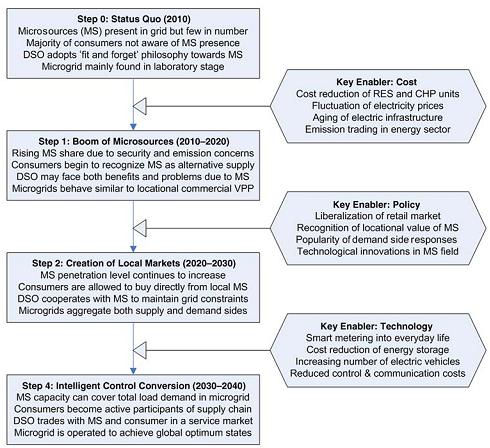
Currently, an increasing number of microgrid pilot sites can be observed in many parts of the world. It is true, however, that up to now,cost, policy and technology barriers have largely restrained the wide deployment of microgrids in distribution networks owing to their limited commercial appeal or social recognition. However, these three barriers are currently undergoing considerable changes – they are very likely to turn into key enablers in the future, eventually leading to a widespread microgrid adoption worldwide.
Firstly, the cost factor might prove to be the most effective driving force for microgrids in the very near future. This might happen not only because of the reduction of microsource costs, but also because of the relative changes of external opportunity costs due to economic (fluctuating market prices), technical (aging of network infrastructure) and environmental (emission trading) factors.
When microsource penetration at a LV grid becomes significant, participants in the electricity retail business will consider the aggregated power from small generators as a new market opportunity. Unlike in the case of VPP, microgrid stakeholders will eventually recognize a unique feature of aggregated microsource units, namely locality: the microsource units can potentially sell directly to end consumers in an “over-the-grid” manner. In order to turn this potential into reality, however, the second factor – appropriate policy and regulatory environment – is needed to enable the operation of a local market within a microgrid.
Finally, the adoption of favorable selling prices in local retail markets will attract even more microsource units, allowing the microgrid to operate islanded, if beneficial. With the help of smart metering, control and communication technologies, the microgrid operator will eventually be able to coordinate a large consortium of intermittent and controllable microsource units, as well as central and distributed storage devices, to achieve multiple objectives and, at the same time, to cater for the interests of different stakeholders.
Source:
MICROGRIDS: Architectures and Control
Nikos Hatziargynou
Dr. Jorge Luis Mírez Tarrillo
Group of Mathematical Modeling and Numerical Simulation (GMMNS).
Universidad Nacional de Ingeniería. Lima, Perú.
E-mail: jmirez@uni.edu.pe
Website Personal: https://jorgemirez2002.wixsite.com/jorgemirez
Facebook http://www.facebook.com/jorgemirezperu
Linkedin https://www.linkedin.com/in/jorge-luis-mirez-tarrillo-94918423/
Scopus ID: https://www.scopus.com/authid/detail.uri?authorId=56488109800
Google Scholar: https://scholar.google.com/citations?user=_dSpp4YAAAAJ
MATLAB Group Admin in Facebook: https://www.facebook.com/groups/Matlab.Simulink.for.All
WhatsApp Channel/Canal: https://whatsapp.com/channel/0029VbCvpZsAYlUSz2esek2y

Currently available DG technologies provide a wide variety of different active and reactive power generation options. The final configuration and operation schemes of a microgrid depend on potentially conflicting interests among different stakeholders involved in electricity supply, such as system/network operators, DG owners, DG operators, energy suppliers, customers and regulatory bodies. Therefore, optimal operation scheduling in microgrids can have economic, technical and environmental objectives
Depending on the stakeholders involved in the planning or operation process, four different microgrid operational objectives can be identified: economic option, technical option, environmental option and combined objective option.
In the economic option, the objective function is to minimize total costs regardless of network impact/performance. This option may be envisaged by DG owners or operators. DGs are operated without concern for grid or emission obligations. The main limitations come from the physical constraints of DG.
The technical option optimizes network operation (minimizing power losses, voltage variation and device loading), without consideration of DG production costs and revenues. This option might be preferred by system operators.
The environmental option dispatches DG units with lower specific emission levels with higher priority, disregarding financial or technical aspects. This is preferred for meeting environmental targets, currently mainly supported by regulatory schemes. DG dispatch is solely determined by emission quota; only DG physical limitations are considered.
The combined objective option solves a multi-objective DG optimal dispatch problem, taking into account all economic, technical and environmental factors. It converts technical and environmental criteria into economic equivalents, considering constraints from both network and DG physical limits. This approach could be relevant, for instance, to actors that participate not only in classical energy markets, but also in other potential markets for provision of network services and emission certificates
Source:
MICROGRIDS: Architectures and Control
Nikos Hatziargynou
Dr. Jorge Luis Mírez Tarrillo
Group of Mathematical Modeling and Numerical Simulation (GMMNS).
Universidad Nacional de Ingeniería. Lima, Perú.
E-mail: jmirez@uni.edu.pe
Website Personal: https://jorgemirez2002.wixsite.com/jorgemirez
Facebook http://www.facebook.com/jorgemirezperu
Linkedin https://www.linkedin.com/in/jorge-luis-mirez-tarrillo-94918423/
Scopus ID: https://www.scopus.com/authid/detail.uri?authorId=56488109800
Google Scholar: https://scholar.google.com/citations?user=_dSpp4YAAAAJ
MATLAB Group Admin in Facebook: https://www.facebook.com/groups/Matlab.Simulink.for.All
WhatsApp Channel/Canal: https://whatsapp.com/channel/0029VbCvpZsAYlUSz2esek2y

The communication infrastructure of a power system typically consists of SCADA systems with dedicated communication channels to and from the System Control Centre and a Wide Area Network (WAN). Some long-established power utilities may have private telephone networks and other legacy communication systems. The SCADA systems connect all the major power system operational facilities, that is, the central generating stations, the transmission grid substations and the primary distribution substations to the System Control Centre. The WAN is used for corporate business and market operations. These form the core communication networks of the traditional power system. However, in the Smart Grid,it is expected that these two elements of communication infrastructure will merge into a Utility WAN.
An essential development of the Smart Grid (see figure ) is to extend communication throughout the distribution system and to establish two-way communications with customers through Neighbourhood Area Networks (NANs) covering the areas served by distribution substations. Customers’ premises will have Home Area Networks (HANs). The interface of the Home and Neighbourhood Area Networks will be through a smart meter or smart interfacing device.
Source:
SMART GRID
TECHNOLOGY AND APPLICATIONS
Janaka Ekanayake
Cardiff University, UK
Kithsiri Liyanage
University of Peradeniya, Sri Lanka
Jianzhong Wu
Cardiff University, UK
Akihiko Yokoyama
University of Tokyo, Japan
Nick Jenkins
Cardiff University, UK
A John Wiley & Sons, Ltd., Publication
Dr. Jorge Luis Mírez Tarrillo
Group of Mathematical Modeling and Numerical Simulation (GMMNS).
Universidad Nacional de Ingeniería. Lima, Perú.
E-mail: jmirez@uni.edu.pe
Website Personal: https://jorgemirez2002.wixsite.com/jorgemirez
Facebook http://www.facebook.com/jorgemirezperu
Linkedin https://www.linkedin.com/in/jorge-luis-mirez-tarrillo-94918423/
Scopus ID: https://www.scopus.com/authid/detail.uri?authorId=56488109800
Google Scholar: https://scholar.google.com/citations?user=_dSpp4YAAAAJ
MATLAB Group Admin in Facebook: https://www.facebook.com/groups/Matlab.Simulink.for.All
WhatsApp Channel/Canal: https://whatsapp.com/channel/0029VbCvpZsAYlUSz2esek2y

La tabla que se presenta acá son lo recomendados límites de variación de voltaje para circuitos que operan con voltajes de hasta 1000 voltios. Hay los límites en condiciones normales y los límites de operación extremos. Quiere decir que los diseñadores de equipos consideran estos valores para el cálculo, selección de materiales y condiciones de trabajo de los equipos eléctricos, electrónicos y electromecánicos que pudieran haber en cualquier instalación. Obviamente que equipos construidos con normas locales, en la vida van a cumplir las exigencias, así mismo, equipos que por cuestión de marca ponen exigencias a los usuarios para mantener el voltaje dentro de un valor determinado y el usuario tiene que hacer inversión en UPS, transformadores de aislamiento y demás cosas («son las niñas bonitas estas marcas del mercado»). Por lo tanto, al ingreso del circuito estos valores son los recomendados, implica de ahí aguas adentro, el diámetro de los conductores, la topología de la red eléctrica, calidad de empalmes, calidad de contactos, conductores en ductos o bandejas, condiciones ambientales, etc.
The information related to this post for sale for US $ 10.00. You can make payments through PayPal account: jorgemirez2002@gmail.com or send an e-mail to receive PayPal invoice and make your payment quickly and easily. Tell us (through e-mail) the name of the input or inputs that interests you. // La información relacionada con este post en venta por US $ 10.00. Usted puede hacer pagos a través de cuenta PayPal: jorgemirez2002@gmail.com o enviar un e-mail para recibir la factura de PayPal y hacer su pago de forma rápida y sencilla. Díganos (por medio de email) el nombre de la entrada o entradas que le interese.
Dr. Jorge Luis Mírez Tarrillo
Group of Mathematical Modeling and Numerical Simulation (GMMNS).
Universidad Nacional de Ingeniería. Lima, Perú.
E-mail: jmirez@uni.edu.pe
Website Personal: https://jorgemirez2002.wixsite.com/jorgemirez
Facebook http://www.facebook.com/jorgemirezperu
Linkedin https://www.linkedin.com/in/jorge-luis-mirez-tarrillo-94918423/
Scopus ID: https://www.scopus.com/authid/detail.uri?authorId=56488109800
Google Scholar: https://scholar.google.com/citations?user=_dSpp4YAAAAJ
MATLAB Group Admin in Facebook: https://www.facebook.com/groups/Matlab.Simulink.for.All
WhatsApp Channel/Canal: https://whatsapp.com/channel/0029VbCvpZsAYlUSz2esek2y

En este post muestro la portada de tesis «Implementación de un Sistema de Generación Distribuida con Energías Renovables ENDE Corporación» elaborado por Mario Torrico para la Universidad Privada del Valle en Cochabamba – Bolivia para optar el título de Ingeniero Electromecánico. Trabajo que compartimos durante unos tres meses de intercambio de información, modelos matemáticos y simulaciones numéricas, además de diálogo, envío de información, debate y varios borradores de tesis que iban y venían en el correo electrónico. Su defensa fue un éxito alcanzando la nota de 90/100 para alegría de Mario, de su familia, profesores, colegas y amigos. Éxitos Mario en tu vida profesional, tengo un colega amigo más :)D . En lo personal el tema fue muy interesante e implicó ingresar en una temática no desarrollada e innovadora… la portada de la tesis esta bonita también. Saludos a la plurinación boliviana… A quienes desean desarrollar conmigo sus tesis (Yo como Asesor Externo) a nivel de pregrado y postgrado, así como desarrollar sus proyectos de investigación tanto en universidades, institutos o empresas me escriben.
Dr. Jorge Luis Mírez Tarrillo
Group of Mathematical Modeling and Numerical Simulation (GMMNS).
Universidad Nacional de Ingeniería. Lima, Perú.
E-mail: jmirez@uni.edu.pe
Website Personal: https://jorgemirez2002.wixsite.com/jorgemirez
Facebook http://www.facebook.com/jorgemirezperu
Linkedin https://www.linkedin.com/in/jorge-luis-mirez-tarrillo-94918423/
Scopus ID: https://www.scopus.com/authid/detail.uri?authorId=56488109800
Google Scholar: https://scholar.google.com/citations?user=_dSpp4YAAAAJ
MATLAB Group Admin in Facebook: https://www.facebook.com/groups/Matlab.Simulink.for.All
WhatsApp Channel/Canal: https://whatsapp.com/channel/0029VbCvpZsAYlUSz2esek2y


The information related to this post for sale for US $ 100.00. You can make payments through PayPal account: jorgemirez2002@gmail.com or send an e-mail to receive PayPal invoice and make your payment quickly and easily. Tell us (through e-mail) the name of the input or inputs that interests you. // La información relacionada con este post en venta por US $ 100.00. Usted puede hacer pagos a través de cuenta PayPal: jorgemirez2002@gmail.com o enviar un e-mail para recibir la factura de PayPal y hacer su pago de forma rápida y sencilla. Díganos (por medio de email) el nombre de la entrada o entradas que le interese.
Dr. Jorge Luis Mírez Tarrillo
Group of Mathematical Modeling and Numerical Simulation (GMMNS).
Universidad Nacional de Ingeniería. Lima, Perú.
E-mail: jmirez@uni.edu.pe
Website Personal: https://jorgemirez2002.wixsite.com/jorgemirez
Facebook http://www.facebook.com/jorgemirezperu
Linkedin https://www.linkedin.com/in/jorge-luis-mirez-tarrillo-94918423/
Scopus ID: https://www.scopus.com/authid/detail.uri?authorId=56488109800
Google Scholar: https://scholar.google.com/citations?user=_dSpp4YAAAAJ
MATLAB Group Admin in Facebook: https://www.facebook.com/groups/Matlab.Simulink.for.All
WhatsApp Channel/Canal: https://whatsapp.com/channel/0029VbCvpZsAYlUSz2esek2y


Atiendo a esta reunión bastante importante es que gracias al apoyo de CYTED y CEDER-CIEMAT es que daremos esta conferencia en el marco del IIi Congreso Iberoamericano de Microredes con Generación Distribuida de Renovables. Este evento sirve de marco para el intercambio de información, experiencias y el tomar en contacto con investigadores provenientes de diferentes países de habla hispana y no hispana, dedicados al sector energía y otros sectores incluyendo el aeroespacial en que el uso de fuentes de energía como sol, viento, biomasa, celdas de combustible, entre otras es bastante importante. Y no sólo eso, importante y quizás mucho más lo que es las técnicas de control, predicción, modelamiento y simulación, software desarrollado que son las cosas de mayor valor agregado, la combinación de diferentes escenarios de trabajo y de implementación en industrias, centros de atención de salud, barcos, naves espaciales, soporte de vida en condiciones extremas, etc. Les dejo la portada de mi presentación y cualquier comunicación a jorgemirez2002@gmail.com, y quienes estén por acá, estaremos conversando.
The information related to this post for sale for US $ 100.00. You can make payments through PayPal account: jorgemirez2002@gmail.com or send an e-mail to receive PayPal invoice and make your payment quickly and easily. Tell us (through e-mail) the name of the input or inputs that interests you. // La información relacionada con este post en venta por US $ 100.00. Usted puede hacer pagos a través de cuenta PayPal: jorgemirez2002@gmail.com o enviar un e-mail para recibir la factura de PayPal y hacer su pago de forma rápida y sencilla. Díganos (por medio de email) el nombre de la entrada o entradas que le interese.
Dr. Jorge Luis Mírez Tarrillo
Group of Mathematical Modeling and Numerical Simulation (GMMNS).
Universidad Nacional de Ingeniería. Lima, Perú.
E-mail: jmirez@uni.edu.pe
Website Personal: https://jorgemirez2002.wixsite.com/jorgemirez
Facebook http://www.facebook.com/jorgemirezperu
Linkedin https://www.linkedin.com/in/jorge-luis-mirez-tarrillo-94918423/
Scopus ID: https://www.scopus.com/authid/detail.uri?authorId=56488109800
Google Scholar: https://scholar.google.com/citations?user=_dSpp4YAAAAJ
MATLAB Group Admin in Facebook: https://www.facebook.com/groups/Matlab.Simulink.for.All
WhatsApp Channel/Canal: https://whatsapp.com/channel/0029VbCvpZsAYlUSz2esek2y
Estimado(a) colega
Es un gusto para nosotros presentarle el contenido de la última edición de la revista Inge@UAN – Tendencias en la Ingeniería, correspondiente al volumen 5 número 10 de 2015 y que se encuentra disponible en nuestra página web con los siguientes trabajos:
ARTÍCULOS DE INVESTIGACIÓN CIENTÍFICA Y TECNOLÓGICA
Aplicación del Loop Automation en una red de distribución aérea de media tensión
D. Miraglia, J. Mirez Tarrillo

PD: Con Dante hemos trabajo durante varios meses y años, en el desarrollo de su tema de investigación allá en Cuba, producto de esa interacción es el presente artículo que hoy viernes 20 de Noviembre del 2015, tengo el agrado de recibir en el correo y que en éste post les doy a conocer para que lo puedan leer visitando la página de la Revista. Con Dante seguiremos trabajando, así mismo, queda la invitación a quienes deseen desarrollar temáticas que conlleven a publicaciones, que sea esto algo normal de cada día publicar con cierta regularidad, para demostrar una vez más a los incrédulos que si se puede hacer esto y a la vez, lo que se vierte a los alumnos en las aulas no es cualquier cosa como a veces mediocremente se ha mencionado.
Dr. Jorge Luis Mírez Tarrillo
Group of Mathematical Modeling and Numerical Simulation (GMMNS).
Universidad Nacional de Ingeniería. Lima, Perú.
E-mail: jmirez@uni.edu.pe
Website Personal: https://jorgemirez2002.wixsite.com/jorgemirez
Facebook http://www.facebook.com/jorgemirezperu
Linkedin https://www.linkedin.com/in/jorge-luis-mirez-tarrillo-94918423/
Scopus ID: https://www.scopus.com/authid/detail.uri?authorId=56488109800
Google Scholar: https://scholar.google.com/citations?user=_dSpp4YAAAAJ
MATLAB Group Admin in Facebook: https://www.facebook.com/groups/Matlab.Simulink.for.All
WhatsApp Channel/Canal: https://whatsapp.com/channel/0029VbCvpZsAYlUSz2esek2y
Estimados lectores, éstas son las diapositivas de la ponencia que daré el día jueves 19 de noviembre del 2015 en la Universidad Nacional San Agustín de Arequipa como parte de las actividades del XXII Simposio Peruano de Energía Solar que se está realizando desde del 17 al 21 de Noviembre en Arequipa – Perú. Quedan todos invitados, igualmente bienvenidas sus preguntas, opiniones, sugerencias y el hacer cooperación académica o conversar sobre asuntos laborales. Arequipa está cerca de Bolivia y Chile.


The information related to this post for sale for US $ 100.00. You can make payments through PayPal account: jorgemirez2002@gmail.com or send an e-mail to receive PayPal invoice and make your payment quickly and easily. Tell us (through e-mail) the name of the input or inputs that interests you. // La información relacionada con este post en venta por US $ 100.00. Usted puede hacer pagos a través de cuenta PayPal: jorgemirez2002@gmail.com o enviar un e-mail para recibir la factura de PayPal y hacer su pago de forma rápida y sencilla. Díganos (por medio de email) el nombre de la entrada o entradas que le interese.
Dr. Jorge Luis Mírez Tarrillo
Group of Mathematical Modeling and Numerical Simulation (GMMNS).
Universidad Nacional de Ingeniería. Lima, Perú.
E-mail: jmirez@uni.edu.pe
Website Personal: https://jorgemirez2002.wixsite.com/jorgemirez
Facebook http://www.facebook.com/jorgemirezperu
Linkedin https://www.linkedin.com/in/jorge-luis-mirez-tarrillo-94918423/
Scopus ID: https://www.scopus.com/authid/detail.uri?authorId=56488109800
Google Scholar: https://scholar.google.com/citations?user=_dSpp4YAAAAJ
MATLAB Group Admin in Facebook: https://www.facebook.com/groups/Matlab.Simulink.for.All
WhatsApp Channel/Canal: https://whatsapp.com/channel/0029VbCvpZsAYlUSz2esek2y

During 2013 and 2014, i was working with Daniella Rough in your thesys master. Title of thesys is: «Techincal and Financial Feasibility of Wind Power to Gas Systems: A Case Study of the Talara Wind Farm, Perú». Very interesting with complex modelling mathematical and simulation on Matlab/Simulink. I was the second examiner, i live in Perú because Talara Wind Farm has placed near to Piura (in the North of Perú). Actually Talara Wind Farm is in operation.
Dr. Jorge Luis Mírez Tarrillo
Group of Mathematical Modeling and Numerical Simulation (GMMNS).
Universidad Nacional de Ingeniería. Lima, Perú.
E-mail: jmirez@uni.edu.pe
Website Personal: https://jorgemirez2002.wixsite.com/jorgemirez
Facebook http://www.facebook.com/jorgemirezperu
Linkedin https://www.linkedin.com/in/jorge-luis-mirez-tarrillo-94918423/
Scopus ID: https://www.scopus.com/authid/detail.uri?authorId=56488109800
Google Scholar: https://scholar.google.com/citations?user=_dSpp4YAAAAJ
MATLAB Group Admin in Facebook: https://www.facebook.com/groups/Matlab.Simulink.for.All
WhatsApp Channel/Canal: https://whatsapp.com/channel/0029VbCvpZsAYlUSz2esek2y

Féliz Almánzar y Raúl Castro, dos jóvenes ahora ingenieros en República Dominicana hacia el año 2011 trabajamos con su tesis de pregrado titulada: «Impacto de la interconexión de una línea de transmisión (HVDC) entre la República Colombia – República Domica, en el sistema eléctrico Dominicano». El reto fue grande, dado que teniamos que trabajar con el diseño, modelamiento y simulación de una línea de HVDC en la que encontramos en aquella época 2011 poca información. Resulta que hay una solo gran empresa que realiza estas líneas y es ABB, teníamos que hacer bastante búsqueda de información y diversas herramientas tanto conseguidas desde Perú como desde República Dominicana. Finalmente logramos un diseño, su modelamiento y simulación que pudo calcular los parámetros de una línea de transmisión, Féliz y Raúl hicieron la respectiva defensa con éxito y considero que esta es una muy buena solución a la necesidad energética de dicho país. A veces te piden experiencia en determinadas temáticas, pero resulta que logramos ser co-asesores de una tesis, pero tal parece que estas cosas no califican como experiencia para trabajar o solicitar trabajo. En fin, esta temática fue muy interesante y espero poder continuarla con los interesados, grupos de investigación, universidades o ya sea en trabajo profesional.
Dr. Jorge Luis Mírez Tarrillo
Group of Mathematical Modeling and Numerical Simulation (GMMNS).
Universidad Nacional de Ingeniería. Lima, Perú.
E-mail: jmirez@uni.edu.pe
Website Personal: https://jorgemirez2002.wixsite.com/jorgemirez
Facebook http://www.facebook.com/jorgemirezperu
Linkedin https://www.linkedin.com/in/jorge-luis-mirez-tarrillo-94918423/
Scopus ID: https://www.scopus.com/authid/detail.uri?authorId=56488109800
Google Scholar: https://scholar.google.com/citations?user=_dSpp4YAAAAJ
MATLAB Group Admin in Facebook: https://www.facebook.com/groups/Matlab.Simulink.for.All
WhatsApp Channel/Canal: https://whatsapp.com/channel/0029VbCvpZsAYlUSz2esek2y

Durante el año 2011 trabajamos con Diana Carolina Núñez Reyes de la República Dominicana en el desarrollo de su tesis de pregrado titulada: «Diseño de un Controlador para el Despacho de Potencia a un Hogar, basado en Energía Renovable» para la Pontifica Universidad Católica Madre y Maestra. En esa oportunidad, era mi primer tesista de pregrado a distancia a la que brindaba asesoramiento usando los medios de comunicación como Gmail, Skype y el envío de correos con preguntas, información, códigos y figuras. Diana aprendió rápidamente a programar en Matlab/Simulink y progresivamente avanzó en sus modelos de instalaciones renovables para una casa típica en su país: República Dominicana. Esta primera experiencia sirvió bastante para los siguientes tesistas que tuve, que por lo general, han sido por lo general, fuera del Perú y a veces quizás será porque en Perú los estudiantes deseas titularse para ganar dinero y no para investigación, los docentes sólo dictar sus clases y ganar, las universidades muchas sólo votar la mayor cantidad de egresados con su título y fastuosas ceremonias como para que la cosa se vea impresionante, he ahí quizás la baja producción científica de mi país.
Dr. Jorge Luis Mírez Tarrillo
Group of Mathematical Modeling and Numerical Simulation (GMMNS).
Universidad Nacional de Ingeniería. Lima, Perú.
E-mail: jmirez@uni.edu.pe
Website Personal: https://jorgemirez2002.wixsite.com/jorgemirez
Facebook http://www.facebook.com/jorgemirezperu
Linkedin https://www.linkedin.com/in/jorge-luis-mirez-tarrillo-94918423/
Scopus ID: https://www.scopus.com/authid/detail.uri?authorId=56488109800
Google Scholar: https://scholar.google.com/citations?user=_dSpp4YAAAAJ
MATLAB Group Admin in Facebook: https://www.facebook.com/groups/Matlab.Simulink.for.All
WhatsApp Channel/Canal: https://whatsapp.com/channel/0029VbCvpZsAYlUSz2esek2y
Estaré presente en Arequipa para dar esta ponencia en que resumo el trabajo del equipo del que formo parte en microredes de la Red CYTED, hablaré sobre el porque de importante es desarrollar modelamiento y simulación de microredes, y también de mi experiencia en un Centro de Desarrollo de Energías Renovables. Para quienes siguen este blog y mis actividades, yo realizo mi trabajo usando Matlab/Simulink dado que es un software de alto nivel y que facilita mucho la programación, aparte de que es un lenguaje ampliamente conocido, aunque a veces me falta datos y es un tanto difícil encontrar lugares donde hacer pasantías e investigación, otro lío es encontrar el financiamiento en países en que los conocimientos con potencial altamente valor agregado no se valoran. Quedan cordialmente invitados al evento del cual adjunto el aficho y la programación del mismo..


Dr. Jorge Luis Mírez Tarrillo
Group of Mathematical Modeling and Numerical Simulation (GMMNS).
Universidad Nacional de Ingeniería. Lima, Perú.
E-mail: jmirez@uni.edu.pe
Website Personal: https://jorgemirez2002.wixsite.com/jorgemirez
Facebook http://www.facebook.com/jorgemirezperu
Linkedin https://www.linkedin.com/in/jorge-luis-mirez-tarrillo-94918423/
Scopus ID: https://www.scopus.com/authid/detail.uri?authorId=56488109800
Google Scholar: https://scholar.google.com/citations?user=_dSpp4YAAAAJ
MATLAB Group Admin in Facebook: https://www.facebook.com/groups/Matlab.Simulink.for.All
WhatsApp Channel/Canal: https://whatsapp.com/channel/0029VbCvpZsAYlUSz2esek2y

En este post muestro el ejemplo que han usado para analizar la performance de un sistema eléctrico que cuenta con un Distribuited Energy Storage (almacenamiento de energía distribuida… o su equivalente en español). Muchos de estos escenarios no han sido construidos porque toda vez, éstos se están recién investigando en el mundo, y lo que se ha podido construir son casos puntuales en que casi a medida del laboratorio, universidad o institución de investigación se han implementado. Observen la cantidad de potencia que está involucrada y a eso apunta el mercado eléctrico, a una implementación masiva de estas soluciones en los mercados nacionales. Cargas eléctricas, barras y elementos de acondicionamiento de energía eléctrica desarrollados con electrónica de potencia son esenciales en estas implementaciones, que me encargo de estudiar y por medio de este blog compartir con la comunidad de habla española y a quienes usan el traductor del blog (en inglés). Si desean hacer sus políticas nacionales o estudios de impacto de las renovables o investigaciones relacionadas mi correo jorgemirez2002@gmail.com
The information related to this post for sale for US $ 20.00. You can make payments through PayPal account: jorgemirez2002@gmail.com or send an e-mail to receive PayPal invoice and make your payment quickly and easily. Tell us (through e-mail) the name of the input or inputs that interests you. // La información relacionada con este post en venta por US $ 20.00. Usted puede hacer pagos a través de cuenta PayPal: jorgemirez2002@gmail.com o enviar un e-mail para recibir la factura de PayPal y hacer su pago de forma rápida y sencilla. Díganos (por medio de email) el nombre de la entrada o entradas que le interese.
Dr. Jorge Luis Mírez Tarrillo
Group of Mathematical Modeling and Numerical Simulation (GMMNS).
Universidad Nacional de Ingeniería. Lima, Perú.
E-mail: jmirez@uni.edu.pe
Website Personal: https://jorgemirez2002.wixsite.com/jorgemirez
Facebook http://www.facebook.com/jorgemirezperu
Linkedin https://www.linkedin.com/in/jorge-luis-mirez-tarrillo-94918423/
Scopus ID: https://www.scopus.com/authid/detail.uri?authorId=56488109800
Google Scholar: https://scholar.google.com/citations?user=_dSpp4YAAAAJ
MATLAB Group Admin in Facebook: https://www.facebook.com/groups/Matlab.Simulink.for.All
WhatsApp Channel/Canal: https://whatsapp.com/channel/0029VbCvpZsAYlUSz2esek2y
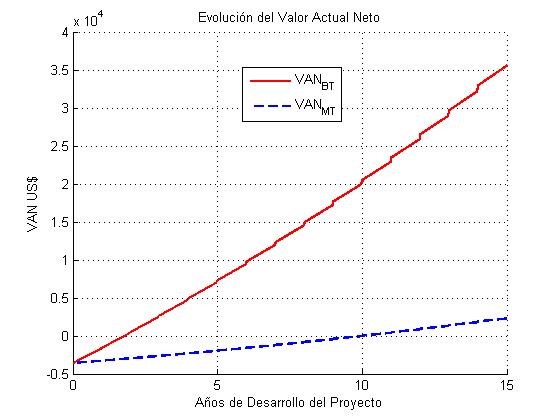
Cualquier instalación de equipos de energía involucra en sí la realización de un proyecto que parte desde atender una necesidad energética o en todo caso proyectarse hacia una demanda energética por abastecerse. Una de las fuentes son las alternativas renovables, las que hay que considerar que son las turbinas eólicas, energía solar, etc. Estas tienen un costo inicial que en sí es una inversión que se cuenta en negativo, a partir de ahí el proyecto va recuperando su inversión en la medida que el costo de energía producida es menor al que se hubiera seguido usando la misma fuente energética. La figura muestra dos casos tanto para un usuario en baja tensión como en media tensión con valores asumidos, de implementación de paneles solares. Un usuario en baja tensión recupera mucho más rápido su inversión, pero al final del proyecto que viene a ser unos 15 años ambos están en ganancia. Recordar que los paneles solares los venden ahora con una garantía de 20 años y hasta de 25 años. Los modelo matemático y las curvas son hechas en Matlab de MathWork Inc.
The information related to this post for sale for US $ 200.00. You can make payments through PayPal account: jorgemirez2002@gmail.com or send an e-mail to receive PayPal invoice and make your payment quickly and easily. Tell us (through e-mail) the name of the input or inputs that interests you. // La información relacionada con este post en venta por US $ 200.00. Usted puede hacer pagos a través de cuenta PayPal: jorgemirez2002@gmail.com o enviar un e-mail para recibir la factura de PayPal y hacer su pago de forma rápida y sencilla. Díganos (por medio de email) el nombre de la entrada o entradas que le interese.
Dr. Jorge Luis Mírez Tarrillo
Group of Mathematical Modeling and Numerical Simulation (GMMNS).
Universidad Nacional de Ingeniería. Lima, Perú.
E-mail: jmirez@uni.edu.pe
Website Personal: https://jorgemirez2002.wixsite.com/jorgemirez
Facebook http://www.facebook.com/jorgemirezperu
Linkedin https://www.linkedin.com/in/jorge-luis-mirez-tarrillo-94918423/
Scopus ID: https://www.scopus.com/authid/detail.uri?authorId=56488109800
Google Scholar: https://scholar.google.com/citations?user=_dSpp4YAAAAJ
MATLAB Group Admin in Facebook: https://www.facebook.com/groups/Matlab.Simulink.for.All
WhatsApp Channel/Canal: https://whatsapp.com/channel/0029VbCvpZsAYlUSz2esek2y
Blog in ENGLISH

Compra/Buy – Haz una donación/Make a donation

Dear reader, if you wish to make a donation or are interested in any information or code, please contact me (e-mail: jmirez@uni.edu.pe). Donations will allow you to continue studying and researching, and also to provide more information on this blog. My PayPal account is jorgemirez2002@gmail.com or if it is by bank transfer write to my email jmirez@uni.edu.pe. Any amount of money is welcome. Thank you.
Estimado lector, si desean hacer una donación o le interesa alguna información o código, favor ponerse en contacto con mi persona (e-mail: jmirez@uni.edu.pe). Las donaciones va a permitir seguir estudiando e investigando, y además, el poder brindar más información en este blog. Mi cuenta en PayPal es jorgemirez2002@gmail.com o si es por transferencia bancaria escribirme a mi correo jmirez@uni.edu.pe. Cualquier cantidad de dinero es bienvenido. Gracias.
Datos Generales
Good day. My full name is Jorge Luis MIREZ TARRILLO.
I am Peruvian and live in Lima, capital of Perú in South America.I am Mechanical Electrical Engineering, MSc Physics and Dr. Physics (title doctoral thesis: Control, Optimization, and Management of Microgrid Current Direct)
Too, actually job as Principal Professor in Faculty of Oil, Gas and Petrochemical Engineering of Universidad Nacional de Ingeniería (National University of Engineering) in Lima – PERU (Courses: Modern Physics, Differential Equations and Research's Methodology)
My subjects of my interest are control, signal processing, optimization, simulation, biomedical research, smart grid, microgrid, water.
I have experience in Matlab/Simulink programming, biomedical equipment, electrical systems, renewable energies, microgrids, saturated steam systems 100 psi and organizing academic events.

Comentarios Recientes
Elementos que compon… en J506: Los elementos de un paqu… Dr. Jorge Mírez en Message by IEEE Community Dr. Jorge Mírez en J546: Simulación de campos mag… jose luis huayanay v… en Message by IEEE Community Cesar Aviles en J546: Simulación de campos mag… Dr. Jorge Mírez en J518: La herramienta pdetool d… Dr. Jorge Mírez en J496: Simulación en Matlab/Sim… Raúl Barrios Elizarr… en J496: Simulación en Matlab/Sim… jose luis huayanay v… en J518: La herramienta pdetool d… MSc. Jorge Mírez en J281: La Rosa de Vientos: Frec…


Debe estar conectado para enviar un comentario.