Archive for the ‘Solar’ Category


Dr. Jorge Luis Mírez Tarrillo
Group of Mathematical Modeling and Numerical Simulation (GMMNS).
Universidad Nacional de Ingeniería. Lima, Perú.
E-mail: jmirez@uni.edu.pe
Website Personal: https://jorgemirez2002.wixsite.com/jorgemirez
Facebook http://www.facebook.com/jorgemirezperu
Linkedin https://www.linkedin.com/in/jorge-luis-mirez-tarrillo-94918423/
Scopus ID: https://www.scopus.com/authid/detail.uri?authorId=56488109800
Google Scholar: https://scholar.google.com/citations?user=_dSpp4YAAAAJ
MATLAB Group Admin in Facebook: https://www.facebook.com/groups/Matlab.Simulink.for.All
WhatsApp Channel/Canal: https://whatsapp.com/channel/0029VbCvpZsAYlUSz2esek2y


Enlace del libro (información, precio, compra): https://www.morebooks.de/store/es/book/introducci%C3%B3n-al-modelamiento-y-simulaci%C3%B3n-de-microredes-de-energ%C3%ADa/isbn/978-3-639-63529-4
Introducción al Modelamiento y Simulación de Microredes de Energía
Un acercamiento a los sistemas eléctricos del futuro mediante la ingeniería, física, matemática y programación
Editorial Académica Española (2016-10-25 )
ISBN-13:978-3-639-63529-4
ISBN-10:3639635299
EAN:9783639635294
Idioma del libro:
Notas y citas / Texto breve:
En el libro desarrollo el modelamiento y simulación de una microred (microgrid) de voltaje continuo/alterno alimentado con fuentes solar fotovoltaica, eólica, de almacenamiento, una red eléctrica convencional (red de empresa pública o privada de electricidad) y que posee además cargas eléctricas. En dicha microgrid se realiza la evaluación del comportamiento de los parámetros del sistema: voltaje, corriente, potencia y energía eléctrica, en condiciones normales de funcionamiento. Matlab/Simulink de MathWork Inc. es la herramienta de simulación usada y los códigos son dados en Anexos. El libro está pensando para un amplio círculo de lectores, entre: (a) estudiantes de pregrado y postgrado de diferentes carreras relacionadas a la temática de microgrids, energias renovables y energia en general, como son de ingeniería mecanica, eléctrica, electrónica y electromecanico; física, matemática, computacion, economía, entre otras; (b) empresarios y profesionales que desean especializarse o ampliar sus conocimientos en energías renovables y/o modelamiento matemático y simulación numérica; (c) autoridades y público en general interesados en temas de energía.
Editorial: Editorial Académica Española
Sitio web: https://www.eae-publishing.com
Por (autor): Jorge Luis Mírez Tarrillo
Número de páginas: 240
Publicado en: 2016-10-25
Categoría: Tecnología
Palabras clave: Energías renovables, Microred, Modelamiento y Simulación, sistema eléctrico, Matlab Simulink
(Dénle Me gusta en mi Fanpage personal: http://www.facebook.com/jorgemirez )
Dr. Jorge Luis Mírez Tarrillo
Group of Mathematical Modeling and Numerical Simulation (GMMNS).
Universidad Nacional de Ingeniería. Lima, Perú.
E-mail: jmirez@uni.edu.pe
Website Personal: https://jorgemirez2002.wixsite.com/jorgemirez
Facebook http://www.facebook.com/jorgemirezperu
Linkedin https://www.linkedin.com/in/jorge-luis-mirez-tarrillo-94918423/
Scopus ID: https://www.scopus.com/authid/detail.uri?authorId=56488109800
Google Scholar: https://scholar.google.com/citations?user=_dSpp4YAAAAJ
MATLAB Group Admin in Facebook: https://www.facebook.com/groups/Matlab.Simulink.for.All
WhatsApp Channel/Canal: https://whatsapp.com/channel/0029VbCvpZsAYlUSz2esek2y

Dear audience. I am very happy in to write this post 1000 :)D . During many years, it has been a both exciting and hard work in read, understand, programming, modeling, simulations and analysis of results. The figure is a little photovoltaic power plant with its respective solar radiation. It has been implemented from mathematical models of thesys and books. The model is adaptable to PV plant of more power. Made in Matlab of MathWorks Inc.
Dr. Jorge Luis Mírez Tarrillo
Group of Mathematical Modeling and Numerical Simulation (GMMNS).
Universidad Nacional de Ingeniería. Lima, Perú.
E-mail: jmirez@uni.edu.pe
Website Personal: https://jorgemirez2002.wixsite.com/jorgemirez
Facebook http://www.facebook.com/jorgemirezperu
Linkedin https://www.linkedin.com/in/jorge-luis-mirez-tarrillo-94918423/
Scopus ID: https://www.scopus.com/authid/detail.uri?authorId=56488109800
Google Scholar: https://scholar.google.com/citations?user=_dSpp4YAAAAJ
MATLAB Group Admin in Facebook: https://www.facebook.com/groups/Matlab.Simulink.for.All
WhatsApp Channel/Canal: https://whatsapp.com/channel/0029VbCvpZsAYlUSz2esek2y

In the present post a comparasion has been development between differents energy sources: Coal, Oil Thermal, Single Cycle, Combined Cycle, Nuclear Power, Hydropower, Geothermal (my lecture interest in this days in this days), Solar PV Power and Windpower Plant. There is one cycle call «binary cicle» in Geothermal with minimum impacto in enviromental (cuasi zero CO2). Goethermal have a good potential in applications as heat and electric power generation. In Perú it have a promisore future and other countries too. Mathematical models and numerical simulations in Matlab/Simulink of this topic is of my interest.
Dr. Jorge Luis Mírez Tarrillo
Group of Mathematical Modeling and Numerical Simulation (GMMNS).
Universidad Nacional de Ingeniería. Lima, Perú.
E-mail: jmirez@uni.edu.pe
Website Personal: https://jorgemirez2002.wixsite.com/jorgemirez
Facebook http://www.facebook.com/jorgemirezperu
Linkedin https://www.linkedin.com/in/jorge-luis-mirez-tarrillo-94918423/
Scopus ID: https://www.scopus.com/authid/detail.uri?authorId=56488109800
Google Scholar: https://scholar.google.com/citations?user=_dSpp4YAAAAJ
MATLAB Group Admin in Facebook: https://www.facebook.com/groups/Matlab.Simulink.for.All
WhatsApp Channel/Canal: https://whatsapp.com/channel/0029VbCvpZsAYlUSz2esek2y

The dc-bus microgrid link the diferent component of the microgrid both loads as sources. The figure is a general representation with conextion to AC-grid, wind turbine, PV solar plant, DC and AC loads, Batteries, fluwheel, micro turbine, AC/DC converser, DC/AC converser and DC/DC converser.
Source:
S. Vimalraj, P. Somasundaram, “Fault Detection, Isolation and Identification of Fault Location in Low-Voltage DC Ring Bus Microgrid System,” Int. J. Advanced Res. in Electrical, Electronics and Instr. Eng. vol. 3, special iss. 2, pp: 570-582, Apr. 2014
Dr. Jorge Luis Mírez Tarrillo
Group of Mathematical Modeling and Numerical Simulation (GMMNS).
Universidad Nacional de Ingeniería. Lima, Perú.
E-mail: jmirez@uni.edu.pe
Website Personal: https://jorgemirez2002.wixsite.com/jorgemirez
Facebook http://www.facebook.com/jorgemirezperu
Linkedin https://www.linkedin.com/in/jorge-luis-mirez-tarrillo-94918423/
Scopus ID: https://www.scopus.com/authid/detail.uri?authorId=56488109800
Google Scholar: https://scholar.google.com/citations?user=_dSpp4YAAAAJ
MATLAB Group Admin in Facebook: https://www.facebook.com/groups/Matlab.Simulink.for.All
WhatsApp Channel/Canal: https://whatsapp.com/channel/0029VbCvpZsAYlUSz2esek2y

In this system, a PV-diesel hybrid concept with dc grid has been proposed where the PV panel is not placed in any central location but distributively placed on roof tops at conventional locations. The number of solar PVs placed on a roof is such that they can be connected directly to the grid. The diesel generator is needed to give support to the system during bad weather and reduce the battery storage for the system. Diesel generator is placed at a convenient location and in case of higher demand; several diesel generators could be installed at the same place as per increased load demand. Diesel generators would be connected to the grid via ac-dc converters. A battery may be placed to store the power generated from diesel generator. Each consumer is connected to the grid and is metered for the energy consumed. Schematic diagram of a dc micro grid and a typical setup inside the consumer premises is shown in Figure. A consumer will have a dc-dc converter to convert the high grid voltage to nominal 12 V and charge a battery set up individually at the premises to store energy. It may be mentioned here that the charge controller to protect the battery is built inside the converter. During the day time, solar panels will produce output to be stored in the batteries of the individual customers. The size of the batteries will be deduced as per their energy demand. The customer has two options so far the household loads are connected-he/she can use all dc loads or can use an inverter (similar to an IPS) to have 240 Vac load in his house. This option will be useful when the actual power consumption by some of the consumers (well off consumers) are high and rich enough to use household gadgets like fridge, TV etc.
Source:
Syed Enam Reza, Mou Mahmood, A. S. M Kalkobad, Ehasanul Kabir, Nahid-ur-Rahman Chowdhury, “A Novel Load Distribution Technique of DC Micro-Grid Scheme on PV-Diesel Hybrid System for Remote Areas of Bangladesh,” Int. J. Scient. & Tech. Res., vol 2, issue 1, pp: 133-137, Jan. 2013
Dr. Jorge Luis Mírez Tarrillo
Group of Mathematical Modeling and Numerical Simulation (GMMNS).
Universidad Nacional de Ingeniería. Lima, Perú.
E-mail: jmirez@uni.edu.pe
Website Personal: https://jorgemirez2002.wixsite.com/jorgemirez
Facebook http://www.facebook.com/jorgemirezperu
Linkedin https://www.linkedin.com/in/jorge-luis-mirez-tarrillo-94918423/
Scopus ID: https://www.scopus.com/authid/detail.uri?authorId=56488109800
Google Scholar: https://scholar.google.com/citations?user=_dSpp4YAAAAJ
MATLAB Group Admin in Facebook: https://www.facebook.com/groups/Matlab.Simulink.for.All
WhatsApp Channel/Canal: https://whatsapp.com/channel/0029VbCvpZsAYlUSz2esek2y

The Figure shown an example of Wind PV BESS hybrid power generation system with large-scale battery energy storage station (it is in BESS – Battery Energy Storage Station). It is used for compensation of aleatory energy production from wind turbine or PV plant. This BESS have orden of MW’s both for charge/discharge process.
Source:
Xiangjun Li, Dong Hui and Xiaokang Lai «Battery Energy Storage Station (BESS) – Based Smoothing Control of Photovoltaic (PV) and Wind Power Generation Fluctuations». IEEE Transactions on Sustainable Energy, Vol. 4, No. 2, April 2013.
Dr. Jorge Luis Mírez Tarrillo
Group of Mathematical Modeling and Numerical Simulation (GMMNS).
Universidad Nacional de Ingeniería. Lima, Perú.
E-mail: jmirez@uni.edu.pe
Website Personal: https://jorgemirez2002.wixsite.com/jorgemirez
Facebook http://www.facebook.com/jorgemirezperu
Linkedin https://www.linkedin.com/in/jorge-luis-mirez-tarrillo-94918423/
Scopus ID: https://www.scopus.com/authid/detail.uri?authorId=56488109800
Google Scholar: https://scholar.google.com/citations?user=_dSpp4YAAAAJ
MATLAB Group Admin in Facebook: https://www.facebook.com/groups/Matlab.Simulink.for.All
WhatsApp Channel/Canal: https://whatsapp.com/channel/0029VbCvpZsAYlUSz2esek2y

Sun –> energy provided from photovoltaic energy plant.
Wind –> similar from wind turbine(s)
Batt –> similar from battery bank
ene –> similar injected from electrical network external or utility electric network
In other image in red is the total suministed for this sources and red line is the demand. Other images is cost, evoluction of energy supply from each source and more details. It is made for me (Jorge Mírez) in Matlabb/Simulink and I utilized concept of linear programming. Image is from my destokp laptop.
Dr. Jorge Luis Mírez Tarrillo
Group of Mathematical Modeling and Numerical Simulation (GMMNS).
Universidad Nacional de Ingeniería. Lima, Perú.
E-mail: jmirez@uni.edu.pe
Website Personal: https://jorgemirez2002.wixsite.com/jorgemirez
Facebook http://www.facebook.com/jorgemirezperu
Linkedin https://www.linkedin.com/in/jorge-luis-mirez-tarrillo-94918423/
Scopus ID: https://www.scopus.com/authid/detail.uri?authorId=56488109800
Google Scholar: https://scholar.google.com/citations?user=_dSpp4YAAAAJ
MATLAB Group Admin in Facebook: https://www.facebook.com/groups/Matlab.Simulink.for.All
WhatsApp Channel/Canal: https://whatsapp.com/channel/0029VbCvpZsAYlUSz2esek2y

This DC microgrid have three photovoltaic solar plant, pne DC load, battery bank and microsource with DC/AC 3 -Phase Bi-directional Inverter, all components conected to DC bus of microgrid. Great !!
Reference:
T. F. Wu, C. H. Chang, L. C. Lin and Y. C. Chang. “DC-Bus Voltage Control for Three-Phase Bi-directional Inverter in DC Microgrid Applications”. Applied Power Electronics Conference and Exposition (APEC), 2012 Twenty-Seventh Annual IEEE
Dr. Jorge Luis Mírez Tarrillo
Group of Mathematical Modeling and Numerical Simulation (GMMNS).
Universidad Nacional de Ingeniería. Lima, Perú.
E-mail: jmirez@uni.edu.pe
Website Personal: https://jorgemirez2002.wixsite.com/jorgemirez
Facebook http://www.facebook.com/jorgemirezperu
Linkedin https://www.linkedin.com/in/jorge-luis-mirez-tarrillo-94918423/
Scopus ID: https://www.scopus.com/authid/detail.uri?authorId=56488109800
Google Scholar: https://scholar.google.com/citations?user=_dSpp4YAAAAJ
MATLAB Group Admin in Facebook: https://www.facebook.com/groups/Matlab.Simulink.for.All
WhatsApp Channel/Canal: https://whatsapp.com/channel/0029VbCvpZsAYlUSz2esek2y

This simulation is about microgrid with solar and wind source, battery storage and utility network. It have cost differents and the simulation is para 96 time’s step. The distance between time’s step is configurable and it depend of characteristic of each source and all source in general. Made on Matlab of Math/Works Inc.
Dr. Jorge Luis Mírez Tarrillo
Group of Mathematical Modeling and Numerical Simulation (GMMNS).
Universidad Nacional de Ingeniería. Lima, Perú.
E-mail: jmirez@uni.edu.pe
Website Personal: https://jorgemirez2002.wixsite.com/jorgemirez
Facebook http://www.facebook.com/jorgemirezperu
Linkedin https://www.linkedin.com/in/jorge-luis-mirez-tarrillo-94918423/
Scopus ID: https://www.scopus.com/authid/detail.uri?authorId=56488109800
Google Scholar: https://scholar.google.com/citations?user=_dSpp4YAAAAJ
MATLAB Group Admin in Facebook: https://www.facebook.com/groups/Matlab.Simulink.for.All
WhatsApp Channel/Canal: https://whatsapp.com/channel/0029VbCvpZsAYlUSz2esek2y

During operation a microgrid, sometimes; renewable energy sources and the external power grid, dispatched electric energy simultaneously. Sometimes, many sources is neccesary for supply to electric load. Also, all it, considering both economic and technical criteria. The figure represent la connection and disconnetion of sources for each state of performance of a microgrid. Too, it is applicable to other similar electric systems.
Dr. Jorge Luis Mírez Tarrillo
Group of Mathematical Modeling and Numerical Simulation (GMMNS).
Universidad Nacional de Ingeniería. Lima, Perú.
E-mail: jmirez@uni.edu.pe
Website Personal: https://jorgemirez2002.wixsite.com/jorgemirez
Facebook http://www.facebook.com/jorgemirezperu
Linkedin https://www.linkedin.com/in/jorge-luis-mirez-tarrillo-94918423/
Scopus ID: https://www.scopus.com/authid/detail.uri?authorId=56488109800
Google Scholar: https://scholar.google.com/citations?user=_dSpp4YAAAAJ
MATLAB Group Admin in Facebook: https://www.facebook.com/groups/Matlab.Simulink.for.All
WhatsApp Channel/Canal: https://whatsapp.com/channel/0029VbCvpZsAYlUSz2esek2y
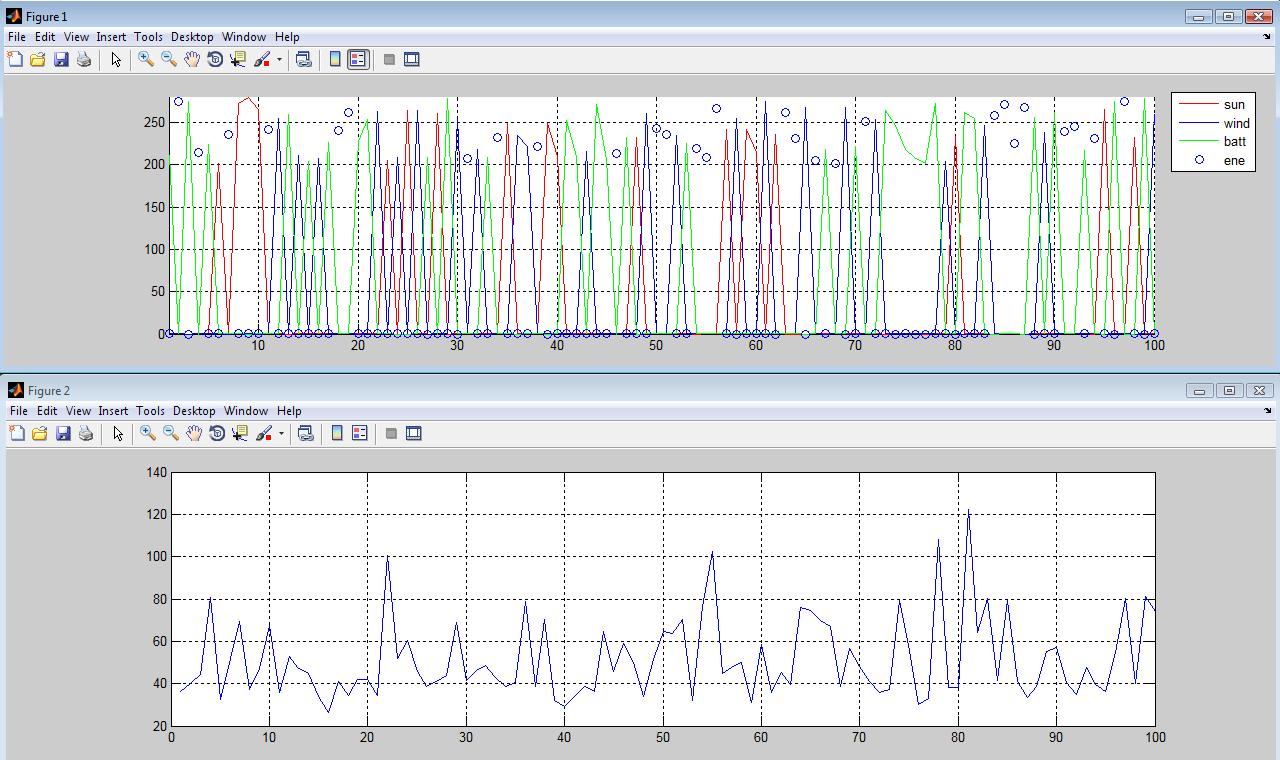
Usually the microgrid used wind turbine (wind), PV (sun), battery (batt) and load, aditional it have a PCC with electrical network external (ene). Both the technical operation as the economic operation are important during performance microgrid. In the figure I show the results of optimization process with imaginary energy prices from diferent source mentioned. In top figure is the power distribution between sources and down figure the total cost of each state. Programming linear has been used in this modelling and simulations.
Dr. Jorge Luis Mírez Tarrillo
Group of Mathematical Modeling and Numerical Simulation (GMMNS).
Universidad Nacional de Ingeniería. Lima, Perú.
E-mail: jmirez@uni.edu.pe
Website Personal: https://jorgemirez2002.wixsite.com/jorgemirez
Facebook http://www.facebook.com/jorgemirezperu
Linkedin https://www.linkedin.com/in/jorge-luis-mirez-tarrillo-94918423/
Scopus ID: https://www.scopus.com/authid/detail.uri?authorId=56488109800
Google Scholar: https://scholar.google.com/citations?user=_dSpp4YAAAAJ
MATLAB Group Admin in Facebook: https://www.facebook.com/groups/Matlab.Simulink.for.All
WhatsApp Channel/Canal: https://whatsapp.com/channel/0029VbCvpZsAYlUSz2esek2y

The present post describe the charge and discharge process of a battery bank of a microgrid. This microgrid have a aleatory voltage with inferior and superior limit. The current and electric power of charge and discharge is in picture. This simulation has writing and processing on Matlab/Simulink of MathaWorth Inc. Actually my interest is the control, optimization and management of microgrid DC. Greetings from Perú.
The information related to this post for sale for US $ 1000.00. You can make payments through PayPal account: jorgemirez2002@gmail.com or send an e-mail to receive PayPal invoice and make your payment quickly and easily. Tell us (through e-mail) the name of the input or inputs that interests you. // La información relacionada con este post en venta por US $ 1000.00. Usted puede hacer pagos a través de cuenta PayPal: jorgemirez2002@gmail.com o enviar un e-mail para recibir la factura de PayPal y hacer su pago de forma rápida y sencilla. Díganos (por medio de email) el nombre de la entrada o entradas que le interese.
Dr. Jorge Luis Mírez Tarrillo
Group of Mathematical Modeling and Numerical Simulation (GMMNS).
Universidad Nacional de Ingeniería. Lima, Perú.
E-mail: jmirez@uni.edu.pe
Website Personal: https://jorgemirez2002.wixsite.com/jorgemirez
Facebook http://www.facebook.com/jorgemirezperu
Linkedin https://www.linkedin.com/in/jorge-luis-mirez-tarrillo-94918423/
Scopus ID: https://www.scopus.com/authid/detail.uri?authorId=56488109800
Google Scholar: https://scholar.google.com/citations?user=_dSpp4YAAAAJ
MATLAB Group Admin in Facebook: https://www.facebook.com/groups/Matlab.Simulink.for.All
WhatsApp Channel/Canal: https://whatsapp.com/channel/0029VbCvpZsAYlUSz2esek2y

En este post muestro la portada de tesis «Implementación de un Sistema de Generación Distribuida con Energías Renovables ENDE Corporación» elaborado por Mario Torrico para la Universidad Privada del Valle en Cochabamba – Bolivia para optar el título de Ingeniero Electromecánico. Trabajo que compartimos durante unos tres meses de intercambio de información, modelos matemáticos y simulaciones numéricas, además de diálogo, envío de información, debate y varios borradores de tesis que iban y venían en el correo electrónico. Su defensa fue un éxito alcanzando la nota de 90/100 para alegría de Mario, de su familia, profesores, colegas y amigos. Éxitos Mario en tu vida profesional, tengo un colega amigo más :)D . En lo personal el tema fue muy interesante e implicó ingresar en una temática no desarrollada e innovadora… la portada de la tesis esta bonita también. Saludos a la plurinación boliviana… A quienes desean desarrollar conmigo sus tesis (Yo como Asesor Externo) a nivel de pregrado y postgrado, así como desarrollar sus proyectos de investigación tanto en universidades, institutos o empresas me escriben.
Dr. Jorge Luis Mírez Tarrillo
Group of Mathematical Modeling and Numerical Simulation (GMMNS).
Universidad Nacional de Ingeniería. Lima, Perú.
E-mail: jmirez@uni.edu.pe
Website Personal: https://jorgemirez2002.wixsite.com/jorgemirez
Facebook http://www.facebook.com/jorgemirezperu
Linkedin https://www.linkedin.com/in/jorge-luis-mirez-tarrillo-94918423/
Scopus ID: https://www.scopus.com/authid/detail.uri?authorId=56488109800
Google Scholar: https://scholar.google.com/citations?user=_dSpp4YAAAAJ
MATLAB Group Admin in Facebook: https://www.facebook.com/groups/Matlab.Simulink.for.All
WhatsApp Channel/Canal: https://whatsapp.com/channel/0029VbCvpZsAYlUSz2esek2y


The information related to this post for sale for US $ 100.00. You can make payments through PayPal account: jorgemirez2002@gmail.com or send an e-mail to receive PayPal invoice and make your payment quickly and easily. Tell us (through e-mail) the name of the input or inputs that interests you. // La información relacionada con este post en venta por US $ 100.00. Usted puede hacer pagos a través de cuenta PayPal: jorgemirez2002@gmail.com o enviar un e-mail para recibir la factura de PayPal y hacer su pago de forma rápida y sencilla. Díganos (por medio de email) el nombre de la entrada o entradas que le interese.
Dr. Jorge Luis Mírez Tarrillo
Group of Mathematical Modeling and Numerical Simulation (GMMNS).
Universidad Nacional de Ingeniería. Lima, Perú.
E-mail: jmirez@uni.edu.pe
Website Personal: https://jorgemirez2002.wixsite.com/jorgemirez
Facebook http://www.facebook.com/jorgemirezperu
Linkedin https://www.linkedin.com/in/jorge-luis-mirez-tarrillo-94918423/
Scopus ID: https://www.scopus.com/authid/detail.uri?authorId=56488109800
Google Scholar: https://scholar.google.com/citations?user=_dSpp4YAAAAJ
MATLAB Group Admin in Facebook: https://www.facebook.com/groups/Matlab.Simulink.for.All
WhatsApp Channel/Canal: https://whatsapp.com/channel/0029VbCvpZsAYlUSz2esek2y

Las energías renovables principalmente el viento y el sol tiene un comportamiento no predecible. Y muchas veces es evaluado al año, al mes o en promedio de velocidad de viento por día o lo que se presenta cada hora. Sin embargo, esto son sólo datos que permiten una valorización energético del recurso. Para la operación de pequeñas fuentes de energía, se hace necesario la toma de datos en tiempo más cortos, mucho más sin redes eléctricas inteligentes llamadas microgrid o smartgrid en donde los datos del recurso disponible influencia grandemente la gestión, optimización y predicción de comportamiento de la microred o smartgrid. La figura muestra el comportamiento de la irradiación global durante un día tomado en una ciudad europea – eso no quita de que haya algo similar en cualquier parte del mundo sólo que ellos se tomaron la molestia de publicarlo – en ella haciendo un zoom de la figura se puede ver que en cuestión de lecturas cada 15 segundos hay grandes variaciones de la irradiación solar y éstas tienen un comportamiento aleatorio (no tienen un patrón) y resulta muy interesante pues alimenta la imaginación y afina el criterio de quienes desarrollan e implementan sistemas de control para centrales solares fotovoltaicas.
The information related to this post for sale for US $ 25.00. You can make payments through PayPal account: jorgemirez2002@gmail.com or send an e-mail to receive PayPal invoice and make your payment quickly and easily. Tell us (through e-mail) the name of the input or inputs that interests you. // La información relacionada con este post en venta por US $ 25.00. Usted puede hacer pagos a través de cuenta PayPal: jorgemirez2002@gmail.com o enviar un e-mail para recibir la factura de PayPal y hacer su pago de forma rápida y sencilla. Díganos (por medio de email) el nombre de la entrada o entradas que le interese.
Dr. Jorge Luis Mírez Tarrillo
Group of Mathematical Modeling and Numerical Simulation (GMMNS).
Universidad Nacional de Ingeniería. Lima, Perú.
E-mail: jmirez@uni.edu.pe
Website Personal: https://jorgemirez2002.wixsite.com/jorgemirez
Facebook http://www.facebook.com/jorgemirezperu
Linkedin https://www.linkedin.com/in/jorge-luis-mirez-tarrillo-94918423/
Scopus ID: https://www.scopus.com/authid/detail.uri?authorId=56488109800
Google Scholar: https://scholar.google.com/citations?user=_dSpp4YAAAAJ
MATLAB Group Admin in Facebook: https://www.facebook.com/groups/Matlab.Simulink.for.All
WhatsApp Channel/Canal: https://whatsapp.com/channel/0029VbCvpZsAYlUSz2esek2y


Atiendo a esta reunión bastante importante es que gracias al apoyo de CYTED y CEDER-CIEMAT es que daremos esta conferencia en el marco del IIi Congreso Iberoamericano de Microredes con Generación Distribuida de Renovables. Este evento sirve de marco para el intercambio de información, experiencias y el tomar en contacto con investigadores provenientes de diferentes países de habla hispana y no hispana, dedicados al sector energía y otros sectores incluyendo el aeroespacial en que el uso de fuentes de energía como sol, viento, biomasa, celdas de combustible, entre otras es bastante importante. Y no sólo eso, importante y quizás mucho más lo que es las técnicas de control, predicción, modelamiento y simulación, software desarrollado que son las cosas de mayor valor agregado, la combinación de diferentes escenarios de trabajo y de implementación en industrias, centros de atención de salud, barcos, naves espaciales, soporte de vida en condiciones extremas, etc. Les dejo la portada de mi presentación y cualquier comunicación a jorgemirez2002@gmail.com, y quienes estén por acá, estaremos conversando.
The information related to this post for sale for US $ 100.00. You can make payments through PayPal account: jorgemirez2002@gmail.com or send an e-mail to receive PayPal invoice and make your payment quickly and easily. Tell us (through e-mail) the name of the input or inputs that interests you. // La información relacionada con este post en venta por US $ 100.00. Usted puede hacer pagos a través de cuenta PayPal: jorgemirez2002@gmail.com o enviar un e-mail para recibir la factura de PayPal y hacer su pago de forma rápida y sencilla. Díganos (por medio de email) el nombre de la entrada o entradas que le interese.
Dr. Jorge Luis Mírez Tarrillo
Group of Mathematical Modeling and Numerical Simulation (GMMNS).
Universidad Nacional de Ingeniería. Lima, Perú.
E-mail: jmirez@uni.edu.pe
Website Personal: https://jorgemirez2002.wixsite.com/jorgemirez
Facebook http://www.facebook.com/jorgemirezperu
Linkedin https://www.linkedin.com/in/jorge-luis-mirez-tarrillo-94918423/
Scopus ID: https://www.scopus.com/authid/detail.uri?authorId=56488109800
Google Scholar: https://scholar.google.com/citations?user=_dSpp4YAAAAJ
MATLAB Group Admin in Facebook: https://www.facebook.com/groups/Matlab.Simulink.for.All
WhatsApp Channel/Canal: https://whatsapp.com/channel/0029VbCvpZsAYlUSz2esek2y
Estimados lectores, éstas son las diapositivas de la ponencia que daré el día jueves 19 de noviembre del 2015 en la Universidad Nacional San Agustín de Arequipa como parte de las actividades del XXII Simposio Peruano de Energía Solar que se está realizando desde del 17 al 21 de Noviembre en Arequipa – Perú. Quedan todos invitados, igualmente bienvenidas sus preguntas, opiniones, sugerencias y el hacer cooperación académica o conversar sobre asuntos laborales. Arequipa está cerca de Bolivia y Chile.


The information related to this post for sale for US $ 100.00. You can make payments through PayPal account: jorgemirez2002@gmail.com or send an e-mail to receive PayPal invoice and make your payment quickly and easily. Tell us (through e-mail) the name of the input or inputs that interests you. // La información relacionada con este post en venta por US $ 100.00. Usted puede hacer pagos a través de cuenta PayPal: jorgemirez2002@gmail.com o enviar un e-mail para recibir la factura de PayPal y hacer su pago de forma rápida y sencilla. Díganos (por medio de email) el nombre de la entrada o entradas que le interese.
Dr. Jorge Luis Mírez Tarrillo
Group of Mathematical Modeling and Numerical Simulation (GMMNS).
Universidad Nacional de Ingeniería. Lima, Perú.
E-mail: jmirez@uni.edu.pe
Website Personal: https://jorgemirez2002.wixsite.com/jorgemirez
Facebook http://www.facebook.com/jorgemirezperu
Linkedin https://www.linkedin.com/in/jorge-luis-mirez-tarrillo-94918423/
Scopus ID: https://www.scopus.com/authid/detail.uri?authorId=56488109800
Google Scholar: https://scholar.google.com/citations?user=_dSpp4YAAAAJ
MATLAB Group Admin in Facebook: https://www.facebook.com/groups/Matlab.Simulink.for.All
WhatsApp Channel/Canal: https://whatsapp.com/channel/0029VbCvpZsAYlUSz2esek2y
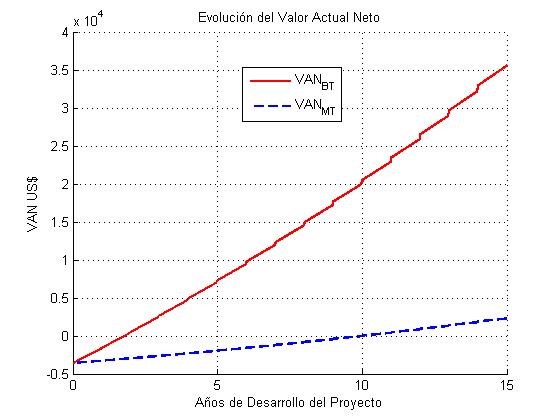
Cualquier instalación de equipos de energía involucra en sí la realización de un proyecto que parte desde atender una necesidad energética o en todo caso proyectarse hacia una demanda energética por abastecerse. Una de las fuentes son las alternativas renovables, las que hay que considerar que son las turbinas eólicas, energía solar, etc. Estas tienen un costo inicial que en sí es una inversión que se cuenta en negativo, a partir de ahí el proyecto va recuperando su inversión en la medida que el costo de energía producida es menor al que se hubiera seguido usando la misma fuente energética. La figura muestra dos casos tanto para un usuario en baja tensión como en media tensión con valores asumidos, de implementación de paneles solares. Un usuario en baja tensión recupera mucho más rápido su inversión, pero al final del proyecto que viene a ser unos 15 años ambos están en ganancia. Recordar que los paneles solares los venden ahora con una garantía de 20 años y hasta de 25 años. Los modelo matemático y las curvas son hechas en Matlab de MathWork Inc.
The information related to this post for sale for US $ 200.00. You can make payments through PayPal account: jorgemirez2002@gmail.com or send an e-mail to receive PayPal invoice and make your payment quickly and easily. Tell us (through e-mail) the name of the input or inputs that interests you. // La información relacionada con este post en venta por US $ 200.00. Usted puede hacer pagos a través de cuenta PayPal: jorgemirez2002@gmail.com o enviar un e-mail para recibir la factura de PayPal y hacer su pago de forma rápida y sencilla. Díganos (por medio de email) el nombre de la entrada o entradas que le interese.
Dr. Jorge Luis Mírez Tarrillo
Group of Mathematical Modeling and Numerical Simulation (GMMNS).
Universidad Nacional de Ingeniería. Lima, Perú.
E-mail: jmirez@uni.edu.pe
Website Personal: https://jorgemirez2002.wixsite.com/jorgemirez
Facebook http://www.facebook.com/jorgemirezperu
Linkedin https://www.linkedin.com/in/jorge-luis-mirez-tarrillo-94918423/
Scopus ID: https://www.scopus.com/authid/detail.uri?authorId=56488109800
Google Scholar: https://scholar.google.com/citations?user=_dSpp4YAAAAJ
MATLAB Group Admin in Facebook: https://www.facebook.com/groups/Matlab.Simulink.for.All
WhatsApp Channel/Canal: https://whatsapp.com/channel/0029VbCvpZsAYlUSz2esek2y
Blog in ENGLISH

Compra/Buy – Haz una donación/Make a donation

Dear reader, if you wish to make a donation or are interested in any information or code, please contact me (e-mail: jmirez@uni.edu.pe). Donations will allow you to continue studying and researching, and also to provide more information on this blog. My PayPal account is jorgemirez2002@gmail.com or if it is by bank transfer write to my email jmirez@uni.edu.pe. Any amount of money is welcome. Thank you.
Estimado lector, si desean hacer una donación o le interesa alguna información o código, favor ponerse en contacto con mi persona (e-mail: jmirez@uni.edu.pe). Las donaciones va a permitir seguir estudiando e investigando, y además, el poder brindar más información en este blog. Mi cuenta en PayPal es jorgemirez2002@gmail.com o si es por transferencia bancaria escribirme a mi correo jmirez@uni.edu.pe. Cualquier cantidad de dinero es bienvenido. Gracias.
Datos Generales
Good day. My full name is Jorge Luis MIREZ TARRILLO.
I am Peruvian and live in Lima, capital of Perú in South America.I am Mechanical Electrical Engineering, MSc Physics and Dr. Physics (title doctoral thesis: Control, Optimization, and Management of Microgrid Current Direct)
Too, actually job as Principal Professor in Faculty of Oil, Gas and Petrochemical Engineering of Universidad Nacional de Ingeniería (National University of Engineering) in Lima – PERU (Courses: Modern Physics, Differential Equations and Research's Methodology)
My subjects of my interest are control, signal processing, optimization, simulation, biomedical research, smart grid, microgrid, water.
I have experience in Matlab/Simulink programming, biomedical equipment, electrical systems, renewable energies, microgrids, saturated steam systems 100 psi and organizing academic events.

Comentarios Recientes
Elementos que compon… en J506: Los elementos de un paqu… Dr. Jorge Mírez en Message by IEEE Community Dr. Jorge Mírez en J546: Simulación de campos mag… jose luis huayanay v… en Message by IEEE Community Cesar Aviles en J546: Simulación de campos mag… Dr. Jorge Mírez en J518: La herramienta pdetool d… Dr. Jorge Mírez en J496: Simulación en Matlab/Sim… Raúl Barrios Elizarr… en J496: Simulación en Matlab/Sim… jose luis huayanay v… en J518: La herramienta pdetool d… MSc. Jorge Mírez en J281: La Rosa de Vientos: Frec…


Debe estar conectado para enviar un comentario.