Archive for the ‘Microgrid DC’ Category

As shown in Figure, the proposed DC micro-grid consists of uncontrolled DGs such as wind power, photovoltaic generation and controlled fuel-cell sources as well as energy storage elements such as super capacitors and batteries, DC loads and grid-tied converters. The wind power system consists of a 2kW PMSG (permanent magnet synchronous generator) which operates under a wide range of wind-speeds without a gear box, and a three-phase PWM converter which converts variable voltage, variable frequency AC voltage to fixed DC voltage with MPPT (maximum power point tracking) capability. The PV (Photo-Voltaic) array converter is a 1.5kW transformer-less boost converter which operates with the MPPT method under varying levels of irradiation and temperature. Since a 1.2 kW PEM (proton exchange membrane) type fuel cell stack generates a low varying DC voltage that is around 26V and is strongly influenced by ripple current, a three-phase isolated DC-DC converter with an active clamp is employed to limit the ripple current into the fuel cells and to increase efficiency. Bidirectional two-phase interleaved converters are used to charge or discharge into the elements. Energy storage elements such as super-capacitors and batteries play an important role for the power management of DC microgrids. They ensure a secure grid network and provide high quality power. A grid-tied three-phase converter, which is a conventional three-phase PWM converter, maintains a constant common DC grid voltage and regulates both the reactive power and the harmonic components in PCC. The DC load is simplified as a variable resistor.
Source:
Ji-Heon Lee, Hyun-Jun Kim, Byung-Moon Han, Yu-Seok Jeong, Hyo-Sik Yang and Han-Ju Cha «DC Micro-Grid Operational Analysis with a Detailed Simulation Model for Distributed Generation» Journal of Power Electronics, Vol. 11, No. 3, May 2011
Dr. Jorge Luis Mírez Tarrillo
Group of Mathematical Modeling and Numerical Simulation (GMMNS).
Universidad Nacional de Ingeniería. Lima, Perú.
E-mail: jmirez@uni.edu.pe
Website Personal: https://jorgemirez2002.wixsite.com/jorgemirez
Facebook http://www.facebook.com/jorgemirezperu
Linkedin https://www.linkedin.com/in/jorge-luis-mirez-tarrillo-94918423/
Scopus ID: https://www.scopus.com/authid/detail.uri?authorId=56488109800
Google Scholar: https://scholar.google.com/citations?user=_dSpp4YAAAAJ
MATLAB Group Admin in Facebook: https://www.facebook.com/groups/Matlab.Simulink.for.All
WhatsApp Channel/Canal: https://whatsapp.com/channel/0029VbCvpZsAYlUSz2esek2y
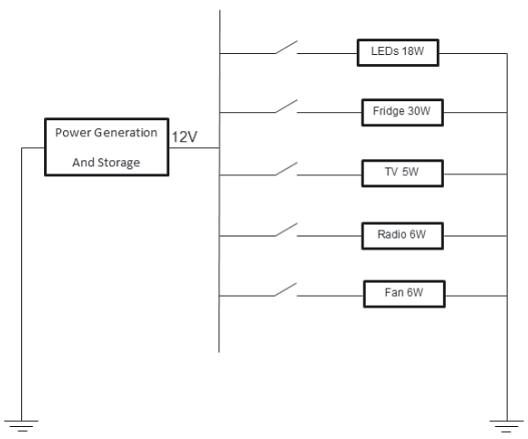
The figure shows the simplified distribution system of the DC microgrid system. The wire sizing has to comply with the South Africa National Standard (SANS) on the wiring of premises 6 mm2 for the generation and storage side, and 2.5 mm2 for the distribution side will allow an acceptable tolerance of voltage drop for this low voltage system, refer to SANS 10142
Source:
Gilbert M Bokanga, Atanda Raji, Mohammed TE Kahn. “Design of a low voltage DC microgrid system for rural electrification in South Africa”. Journal of Energy in Southern Africa • Vol 25 No 2 • May 2014.
Dr. Jorge Luis Mírez Tarrillo
Group of Mathematical Modeling and Numerical Simulation (GMMNS).
Universidad Nacional de Ingeniería. Lima, Perú.
E-mail: jmirez@uni.edu.pe
Website Personal: https://jorgemirez2002.wixsite.com/jorgemirez
Facebook http://www.facebook.com/jorgemirezperu
Linkedin https://www.linkedin.com/in/jorge-luis-mirez-tarrillo-94918423/
Scopus ID: https://www.scopus.com/authid/detail.uri?authorId=56488109800
Google Scholar: https://scholar.google.com/citations?user=_dSpp4YAAAAJ
MATLAB Group Admin in Facebook: https://www.facebook.com/groups/Matlab.Simulink.for.All
WhatsApp Channel/Canal: https://whatsapp.com/channel/0029VbCvpZsAYlUSz2esek2y

Hybrid renewable energy systems have been accepted as possible means of electrifying rural outlying areas where it is too expensive to extend the grid to supply them. As stipulated in the introduction, the system is intended to power households, and it must be cost effective; therefore, only solar energy system is retained. Figure 1 shows the overview of the low voltage DC microgrid system
Source:
Gilbert M Bokanga, Atanda Raji, Mohammed TE Kahn. «Design of a low voltage DC microgrid system for rural electrification in South Africa». Journal of Energy in Southern Africa • Vol 25 No 2 • May 2014.
Dr. Jorge Luis Mírez Tarrillo
Group of Mathematical Modeling and Numerical Simulation (GMMNS).
Universidad Nacional de Ingeniería. Lima, Perú.
E-mail: jmirez@uni.edu.pe
Website Personal: https://jorgemirez2002.wixsite.com/jorgemirez
Facebook http://www.facebook.com/jorgemirezperu
Linkedin https://www.linkedin.com/in/jorge-luis-mirez-tarrillo-94918423/
Scopus ID: https://www.scopus.com/authid/detail.uri?authorId=56488109800
Google Scholar: https://scholar.google.com/citations?user=_dSpp4YAAAAJ
MATLAB Group Admin in Facebook: https://www.facebook.com/groups/Matlab.Simulink.for.All
WhatsApp Channel/Canal: https://whatsapp.com/channel/0029VbCvpZsAYlUSz2esek2y

This is a part of my results about interconnected of two microgrids. It have flow power in function a its capacities, but probably a deficit and/or surplus in supply or demand in both microgrids is present. Negative is deficit in microgrid to import from other source different to other microgrid. Positivo is surplus in microgrid by export to other demand different at other microgrid. The figure is a simple example for to show that it is possible using mathematical modelling and simulations on Matlab of MathWork Inc.
Dr. Jorge Luis Mírez Tarrillo
Group of Mathematical Modeling and Numerical Simulation (GMMNS).
Universidad Nacional de Ingeniería. Lima, Perú.
E-mail: jmirez@uni.edu.pe
Website Personal: https://jorgemirez2002.wixsite.com/jorgemirez
Facebook http://www.facebook.com/jorgemirezperu
Linkedin https://www.linkedin.com/in/jorge-luis-mirez-tarrillo-94918423/
Scopus ID: https://www.scopus.com/authid/detail.uri?authorId=56488109800
Google Scholar: https://scholar.google.com/citations?user=_dSpp4YAAAAJ
MATLAB Group Admin in Facebook: https://www.facebook.com/groups/Matlab.Simulink.for.All
WhatsApp Channel/Canal: https://whatsapp.com/channel/0029VbCvpZsAYlUSz2esek2y

This is part of my results in Matlab about power flow between two microgrids interconected. In different color shown the direction of power flow (from Microgrid 1 to Microgrid 2, and from Microgrid 2 to Microgrid 1). The figure is a simple example for to show that it is possible using mathematical modelling and simulations on Matlab of MathWork Inc.
Dr. Jorge Luis Mírez Tarrillo
Group of Mathematical Modeling and Numerical Simulation (GMMNS).
Universidad Nacional de Ingeniería. Lima, Perú.
E-mail: jmirez@uni.edu.pe
Website Personal: https://jorgemirez2002.wixsite.com/jorgemirez
Facebook http://www.facebook.com/jorgemirezperu
Linkedin https://www.linkedin.com/in/jorge-luis-mirez-tarrillo-94918423/
Scopus ID: https://www.scopus.com/authid/detail.uri?authorId=56488109800
Google Scholar: https://scholar.google.com/citations?user=_dSpp4YAAAAJ
MATLAB Group Admin in Facebook: https://www.facebook.com/groups/Matlab.Simulink.for.All
WhatsApp Channel/Canal: https://whatsapp.com/channel/0029VbCvpZsAYlUSz2esek2y

The dc microgrid considered is schematically shown in Fig. As for a typical dc microgrid, it consists of the following mainelements:
• variable (nondeterministic) generations and, in this example, a wind turbine using permanent-magnet synchronous generator (PMSG); the maximum power output from the wind turbine is largely determined by the wind condition;
• controlled (deterministic) generation (e.g., a diesel generator or with ac grid connection); as shown in Fig, the dc grid in this example is connected to an external ac system via a dc-ac converter which provides bidirectionalpower-flow capability;
• variable loads with different characteristics; a number of ac and dc loads can be anticipated (e.g., ac loads via dc-ac inverters, dc loads via dc-dc converters, and direct-connected dc loads, etc.);
• energy storage (ES) system to accommodate the presence of variable generation and load, and the requirement of possible island operation (i.e., connection to the external ac system being lost)
Reference:
Lie Xu, Dong Chen. “Control and Operation of a DC Microgrid With Variable Generation and Energy Storage”. IEEE Transactions on Power Delivery, Vol. 26, No. 4, October 2011
Dr. Jorge Luis Mírez Tarrillo
Group of Mathematical Modeling and Numerical Simulation (GMMNS).
Universidad Nacional de Ingeniería. Lima, Perú.
E-mail: jmirez@uni.edu.pe
Website Personal: https://jorgemirez2002.wixsite.com/jorgemirez
Facebook http://www.facebook.com/jorgemirezperu
Linkedin https://www.linkedin.com/in/jorge-luis-mirez-tarrillo-94918423/
Scopus ID: https://www.scopus.com/authid/detail.uri?authorId=56488109800
Google Scholar: https://scholar.google.com/citations?user=_dSpp4YAAAAJ
MATLAB Group Admin in Facebook: https://www.facebook.com/groups/Matlab.Simulink.for.All
WhatsApp Channel/Canal: https://whatsapp.com/channel/0029VbCvpZsAYlUSz2esek2y

The DC bus coupled microgrid investigated in this paper is shown in Fig. 1. DC/DC converters for PV modules, a bidirectional DC/DC converter for battery, a bi-directional DC/AC converter and local loads share a DC bus. The modular photovoltaic generation system is the key element in this DC microgrid, which consists of three DC/DC converters with modular design and same ratings. These modular converters transfer the power generated by PV arrays to DC bus. The battery with bi-directional DC/DC
converter is used to balance the power differences between PV power supplies and local loads in islanding mode. The local loads include the auxiliary power supplies for microgrid operations, such as control/monitoring of PV arrays, battery monitoring, control/driving of converters. The bi-directional DC/AC converter is used to realize the connection between DC microgrid and AC grid
Reference:
Li Zhan, Tianjin Wu, Yan Xing, Kai Sun, Josep M. Guerrero. “Power Control of DC Microgrid Using DC Bus Signaling”. Applied Power Electronics Conference and Exposition (APEC), 2011 Twenty-Sixth Annual IEEE.
Dr. Jorge Luis Mírez Tarrillo
Group of Mathematical Modeling and Numerical Simulation (GMMNS).
Universidad Nacional de Ingeniería. Lima, Perú.
E-mail: jmirez@uni.edu.pe
Website Personal: https://jorgemirez2002.wixsite.com/jorgemirez
Facebook http://www.facebook.com/jorgemirezperu
Linkedin https://www.linkedin.com/in/jorge-luis-mirez-tarrillo-94918423/
Scopus ID: https://www.scopus.com/authid/detail.uri?authorId=56488109800
Google Scholar: https://scholar.google.com/citations?user=_dSpp4YAAAAJ
MATLAB Group Admin in Facebook: https://www.facebook.com/groups/Matlab.Simulink.for.All
WhatsApp Channel/Canal: https://whatsapp.com/channel/0029VbCvpZsAYlUSz2esek2y

This DC microgrid have three photovoltaic solar plant, pne DC load, battery bank and microsource with DC/AC 3 -Phase Bi-directional Inverter, all components conected to DC bus of microgrid. Great !!
Reference:
T. F. Wu, C. H. Chang, L. C. Lin and Y. C. Chang. “DC-Bus Voltage Control for Three-Phase Bi-directional Inverter in DC Microgrid Applications”. Applied Power Electronics Conference and Exposition (APEC), 2012 Twenty-Seventh Annual IEEE
Dr. Jorge Luis Mírez Tarrillo
Group of Mathematical Modeling and Numerical Simulation (GMMNS).
Universidad Nacional de Ingeniería. Lima, Perú.
E-mail: jmirez@uni.edu.pe
Website Personal: https://jorgemirez2002.wixsite.com/jorgemirez
Facebook http://www.facebook.com/jorgemirezperu
Linkedin https://www.linkedin.com/in/jorge-luis-mirez-tarrillo-94918423/
Scopus ID: https://www.scopus.com/authid/detail.uri?authorId=56488109800
Google Scholar: https://scholar.google.com/citations?user=_dSpp4YAAAAJ
MATLAB Group Admin in Facebook: https://www.facebook.com/groups/Matlab.Simulink.for.All
WhatsApp Channel/Canal: https://whatsapp.com/channel/0029VbCvpZsAYlUSz2esek2y

The New Energy and Industrial Technology Development Organization (NEDO) is Japan’s largest public R&D management organization for promoting the development of advanced industrial, environmental, new energy and energy conservation technologies. One of the important objectives of NEDO’s R&D is solving problems that arise when distributed and renewable resources are connected to power grids. These issues arise because the power output from most renewable energy resources fluctuates with weather conditions, and connecting them to traditional power grids may create power quality issues. Therefore, the development of energy management systems, energy storage applications and forecasting
methods is important for resolving connection issues. NEDO is promoting several grid connection related projects, as shown in Figure. In those projects, two microgrid-related projects are involved. After the year 2010, NEDO started several international smart community projects
Source:
Nikos Hatziargyriou. “Microgrids Architectures and Control”. 2014 John Wiley and Sons Ltd. ISBN: 978-1-118-72068-4.
Dr. Jorge Luis Mírez Tarrillo
Group of Mathematical Modeling and Numerical Simulation (GMMNS).
Universidad Nacional de Ingeniería. Lima, Perú.
E-mail: jmirez@uni.edu.pe
Website Personal: https://jorgemirez2002.wixsite.com/jorgemirez
Facebook http://www.facebook.com/jorgemirezperu
Linkedin https://www.linkedin.com/in/jorge-luis-mirez-tarrillo-94918423/
Scopus ID: https://www.scopus.com/authid/detail.uri?authorId=56488109800
Google Scholar: https://scholar.google.com/citations?user=_dSpp4YAAAAJ
MATLAB Group Admin in Facebook: https://www.facebook.com/groups/Matlab.Simulink.for.All
WhatsApp Channel/Canal: https://whatsapp.com/channel/0029VbCvpZsAYlUSz2esek2y

This simulation is about microgrid with solar and wind source, battery storage and utility network. It have cost differents and the simulation is para 96 time’s step. The distance between time’s step is configurable and it depend of characteristic of each source and all source in general. Made on Matlab of Math/Works Inc.
Dr. Jorge Luis Mírez Tarrillo
Group of Mathematical Modeling and Numerical Simulation (GMMNS).
Universidad Nacional de Ingeniería. Lima, Perú.
E-mail: jmirez@uni.edu.pe
Website Personal: https://jorgemirez2002.wixsite.com/jorgemirez
Facebook http://www.facebook.com/jorgemirezperu
Linkedin https://www.linkedin.com/in/jorge-luis-mirez-tarrillo-94918423/
Scopus ID: https://www.scopus.com/authid/detail.uri?authorId=56488109800
Google Scholar: https://scholar.google.com/citations?user=_dSpp4YAAAAJ
MATLAB Group Admin in Facebook: https://www.facebook.com/groups/Matlab.Simulink.for.All
WhatsApp Channel/Canal: https://whatsapp.com/channel/0029VbCvpZsAYlUSz2esek2y

Satisfaction of local consumption implies that the power produced by microgeneration is used to supply partly or wholly in-site consumption. In such a case, there is no requirement for separate metering of microsource generation (also called “net-metering”). However, on-site generation and on-site load need to be metered separately when microsource units appear as independent generators that sell all their production directly to the network and are not financially related to end consumers. In this case, local consumption is a market opportunity that can be easily overlooked by all players (see Figure). There are two main advantages of promoting local consumption satisfaction within a microgrid:
1. End consumers are provided with more choices in retail power supply.
2. Microsource operators have the possibility to obtain quasi-retail prices via selling locallyto minimize network charges.
The local retail market concept is therefore directly linked to the local consumption mechanism, which can also be seen as a two-sided hedging tool for both demand and supply players for reducing market risk: consumers can use the local market to hedge against high market price, while microsources can use the local market to hedge against low market price.
Source:
Nikos Hatziargyriou. “Microgrids Architectures and Control”. 2014 John Wiley and Sons Ltd. ISBN: 978-1-118-72068-4.
Dr. Jorge Luis Mírez Tarrillo
Group of Mathematical Modeling and Numerical Simulation (GMMNS).
Universidad Nacional de Ingeniería. Lima, Perú.
E-mail: jmirez@uni.edu.pe
Website Personal: https://jorgemirez2002.wixsite.com/jorgemirez
Facebook http://www.facebook.com/jorgemirezperu
Linkedin https://www.linkedin.com/in/jorge-luis-mirez-tarrillo-94918423/
Scopus ID: https://www.scopus.com/authid/detail.uri?authorId=56488109800
Google Scholar: https://scholar.google.com/citations?user=_dSpp4YAAAAJ
MATLAB Group Admin in Facebook: https://www.facebook.com/groups/Matlab.Simulink.for.All
WhatsApp Channel/Canal: https://whatsapp.com/channel/0029VbCvpZsAYlUSz2esek2y

In Figure, the microgrid concept is further clarified by examples that highlight three essential microgrid features: local load, local microsources and intelligent control. In many countries environmental protection is romoted by the provision of carbon credits by the use of RES and CHP technologies; this should be also added as a microgrids feature. Absence of one or more features would be better described by DG interconnection cases or DSI (Demand Side integration) case.
Source:
Nikos Hatziargyriou. “Microgrids Architectures and Control”. 2014 John Wiley and Sons Ltd. ISBN: 978-1-118-72068-4.
Dr. Jorge Luis Mírez Tarrillo
Group of Mathematical Modeling and Numerical Simulation (GMMNS).
Universidad Nacional de Ingeniería. Lima, Perú.
E-mail: jmirez@uni.edu.pe
Website Personal: https://jorgemirez2002.wixsite.com/jorgemirez
Facebook http://www.facebook.com/jorgemirezperu
Linkedin https://www.linkedin.com/in/jorge-luis-mirez-tarrillo-94918423/
Scopus ID: https://www.scopus.com/authid/detail.uri?authorId=56488109800
Google Scholar: https://scholar.google.com/citations?user=_dSpp4YAAAAJ
MATLAB Group Admin in Facebook: https://www.facebook.com/groups/Matlab.Simulink.for.All
WhatsApp Channel/Canal: https://whatsapp.com/channel/0029VbCvpZsAYlUSz2esek2y

A microgrid appears at a large variety of scales: it can be defined at the level of a LV grid, a LV feeder or a LV house – examples are given in Figure. As a microgrid grows in scale, it will likely be equipped with more balancing capacities and feature better controllability to reduce the intermittencies of load and RES. In general, the maximum capacity of a microgrid (in terms of peak load demand) is limited to few MW (at least at the European scale, other regions may have different upper limits, see Chapter 6). At higher voltage levels, multimicrogrid concepts are applied, implying the coordination of interconnected, but separate microgrids in collaboration with upstream connected DGs and MV network controls. The operation of multi-microgrids)…
Source:
Nikos Hatziargyriou. “Microgrids Architectures and Control”. 2014 John Wiley and Sons Ltd. ISBN: 978-1-118-72068-4.
Dr. Jorge Luis Mírez Tarrillo
Group of Mathematical Modeling and Numerical Simulation (GMMNS).
Universidad Nacional de Ingeniería. Lima, Perú.
E-mail: jmirez@uni.edu.pe
Website Personal: https://jorgemirez2002.wixsite.com/jorgemirez
Facebook http://www.facebook.com/jorgemirezperu
Linkedin https://www.linkedin.com/in/jorge-luis-mirez-tarrillo-94918423/
Scopus ID: https://www.scopus.com/authid/detail.uri?authorId=56488109800
Google Scholar: https://scholar.google.com/citations?user=_dSpp4YAAAAJ
MATLAB Group Admin in Facebook: https://www.facebook.com/groups/Matlab.Simulink.for.All
WhatsApp Channel/Canal: https://whatsapp.com/channel/0029VbCvpZsAYlUSz2esek2y

During operation a microgrid, sometimes; renewable energy sources and the external power grid, dispatched electric energy simultaneously. Sometimes, many sources is neccesary for supply to electric load. Also, all it, considering both economic and technical criteria. The figure represent la connection and disconnetion of sources for each state of performance of a microgrid. Too, it is applicable to other similar electric systems.
Dr. Jorge Luis Mírez Tarrillo
Group of Mathematical Modeling and Numerical Simulation (GMMNS).
Universidad Nacional de Ingeniería. Lima, Perú.
E-mail: jmirez@uni.edu.pe
Website Personal: https://jorgemirez2002.wixsite.com/jorgemirez
Facebook http://www.facebook.com/jorgemirezperu
Linkedin https://www.linkedin.com/in/jorge-luis-mirez-tarrillo-94918423/
Scopus ID: https://www.scopus.com/authid/detail.uri?authorId=56488109800
Google Scholar: https://scholar.google.com/citations?user=_dSpp4YAAAAJ
MATLAB Group Admin in Facebook: https://www.facebook.com/groups/Matlab.Simulink.for.All
WhatsApp Channel/Canal: https://whatsapp.com/channel/0029VbCvpZsAYlUSz2esek2y

In a microgrid, each energy source is required according to the criterion of costs and production capacity. During the operation time, accumulative energy from each source is represented in the figure. Criteria of linear optimization has been used in this modelling and simulation. This allows determining the nominal capacity and the ability to respond to sudden requests. Made on Matlab of MathWorks Inc.
Dr. Jorge Luis Mírez Tarrillo
Group of Mathematical Modeling and Numerical Simulation (GMMNS).
Universidad Nacional de Ingeniería. Lima, Perú.
E-mail: jmirez@uni.edu.pe
Website Personal: https://jorgemirez2002.wixsite.com/jorgemirez
Facebook http://www.facebook.com/jorgemirezperu
Linkedin https://www.linkedin.com/in/jorge-luis-mirez-tarrillo-94918423/
Scopus ID: https://www.scopus.com/authid/detail.uri?authorId=56488109800
Google Scholar: https://scholar.google.com/citations?user=_dSpp4YAAAAJ
MATLAB Group Admin in Facebook: https://www.facebook.com/groups/Matlab.Simulink.for.All
WhatsApp Channel/Canal: https://whatsapp.com/channel/0029VbCvpZsAYlUSz2esek2y

A microgrid operate in state stable in this simulation made on Matlab. Each state represent a determinate time (10 minutes, 15 minutes o more o less). But during this time, la Microgrid makes calculations of energy cost dispatched for each source. The imagen is the global cost of microgrid (or similar or other electric system considering all costs). The microgrid optimizer decides in base a linear programming the connection and disconnection of each source.
Dr. Jorge Luis Mírez Tarrillo
Group of Mathematical Modeling and Numerical Simulation (GMMNS).
Universidad Nacional de Ingeniería. Lima, Perú.
E-mail: jmirez@uni.edu.pe
Website Personal: https://jorgemirez2002.wixsite.com/jorgemirez
Facebook http://www.facebook.com/jorgemirezperu
Linkedin https://www.linkedin.com/in/jorge-luis-mirez-tarrillo-94918423/
Scopus ID: https://www.scopus.com/authid/detail.uri?authorId=56488109800
Google Scholar: https://scholar.google.com/citations?user=_dSpp4YAAAAJ
MATLAB Group Admin in Facebook: https://www.facebook.com/groups/Matlab.Simulink.for.All
WhatsApp Channel/Canal: https://whatsapp.com/channel/0029VbCvpZsAYlUSz2esek2y

Microgrids are both partand beneficiariesof the smart-grid concept. Is evident thatthere are objectives
shared between microgrids and the smart-grid concept: reduce the costs of energy and the reliability, efficiency and security improvement. Also, there are benefits which are linked to the useof smart-grid technologies: the deployment ofgreen technologies, different levels of quality and the use of demand response strategies
Source:
René B. Martínez-Cid. «Renewable-Driven Microgrids in Isolated Communities». A thesis submitted in partial fulfillment of the requirements for the degree of Master of Science in Electrical Engineering. University of Puerto Rico. Mayagüez Campus. 2009.
Dr. Jorge Luis Mírez Tarrillo
Group of Mathematical Modeling and Numerical Simulation (GMMNS).
Universidad Nacional de Ingeniería. Lima, Perú.
E-mail: jmirez@uni.edu.pe
Website Personal: https://jorgemirez2002.wixsite.com/jorgemirez
Facebook http://www.facebook.com/jorgemirezperu
Linkedin https://www.linkedin.com/in/jorge-luis-mirez-tarrillo-94918423/
Scopus ID: https://www.scopus.com/authid/detail.uri?authorId=56488109800
Google Scholar: https://scholar.google.com/citations?user=_dSpp4YAAAAJ
MATLAB Group Admin in Facebook: https://www.facebook.com/groups/Matlab.Simulink.for.All
WhatsApp Channel/Canal: https://whatsapp.com/channel/0029VbCvpZsAYlUSz2esek2y

Community/Utility Microgrids:The word “community” implies a geographical region that includes residential customers. Most observers predict that this class of microgrids will not achieve widespread commercial acceptance until standards are in place and regulatory barriers are removed.
Commercial/Industrial:The first “modern” industrial microgrid in the United States was a 64 MW facility constructed in 1955 at the Whitling Refinery in Indiana. All told, 455 megawatts (MW) of these vintage microgrids are currently online in the United States. Unlike today’s conceptual state-of-the-art models, these initial designs for the petrochemical industry still feature centralizedcontrols and fossil-fueled generation sets. Japan is a modern leader in the commercial/industrial sector, though most of its microgrids include governmental and other institutional customers.
Institutional/Campus:Because of the advantage of common ownership, this class of microgrids offers the best near-term development opportunity. At present, 322 MW of college campus microgrids are up and running in the United States, with more sophisticated state-of-the-art microgrids on the drawing boards. In the U.S., 40% of future microgrids will be developed in this market segment, adding 940 MW of new
capacity valued at $2.76 billion by 2015.
Remote Off-Grid Systems:This segment represents the greatest number of microgrids currently operating globally, but it has the smallest average capacity. While many systems have historically featured diesel distributed energy generation (DEG), the largest growth sector is solar photovoltaics (PV). Small wind is projected to play a growing role, as well.
Military Microgrids:The smallest market segment, these microgrids are just now being developed. They are integrating Renewable Distributed Energy Generation (RDEG) as a way to secure power supply without being dependent on any supplied fuel. GE and Sandia are moving forward in this area and model prototypes are expected in 2010.
Source:
Peter Asmus. Adam Cornelus. Clint Wheelock. «Microgrids: Islanded Power Grids and Distributed Generation for Community, Commercial, and Institutional Apllications». Research Report. PikeResearch. 2009.
Dr. Jorge Luis Mírez Tarrillo
Group of Mathematical Modeling and Numerical Simulation (GMMNS).
Universidad Nacional de Ingeniería. Lima, Perú.
E-mail: jmirez@uni.edu.pe
Website Personal: https://jorgemirez2002.wixsite.com/jorgemirez
Facebook http://www.facebook.com/jorgemirezperu
Linkedin https://www.linkedin.com/in/jorge-luis-mirez-tarrillo-94918423/
Scopus ID: https://www.scopus.com/authid/detail.uri?authorId=56488109800
Google Scholar: https://scholar.google.com/citations?user=_dSpp4YAAAAJ
MATLAB Group Admin in Facebook: https://www.facebook.com/groups/Matlab.Simulink.for.All
WhatsApp Channel/Canal: https://whatsapp.com/channel/0029VbCvpZsAYlUSz2esek2y

One question that most system operators are concerned with is the optimised DG penetration level. Relationship regarding different cost models between optimum DG penetration level and interruption frequency is indicated in Figure.
Optimum micro-source penetration level is positive related with the interruption frequency without DG penetration; especially for average interruption costs, the relationship is almost linear. This relationship is important for systemplanning; as the system interruption frequency without DG penetration is generally known, the system operator is able to roughly determine of the optimum DG penetration level from reliability point of view
Dr. Jorge Luis Mírez Tarrillo
Group of Mathematical Modeling and Numerical Simulation (GMMNS).
Universidad Nacional de Ingeniería. Lima, Perú.
E-mail: jmirez@uni.edu.pe
Website Personal: https://jorgemirez2002.wixsite.com/jorgemirez
Facebook http://www.facebook.com/jorgemirezperu
Linkedin https://www.linkedin.com/in/jorge-luis-mirez-tarrillo-94918423/
Scopus ID: https://www.scopus.com/authid/detail.uri?authorId=56488109800
Google Scholar: https://scholar.google.com/citations?user=_dSpp4YAAAAJ
MATLAB Group Admin in Facebook: https://www.facebook.com/groups/Matlab.Simulink.for.All
WhatsApp Channel/Canal: https://whatsapp.com/channel/0029VbCvpZsAYlUSz2esek2y

A reduction of system unavailability Q, as one example for system reliability indices, by the installation of micro-sources that enable (partial) island operation is demonstrated in Figure for selected European countries, compared to the case without DG.
The countries which have worse system reliability achieve higher improvements than the countries with high system reliabilities also in case without DG. For instance, in Portugal rural network the system unavailability decreases from more than 10 h/a to the value of below 1 h/a with maximum and average cost model; even with average cost model yearly unavailability is also reduced to approximate 4h/a. However, the improvement for German urban network and Holland network, which have already good system reliability without micro-sources, is not obvious, although system reliability is also improved to a certain extent in both networks. With higher interruption cost model, system reliability can be better improved. Higher interruption costs justify higher micro-source investment, thus achieving higher system reliability improvements. Microgrid operation from reliability point of view is thus most beneficial in countries with lower power quality or in regions or for customer segments with comparably high outage costs.
Source:
Christine Schwaegerl. “DG3&DG4 Report on the technical, social, economic, and environmental benefits provided by Microgrids on power system operation”. Siemens AG. 2009
Dr. Jorge Luis Mírez Tarrillo
Group of Mathematical Modeling and Numerical Simulation (GMMNS).
Universidad Nacional de Ingeniería. Lima, Perú.
E-mail: jmirez@uni.edu.pe
Website Personal: https://jorgemirez2002.wixsite.com/jorgemirez
Facebook http://www.facebook.com/jorgemirezperu
Linkedin https://www.linkedin.com/in/jorge-luis-mirez-tarrillo-94918423/
Scopus ID: https://www.scopus.com/authid/detail.uri?authorId=56488109800
Google Scholar: https://scholar.google.com/citations?user=_dSpp4YAAAAJ
MATLAB Group Admin in Facebook: https://www.facebook.com/groups/Matlab.Simulink.for.All
WhatsApp Channel/Canal: https://whatsapp.com/channel/0029VbCvpZsAYlUSz2esek2y
Blog in ENGLISH

Compra/Buy – Haz una donación/Make a donation

Dear reader, if you wish to make a donation or are interested in any information or code, please contact me (e-mail: jmirez@uni.edu.pe). Donations will allow you to continue studying and researching, and also to provide more information on this blog. My PayPal account is jorgemirez2002@gmail.com or if it is by bank transfer write to my email jmirez@uni.edu.pe. Any amount of money is welcome. Thank you.
Estimado lector, si desean hacer una donación o le interesa alguna información o código, favor ponerse en contacto con mi persona (e-mail: jmirez@uni.edu.pe). Las donaciones va a permitir seguir estudiando e investigando, y además, el poder brindar más información en este blog. Mi cuenta en PayPal es jorgemirez2002@gmail.com o si es por transferencia bancaria escribirme a mi correo jmirez@uni.edu.pe. Cualquier cantidad de dinero es bienvenido. Gracias.
Datos Generales
Good day. My full name is Jorge Luis MIREZ TARRILLO.
I am Peruvian and live in Lima, capital of Perú in South America.I am Mechanical Electrical Engineering, MSc Physics and Dr. Physics (title doctoral thesis: Control, Optimization, and Management of Microgrid Current Direct)
Too, actually job as Principal Professor in Faculty of Oil, Gas and Petrochemical Engineering of Universidad Nacional de Ingeniería (National University of Engineering) in Lima – PERU (Courses: Modern Physics, Differential Equations and Research's Methodology)
My subjects of my interest are control, signal processing, optimization, simulation, biomedical research, smart grid, microgrid, water.
I have experience in Matlab/Simulink programming, biomedical equipment, electrical systems, renewable energies, microgrids, saturated steam systems 100 psi and organizing academic events.

Comentarios Recientes
Elementos que compon… en J506: Los elementos de un paqu… Dr. Jorge Mírez en Message by IEEE Community Dr. Jorge Mírez en J546: Simulación de campos mag… jose luis huayanay v… en Message by IEEE Community Cesar Aviles en J546: Simulación de campos mag… Dr. Jorge Mírez en J518: La herramienta pdetool d… Dr. Jorge Mírez en J496: Simulación en Matlab/Sim… Raúl Barrios Elizarr… en J496: Simulación en Matlab/Sim… jose luis huayanay v… en J518: La herramienta pdetool d… MSc. Jorge Mírez en J281: La Rosa de Vientos: Frec…


Debe estar conectado para enviar un comentario.