Archive for the ‘MicroGrid Eléctrica’ Category

Página Web: http://jmirez.wixsite.com/mapchota2016
Fanpage: https://www.facebook.com/mapchota2016/
PD: Se invita a los que desean grabarlo, transmitirlo por radio, TV y/o cable el evento.
Link Transmisión en Vivo y en Directo en Español
Dr. Jorge Luis Mírez Tarrillo
Group of Mathematical Modeling and Numerical Simulation (GMMNS).
Universidad Nacional de Ingeniería. Lima, Perú.
E-mail: jmirez@uni.edu.pe
Website Personal: https://jorgemirez2002.wixsite.com/jorgemirez
Facebook http://www.facebook.com/jorgemirezperu
Linkedin https://www.linkedin.com/in/jorge-luis-mirez-tarrillo-94918423/
Scopus ID: https://www.scopus.com/authid/detail.uri?authorId=56488109800
Google Scholar: https://scholar.google.com/citations?user=_dSpp4YAAAAJ
MATLAB Group Admin in Facebook: https://www.facebook.com/groups/Matlab.Simulink.for.All
WhatsApp Channel/Canal: https://whatsapp.com/channel/0029VbCvpZsAYlUSz2esek2y


Se invita a todos los que desean participar como Ponentes de este Encuentro. Las reglas son:
-
Las ponencias serán de al menos 15 minutos.
-
Hay espacio para 24 ponencias de 15 minutos.
-
Las ponencias serán transmitidas vía internet por dos canales de YouTube (uno en español y otro en inglés con traductor en vivo).
-
Los ponentes enviarán hasta el 21 de diciembre sus ponencias y CV para ser colocados en el Programa del evento.
-
El modelo del CV en formato Word está disponible en el siguiente link: https://jmirez.com/wp-content/uploads/2016/12/map-chota-2016_nombreyapellidoponente_cv.docx
-
El modelo de la presentación en formato PPT está disponible en: https://jmirez.com/wp-content/uploads/2016/12/ppt_mar-chota-2016_autor.pptx
-
Los archivo PPT y Word enviarlo a jmirez@uni.edu.pe
Motivación del Encuentro
Las fiestas de fin de año reúnen a la familia y amigos, para lo cual se da el retorno de estudiantes, académicos y profesionales desde sus centros de estudio, investigación y de trabajo a sus ciudades de origen (en los diferentes ciudades y pueblos a nivel nacional) a pasarla en familia, con las amistades o simplemente es un tiempo de retorno a nuestros lugares de origen.
Este es un motivo especial para reunirnos para conocernos y compartir lo realizado durante el año mediante la conversación y ponencias tanto en lo académico y en las experiencias profesionales sean éstas realizadas en el sector público como privado.
Chota, la Atenas del Norte del Perú, se viste de gala al organizar el MAP Chota 2016 e invita a ser parte de este encuentro entre estudiantes de escuelas, colegios, pregrado y postgrado, académicos, profesores, padres de familia, investigadores, profesionales, organizaciones de base y sociedad en general de fin de año 2016 y hacemos el llamado a todas las ciudades del Perú a que se realicen eventos similares, y hacemos extensivo también a todos los pueblos y ciudades de América Latina.
Durante el MAP Chota 2016 estamos organizando algunas actividades extras: como un compartir; feria tecnológica, artesanal y artística; exposición de fotografías y de libros.
Las seis horas que durará el evento quedará guardado en YouTube y la participación en el evento como Ponente o Asistente es totalmente libre y gratuito. Quedan todos invitados a participar.
Página Web del Encuentro http://jmirez.wixsite.com/mapchota2016
Dr. Jorge Luis Mírez Tarrillo
Group of Mathematical Modeling and Numerical Simulation (GMMNS).
Universidad Nacional de Ingeniería. Lima, Perú.
E-mail: jmirez@uni.edu.pe
Website Personal: https://jorgemirez2002.wixsite.com/jorgemirez
Facebook http://www.facebook.com/jorgemirezperu
Linkedin https://www.linkedin.com/in/jorge-luis-mirez-tarrillo-94918423/
Scopus ID: https://www.scopus.com/authid/detail.uri?authorId=56488109800
Google Scholar: https://scholar.google.com/citations?user=_dSpp4YAAAAJ
MATLAB Group Admin in Facebook: https://www.facebook.com/groups/Matlab.Simulink.for.All
WhatsApp Channel/Canal: https://whatsapp.com/channel/0029VbCvpZsAYlUSz2esek2y

Este es un esquema bastante interesante aunque no lo veo tan práctico, sin embargo, considero que el autor visualizó la idea de dos lugares diferentes con diferente potencial energético renovable en la misma área en que se implementa la microred. Hacia el lado izquierdo se visualiza turbinas eólicas como fuente de generación renovable y en la derecha se visualiza que son paneles solares. En ambos lados se tienen cargas AC y DC. El bus de la microred prácticamente está partido en dos. A ambos sub-bus se conectan con conversores AC/DC a un sólo bus o barra que viene a ser la del punto de común acoplamiento con la red eléctrica externa, a la que también está conectada un sistema de almacenamiento que da soporte a ambas partes de la microred. Existen también supercapacitores, pero considero que estos están más que todo por asuntos de mejorar la calidad de la energía eléctrica que por un respaldo en bloque de toda o parte de la microred.
Fuente: Wenchao Fan, Zaijun Wu, Xiaobo Dou et at «Design of a Microgrid with Low-Voltage Ride-Through Capability and Simulation Experiment». Journal of Applied Mathematics, Vol.2014, Art. ID 324527
Dr. Jorge Luis Mírez Tarrillo
Group of Mathematical Modeling and Numerical Simulation (GMMNS).
Universidad Nacional de Ingeniería. Lima, Perú.
E-mail: jmirez@uni.edu.pe
Website Personal: https://jorgemirez2002.wixsite.com/jorgemirez
Facebook http://www.facebook.com/jorgemirezperu
Linkedin https://www.linkedin.com/in/jorge-luis-mirez-tarrillo-94918423/
Scopus ID: https://www.scopus.com/authid/detail.uri?authorId=56488109800
Google Scholar: https://scholar.google.com/citations?user=_dSpp4YAAAAJ
MATLAB Group Admin in Facebook: https://www.facebook.com/groups/Matlab.Simulink.for.All
WhatsApp Channel/Canal: https://whatsapp.com/channel/0029VbCvpZsAYlUSz2esek2y

Cordialmente invitados a mi conferencia hoy miércoles 23 de noviembre desde las 5:45 pm a 6:45 pm en el Auditorio de la Facultad de Ingeniería Eléctrica y Electrónica de la Universidad Nacional de Ingeniería (ingreso por la puerta 5 de la universidad). Esta ponencia lo doy en el marco del VII Simposio de Ingeniería Eléctrica dedicado a las Energías Renovables organizado por la Sección PES de la Rama IEEE de la Universidad Nacional de Ingeniería de Perú. Desde la necesidad energética mundial, los recursos renovables, el cambio climático, los sistemas eléctricos avanzados, las microredes son tratados para terminar la exposición con mostrar al auditorio detalles de la investigación sobre interconexión entre microredes de corriente continua.
PD: Si alguien desea grabar la conferencia, favor me avisa para luego subirlo a YouTube.
Dr. Jorge Luis Mírez Tarrillo
Group of Mathematical Modeling and Numerical Simulation (GMMNS).
Universidad Nacional de Ingeniería. Lima, Perú.
E-mail: jmirez@uni.edu.pe
Website Personal: https://jorgemirez2002.wixsite.com/jorgemirez
Facebook http://www.facebook.com/jorgemirezperu
Linkedin https://www.linkedin.com/in/jorge-luis-mirez-tarrillo-94918423/
Scopus ID: https://www.scopus.com/authid/detail.uri?authorId=56488109800
Google Scholar: https://scholar.google.com/citations?user=_dSpp4YAAAAJ
MATLAB Group Admin in Facebook: https://www.facebook.com/groups/Matlab.Simulink.for.All
WhatsApp Channel/Canal: https://whatsapp.com/channel/0029VbCvpZsAYlUSz2esek2y


Enlace del libro (información, precio, compra): https://www.morebooks.de/store/es/book/introducci%C3%B3n-al-modelamiento-y-simulaci%C3%B3n-de-microredes-de-energ%C3%ADa/isbn/978-3-639-63529-4
Introducción al Modelamiento y Simulación de Microredes de Energía
Un acercamiento a los sistemas eléctricos del futuro mediante la ingeniería, física, matemática y programación
Editorial Académica Española (2016-10-25 )
ISBN-13:978-3-639-63529-4
ISBN-10:3639635299
EAN:9783639635294
Idioma del libro:
Notas y citas / Texto breve:
En el libro desarrollo el modelamiento y simulación de una microred (microgrid) de voltaje continuo/alterno alimentado con fuentes solar fotovoltaica, eólica, de almacenamiento, una red eléctrica convencional (red de empresa pública o privada de electricidad) y que posee además cargas eléctricas. En dicha microgrid se realiza la evaluación del comportamiento de los parámetros del sistema: voltaje, corriente, potencia y energía eléctrica, en condiciones normales de funcionamiento. Matlab/Simulink de MathWork Inc. es la herramienta de simulación usada y los códigos son dados en Anexos. El libro está pensando para un amplio círculo de lectores, entre: (a) estudiantes de pregrado y postgrado de diferentes carreras relacionadas a la temática de microgrids, energias renovables y energia en general, como son de ingeniería mecanica, eléctrica, electrónica y electromecanico; física, matemática, computacion, economía, entre otras; (b) empresarios y profesionales que desean especializarse o ampliar sus conocimientos en energías renovables y/o modelamiento matemático y simulación numérica; (c) autoridades y público en general interesados en temas de energía.
Editorial: Editorial Académica Española
Sitio web: https://www.eae-publishing.com
Por (autor): Jorge Luis Mírez Tarrillo
Número de páginas: 240
Publicado en: 2016-10-25
Categoría: Tecnología
Palabras clave: Energías renovables, Microred, Modelamiento y Simulación, sistema eléctrico, Matlab Simulink
(Dénle Me gusta en mi Fanpage personal: http://www.facebook.com/jorgemirez )
Dr. Jorge Luis Mírez Tarrillo
Group of Mathematical Modeling and Numerical Simulation (GMMNS).
Universidad Nacional de Ingeniería. Lima, Perú.
E-mail: jmirez@uni.edu.pe
Website Personal: https://jorgemirez2002.wixsite.com/jorgemirez
Facebook http://www.facebook.com/jorgemirezperu
Linkedin https://www.linkedin.com/in/jorge-luis-mirez-tarrillo-94918423/
Scopus ID: https://www.scopus.com/authid/detail.uri?authorId=56488109800
Google Scholar: https://scholar.google.com/citations?user=_dSpp4YAAAAJ
MATLAB Group Admin in Facebook: https://www.facebook.com/groups/Matlab.Simulink.for.All
WhatsApp Channel/Canal: https://whatsapp.com/channel/0029VbCvpZsAYlUSz2esek2y

The dc-bus microgrid link the diferent component of the microgrid both loads as sources. The figure is a general representation with conextion to AC-grid, wind turbine, PV solar plant, DC and AC loads, Batteries, fluwheel, micro turbine, AC/DC converser, DC/AC converser and DC/DC converser.
Source:
S. Vimalraj, P. Somasundaram, “Fault Detection, Isolation and Identification of Fault Location in Low-Voltage DC Ring Bus Microgrid System,” Int. J. Advanced Res. in Electrical, Electronics and Instr. Eng. vol. 3, special iss. 2, pp: 570-582, Apr. 2014
Dr. Jorge Luis Mírez Tarrillo
Group of Mathematical Modeling and Numerical Simulation (GMMNS).
Universidad Nacional de Ingeniería. Lima, Perú.
E-mail: jmirez@uni.edu.pe
Website Personal: https://jorgemirez2002.wixsite.com/jorgemirez
Facebook http://www.facebook.com/jorgemirezperu
Linkedin https://www.linkedin.com/in/jorge-luis-mirez-tarrillo-94918423/
Scopus ID: https://www.scopus.com/authid/detail.uri?authorId=56488109800
Google Scholar: https://scholar.google.com/citations?user=_dSpp4YAAAAJ
MATLAB Group Admin in Facebook: https://www.facebook.com/groups/Matlab.Simulink.for.All
WhatsApp Channel/Canal: https://whatsapp.com/channel/0029VbCvpZsAYlUSz2esek2y

In this system, a PV-diesel hybrid concept with dc grid has been proposed where the PV panel is not placed in any central location but distributively placed on roof tops at conventional locations. The number of solar PVs placed on a roof is such that they can be connected directly to the grid. The diesel generator is needed to give support to the system during bad weather and reduce the battery storage for the system. Diesel generator is placed at a convenient location and in case of higher demand; several diesel generators could be installed at the same place as per increased load demand. Diesel generators would be connected to the grid via ac-dc converters. A battery may be placed to store the power generated from diesel generator. Each consumer is connected to the grid and is metered for the energy consumed. Schematic diagram of a dc micro grid and a typical setup inside the consumer premises is shown in Figure. A consumer will have a dc-dc converter to convert the high grid voltage to nominal 12 V and charge a battery set up individually at the premises to store energy. It may be mentioned here that the charge controller to protect the battery is built inside the converter. During the day time, solar panels will produce output to be stored in the batteries of the individual customers. The size of the batteries will be deduced as per their energy demand. The customer has two options so far the household loads are connected-he/she can use all dc loads or can use an inverter (similar to an IPS) to have 240 Vac load in his house. This option will be useful when the actual power consumption by some of the consumers (well off consumers) are high and rich enough to use household gadgets like fridge, TV etc.
Source:
Syed Enam Reza, Mou Mahmood, A. S. M Kalkobad, Ehasanul Kabir, Nahid-ur-Rahman Chowdhury, “A Novel Load Distribution Technique of DC Micro-Grid Scheme on PV-Diesel Hybrid System for Remote Areas of Bangladesh,” Int. J. Scient. & Tech. Res., vol 2, issue 1, pp: 133-137, Jan. 2013
Dr. Jorge Luis Mírez Tarrillo
Group of Mathematical Modeling and Numerical Simulation (GMMNS).
Universidad Nacional de Ingeniería. Lima, Perú.
E-mail: jmirez@uni.edu.pe
Website Personal: https://jorgemirez2002.wixsite.com/jorgemirez
Facebook http://www.facebook.com/jorgemirezperu
Linkedin https://www.linkedin.com/in/jorge-luis-mirez-tarrillo-94918423/
Scopus ID: https://www.scopus.com/authid/detail.uri?authorId=56488109800
Google Scholar: https://scholar.google.com/citations?user=_dSpp4YAAAAJ
MATLAB Group Admin in Facebook: https://www.facebook.com/groups/Matlab.Simulink.for.All
WhatsApp Channel/Canal: https://whatsapp.com/channel/0029VbCvpZsAYlUSz2esek2y

A schematic of the dc microgrid with the conventions employed for power is given in Figure. The dc bus connects wind energy conversion system (WECS), PV panels, multilevel energy storage comprising battery energy storage system (BESS) and supercapacitor, EV smart charging points, EV fast charging station, and grid interface. The WECS is connected to the dc bus via an ac–dc converter. PV panels are connected to the dc bus via a dc–dc converter. The BESS can be realized through flow battery technology connected to the dc bus via a dc–dc converter. The supercapacitor has much less energy capacity than the BESS. Rather, it is aimed at compensating for fast fluctuations of power and so provides cache control.
Source:
Kai Strunz, Ehsan Abbasi and Duc Nguyen Huu «DC Microgrid for Wind and Solar Power Integration» IEEE Journal of Emerging and Selected Topics in Power Electronics, Vol. 2, No. 1, March 2014.
Dr. Jorge Luis Mírez Tarrillo
Group of Mathematical Modeling and Numerical Simulation (GMMNS).
Universidad Nacional de Ingeniería. Lima, Perú.
E-mail: jmirez@uni.edu.pe
Website Personal: https://jorgemirez2002.wixsite.com/jorgemirez
Facebook http://www.facebook.com/jorgemirezperu
Linkedin https://www.linkedin.com/in/jorge-luis-mirez-tarrillo-94918423/
Scopus ID: https://www.scopus.com/authid/detail.uri?authorId=56488109800
Google Scholar: https://scholar.google.com/citations?user=_dSpp4YAAAAJ
MATLAB Group Admin in Facebook: https://www.facebook.com/groups/Matlab.Simulink.for.All
WhatsApp Channel/Canal: https://whatsapp.com/channel/0029VbCvpZsAYlUSz2esek2y

In the not too distant future, the smart grid will emerge as a system of organically integrated smart microgrids with pervasive visibility and command-and-control functions distributed across all levels. The topology of the emerging grid will therefore resemble a hybrid solution, the core intelligence of which grows as a function of its maturity and extent. Figure shows the topology of the smart grid in transition.
Source:
Hassan Farhangi “The Path of the Smart Grid” IEEE Power & Energy Mazagine. January/February 2010. Pag 18 -28.
Dr. Jorge Luis Mírez Tarrillo
Group of Mathematical Modeling and Numerical Simulation (GMMNS).
Universidad Nacional de Ingeniería. Lima, Perú.
E-mail: jmirez@uni.edu.pe
Website Personal: https://jorgemirez2002.wixsite.com/jorgemirez
Facebook http://www.facebook.com/jorgemirezperu
Linkedin https://www.linkedin.com/in/jorge-luis-mirez-tarrillo-94918423/
Scopus ID: https://www.scopus.com/authid/detail.uri?authorId=56488109800
Google Scholar: https://scholar.google.com/citations?user=_dSpp4YAAAAJ
MATLAB Group Admin in Facebook: https://www.facebook.com/groups/Matlab.Simulink.for.All
WhatsApp Channel/Canal: https://whatsapp.com/channel/0029VbCvpZsAYlUSz2esek2y

As Figure shows, the smart grid is therefore expected to emerge as a well-planned plug-and-play integration of smart microgrids that will be interconnected through dedicated highways for command, data, and power exchange. The emergence of these smart microgrids and the degree of their interplay and integration will be a function of rapidly escalating smart grid capabilities and requirements. It is also expected that not all microgrids will be created equal. Depending on their diversity of load, the mix of primary energy sources, and the geography and economics at work in particular areas, among other factors, microgrids will be built with different capabilities, assets, and structures.
Source:
Hassan Farhangi “The Path of the Smart Grid” IEEE Power & Energy Mazagine. January/February 2010. Pag 18 -28.
Dr. Jorge Luis Mírez Tarrillo
Group of Mathematical Modeling and Numerical Simulation (GMMNS).
Universidad Nacional de Ingeniería. Lima, Perú.
E-mail: jmirez@uni.edu.pe
Website Personal: https://jorgemirez2002.wixsite.com/jorgemirez
Facebook http://www.facebook.com/jorgemirezperu
Linkedin https://www.linkedin.com/in/jorge-luis-mirez-tarrillo-94918423/
Scopus ID: https://www.scopus.com/authid/detail.uri?authorId=56488109800
Google Scholar: https://scholar.google.com/citations?user=_dSpp4YAAAAJ
MATLAB Group Admin in Facebook: https://www.facebook.com/groups/Matlab.Simulink.for.All
WhatsApp Channel/Canal: https://whatsapp.com/channel/0029VbCvpZsAYlUSz2esek2y
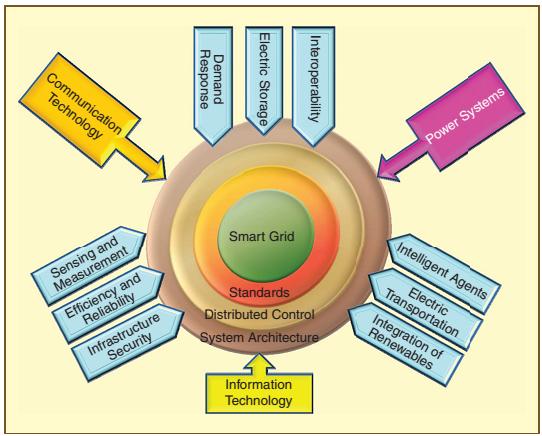
As Figure depicts, the convergence of communication technology and information technology with power system engineering, assisted by an array of new approaches, technologies and applications, allows the existing grid to traverse the complex yet staged trajectory of architecture, protocols, and standards towards the smart grid.
Source:
Hassan Farhangi “The Path of the Smart Grid” IEEE Power & Energy Mazagine. January/February 2010. Pag 18 -28.
Dr. Jorge Luis Mírez Tarrillo
Group of Mathematical Modeling and Numerical Simulation (GMMNS).
Universidad Nacional de Ingeniería. Lima, Perú.
E-mail: jmirez@uni.edu.pe
Website Personal: https://jorgemirez2002.wixsite.com/jorgemirez
Facebook http://www.facebook.com/jorgemirezperu
Linkedin https://www.linkedin.com/in/jorge-luis-mirez-tarrillo-94918423/
Scopus ID: https://www.scopus.com/authid/detail.uri?authorId=56488109800
Google Scholar: https://scholar.google.com/citations?user=_dSpp4YAAAAJ
MATLAB Group Admin in Facebook: https://www.facebook.com/groups/Matlab.Simulink.for.All
WhatsApp Channel/Canal: https://whatsapp.com/channel/0029VbCvpZsAYlUSz2esek2y

The smart grid needs to provide the utility companies with full visibility and pervasive control over their assets and services. The smart grid is required to be self-healing and resilient to system anomalies. And last but not least, the smart grid needs to empower its stakeholders to define and realize new ways of engaging with each other and performing energy transactions across the system. To allow pervasive control and monitoring, the smart grid is emerging as a convergence of information technology and communication technology with power system engineering. Figure depicts the salient features of the smart grid in comparison with the existing grid.
Source:
Hassan Farhangi «The Path of the Smart Grid» IEEE Power & Energy Mazagine. January/February 2010. Pag 18 -28.
Dr. Jorge Luis Mírez Tarrillo
Group of Mathematical Modeling and Numerical Simulation (GMMNS).
Universidad Nacional de Ingeniería. Lima, Perú.
E-mail: jmirez@uni.edu.pe
Website Personal: https://jorgemirez2002.wixsite.com/jorgemirez
Facebook http://www.facebook.com/jorgemirezperu
Linkedin https://www.linkedin.com/in/jorge-luis-mirez-tarrillo-94918423/
Scopus ID: https://www.scopus.com/authid/detail.uri?authorId=56488109800
Google Scholar: https://scholar.google.com/citations?user=_dSpp4YAAAAJ
MATLAB Group Admin in Facebook: https://www.facebook.com/groups/Matlab.Simulink.for.All
WhatsApp Channel/Canal: https://whatsapp.com/channel/0029VbCvpZsAYlUSz2esek2y
J963e: Other example of microgrid con cell fuel wind turbine PV microturbine battery bank and loads…

This microgrid have different elements: wind turbine, photovoltaics, fuel cell, battery bank, microturbine and interconection with main grifd. The level power is little but it is a interesting microgrid for study. It is a typical AC microgrid with load distribuited in many locations into microgrid. Main grind is a sub-transmission network in 20 kV.
Image Source:
Aris L. Dimeas, Nikos D. Natziargyriou “Operation of Multiagent System for Microgrid Control” IEEE Transactions on Power Systems, Vol. 20, No. 3, August 2005.
Dr. Jorge Luis Mírez Tarrillo
Group of Mathematical Modeling and Numerical Simulation (GMMNS).
Universidad Nacional de Ingeniería. Lima, Perú.
E-mail: jmirez@uni.edu.pe
Website Personal: https://jorgemirez2002.wixsite.com/jorgemirez
Facebook http://www.facebook.com/jorgemirezperu
Linkedin https://www.linkedin.com/in/jorge-luis-mirez-tarrillo-94918423/
Scopus ID: https://www.scopus.com/authid/detail.uri?authorId=56488109800
Google Scholar: https://scholar.google.com/citations?user=_dSpp4YAAAAJ
MATLAB Group Admin in Facebook: https://www.facebook.com/groups/Matlab.Simulink.for.All
WhatsApp Channel/Canal: https://whatsapp.com/channel/0029VbCvpZsAYlUSz2esek2y

The overall procedure is the following:
1. The Market Operator (MO) announces the prices for selling (SP) or buying (BP) energy to the Microgrid. Normally it is SP>BP.
2. The local loads announce their demands for the next 15 minutes and an initial price (DP) for the kWh. It is DP>BPand DP<SP.
3. The production units accept or decline the load offer according to an Auction Price (AP).
4. The negotiation continues for a specific time (5 min).
5. After the end of the negotiation time, all the units have adjusted their set points. If there is no production unit within the Microgrid to satisfy the load demand, the power is bought from the grid. In addition, the grid can be considered as a load too, so the production or storage units can sell energy to the grid.
Source:
Aris L. Dimeas, Nikos D. Natziargyriou “Operation of Multiagent System for Microgrid Control” IEEE Transactions on Power Systems, Vol. 20, No. 3, August 2005.
Dr. Jorge Luis Mírez Tarrillo
Group of Mathematical Modeling and Numerical Simulation (GMMNS).
Universidad Nacional de Ingeniería. Lima, Perú.
E-mail: jmirez@uni.edu.pe
Website Personal: https://jorgemirez2002.wixsite.com/jorgemirez
Facebook http://www.facebook.com/jorgemirezperu
Linkedin https://www.linkedin.com/in/jorge-luis-mirez-tarrillo-94918423/
Scopus ID: https://www.scopus.com/authid/detail.uri?authorId=56488109800
Google Scholar: https://scholar.google.com/citations?user=_dSpp4YAAAAJ
MATLAB Group Admin in Facebook: https://www.facebook.com/groups/Matlab.Simulink.for.All
WhatsApp Channel/Canal: https://whatsapp.com/channel/0029VbCvpZsAYlUSz2esek2y

The DNO’s responsible for the technical operation in a medium and low voltage area, in which more than one Microgrids may exist. In addition, one or more MO’s are responsible for the Market Operation of this area. These two entities do not belong to the Microgrid, but they are the delegates of the grid. The DNO
refers to the operational functions of the system and the MO to the Market functions. It should be noted that, despite the autonomous operation of the Microgrid, it should ideally appear as a controlled, intelligent unit in coordination with the DNO.
The MGCC is the main responsible for the optimization of the Microgrid operation, or alternatively, it simply coordinates the local controllers, which assume the main responsibility for this optimization.
The LC’s control the Distributed Energy Resources (DER), production and storage units, and some of the local loads. Depending on themode of operation, they have certain level of intelligence, in order to take decisions locally. Of course, in any type of operation there are certain decisions that can be taken only locally.
Source:
Aris L. Dimeas, Nikos D. Natziargyriou «Operation of Multiagent System for Microgrid Control» IEEE Transactions on Power Systems, Vol. 20, No. 3, August 2005.
Dr. Jorge Luis Mírez Tarrillo
Group of Mathematical Modeling and Numerical Simulation (GMMNS).
Universidad Nacional de Ingeniería. Lima, Perú.
E-mail: jmirez@uni.edu.pe
Website Personal: https://jorgemirez2002.wixsite.com/jorgemirez
Facebook http://www.facebook.com/jorgemirezperu
Linkedin https://www.linkedin.com/in/jorge-luis-mirez-tarrillo-94918423/
Scopus ID: https://www.scopus.com/authid/detail.uri?authorId=56488109800
Google Scholar: https://scholar.google.com/citations?user=_dSpp4YAAAAJ
MATLAB Group Admin in Facebook: https://www.facebook.com/groups/Matlab.Simulink.for.All
WhatsApp Channel/Canal: https://whatsapp.com/channel/0029VbCvpZsAYlUSz2esek2y

Sun –> energy provided from photovoltaic energy plant.
Wind –> similar from wind turbine(s)
Batt –> similar from battery bank
ene –> similar injected from electrical network external or utility electric network
In other image in red is the total suministed for this sources and red line is the demand. Other images is cost, evoluction of energy supply from each source and more details. It is made for me (Jorge Mírez) in Matlabb/Simulink and I utilized concept of linear programming. Image is from my destokp laptop.
Dr. Jorge Luis Mírez Tarrillo
Group of Mathematical Modeling and Numerical Simulation (GMMNS).
Universidad Nacional de Ingeniería. Lima, Perú.
E-mail: jmirez@uni.edu.pe
Website Personal: https://jorgemirez2002.wixsite.com/jorgemirez
Facebook http://www.facebook.com/jorgemirezperu
Linkedin https://www.linkedin.com/in/jorge-luis-mirez-tarrillo-94918423/
Scopus ID: https://www.scopus.com/authid/detail.uri?authorId=56488109800
Google Scholar: https://scholar.google.com/citations?user=_dSpp4YAAAAJ
MATLAB Group Admin in Facebook: https://www.facebook.com/groups/Matlab.Simulink.for.All
WhatsApp Channel/Canal: https://whatsapp.com/channel/0029VbCvpZsAYlUSz2esek2y

A simple block diagram of a hybrid power system is shown in Figure. The sources of electric power in this hybrid system consist of a diesel generator, a battery bank, a PV array, and a wind generator. The diesel generator is the main source of power around the world. The output of the diesel generator is regulated ac voltage, which supplies the load directly through the main distribution transformer. The battery bank, the PV array, and the wind turbine are interlinked through a dc bus. The RTU (Remote Terminal Unit) regulates the flow of power to and from the different units, depending on the load. The integration of a RTU into a hybrid power system is important to enhance the performance of the system. The overall purpose of the RTU is to give knowledgeable personnel the ability to monitor and control the hybrid system from an external control center. Since the hybrid systems of interest in this research are located in remote areas, the ability for external monitoring and control is of utmost importance. The RTU is interfaced with a variety of sensors and control devices located at key locations within the hybrid system. The RTU processes the data from these sensors and transmits it to a control center. In addition, the RTU is also capable of receiving control signals and adjusting parameters within the system without the physical presence of the operating personnel.
Source:
Richard W. Wies, Ron A. Johnson, Ashish N. Agrawal and Tyler J. Chubb «Simulink Model for Economic Analysis and Environmental Impacts of a PV With Diesel-Battery System for Remote Villages» IEEE Transactions on Power Systems, Vol. 20, No. 2, May 2005
Dr. Jorge Luis Mírez Tarrillo
Group of Mathematical Modeling and Numerical Simulation (GMMNS).
Universidad Nacional de Ingeniería. Lima, Perú.
E-mail: jmirez@uni.edu.pe
Website Personal: https://jorgemirez2002.wixsite.com/jorgemirez
Facebook http://www.facebook.com/jorgemirezperu
Linkedin https://www.linkedin.com/in/jorge-luis-mirez-tarrillo-94918423/
Scopus ID: https://www.scopus.com/authid/detail.uri?authorId=56488109800
Google Scholar: https://scholar.google.com/citations?user=_dSpp4YAAAAJ
MATLAB Group Admin in Facebook: https://www.facebook.com/groups/Matlab.Simulink.for.All
WhatsApp Channel/Canal: https://whatsapp.com/channel/0029VbCvpZsAYlUSz2esek2y
Blog in ENGLISH

Compra/Buy – Haz una donación/Make a donation

Dear reader, if you wish to make a donation or are interested in any information or code, please contact me (e-mail: jmirez@uni.edu.pe). Donations will allow you to continue studying and researching, and also to provide more information on this blog. My PayPal account is jorgemirez2002@gmail.com or if it is by bank transfer write to my email jmirez@uni.edu.pe. Any amount of money is welcome. Thank you.
Estimado lector, si desean hacer una donación o le interesa alguna información o código, favor ponerse en contacto con mi persona (e-mail: jmirez@uni.edu.pe). Las donaciones va a permitir seguir estudiando e investigando, y además, el poder brindar más información en este blog. Mi cuenta en PayPal es jorgemirez2002@gmail.com o si es por transferencia bancaria escribirme a mi correo jmirez@uni.edu.pe. Cualquier cantidad de dinero es bienvenido. Gracias.
Datos Generales
Good day. My full name is Jorge Luis MIREZ TARRILLO.
I am Peruvian and live in Lima, capital of Perú in South America.I am Mechanical Electrical Engineering, MSc Physics and Dr. Physics (title doctoral thesis: Control, Optimization, and Management of Microgrid Current Direct)
Too, actually job as Principal Professor in Faculty of Oil, Gas and Petrochemical Engineering of Universidad Nacional de Ingeniería (National University of Engineering) in Lima – PERU (Courses: Modern Physics, Differential Equations and Research's Methodology)
My subjects of my interest are control, signal processing, optimization, simulation, biomedical research, smart grid, microgrid, water.
I have experience in Matlab/Simulink programming, biomedical equipment, electrical systems, renewable energies, microgrids, saturated steam systems 100 psi and organizing academic events.

Comentarios Recientes
Elementos que compon… en J506: Los elementos de un paqu… Dr. Jorge Mírez en Message by IEEE Community Dr. Jorge Mírez en J546: Simulación de campos mag… jose luis huayanay v… en Message by IEEE Community Cesar Aviles en J546: Simulación de campos mag… Dr. Jorge Mírez en J518: La herramienta pdetool d… Dr. Jorge Mírez en J496: Simulación en Matlab/Sim… Raúl Barrios Elizarr… en J496: Simulación en Matlab/Sim… jose luis huayanay v… en J518: La herramienta pdetool d… MSc. Jorge Mírez en J281: La Rosa de Vientos: Frec…


Debe estar conectado para enviar un comentario.